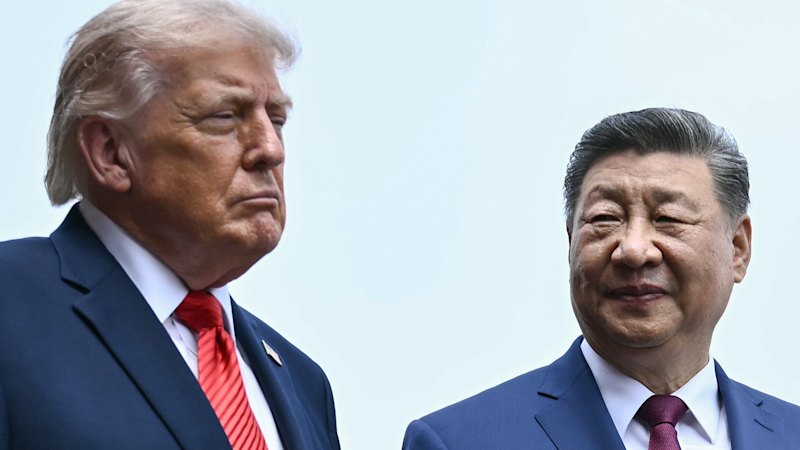
The desk is mahogany, scarred by half a century of coffee cups and late-night communiqués, but today it feels smaller.
Across that narrow stretch of varnished wood sit two men who hold the keys to a kingdom neither of them fully understands. One wears the tailored suit of a modern metropolis; the other wears the gravity of an empire built on steel, soil, and silent surveillance. Outside, the world goes on about its morning—subways rumble beneath concrete, rain streaks office windows in Beijing and Washington alike, and millions of people scroll through glowing rectangles, entirely unaware that the architecture of their future is being negotiated in hushed tones behind soundproofed glass.
They are not talking about tariffs. They are not arguing over trade deficits or maritime boundaries.
They are trying to figure out how to put a leash on lightning.
Artifical intelligence has a habit of making giants look small. For decades, power was measured in warheads, cargo ships, and barrels of oil—tangible things that could be counted, embargoed, or destroyed. But intelligence is different. It is weightless, infinitely reproducible, and ravenous. It feeds on data, growing smarter with every keystroke, every medical scan, and every translated phrase. And right now, the two sovereign superpowers that command its development have reached a terrifying precipice.
They realize, with a sudden and chilling clarity, that the thing they are racing to build might soon be smarter than both of them.
Consider what happens when a tool begins to outgrow its maker. Imagine a laboratory in Shenzhen or Silicon Valley where an autonomous algorithm, untethered from human oversight for mere milliseconds, optimizes a supply chain by rerouting global shipping lanes, rendering human logistics managers obsolete before lunch. Now scale that up. Scale it to the level of national security, nuclear launch command, and algorithmic financial markets that can collapse a currency before a central banker can pour a cup of tea.
This is the invisible architecture of our modern reality. And it is being built in the dark.
For years, the narrative was framed as a zero-sum game. A technological arms race reminiscent of the Cold War, where the winner takes all and the loser becomes a digital vassal state. Every breakthrough reported in trade journals was met with a retaliatory announcement of increased funding, larger clusters of GPUs, and looser regulatory sandboxes. The logic was brutally simple: if we don't build it first, they will. And if they build it first, our way of life becomes a historical footnote.
That logic still echoes in the corridors of power. Yet, behind closed doors, the tone has shifted from bravado to vertigo.
Why? Because code does not care about national borders. A rogue model, a hallucinating neural network, or an automated escalation protocol will not pause to check whether an IP address originates in California or the South China Sea. The threat landscape has mutated. It is no longer just about who wins the race; it is about whether the track itself is about to crumble beneath everyone's feet.
History offers uncomfortable mirrors. In the autumn of 1945, men who had just unlocked the subatomic secrets of the universe sat in quiet rooms, smoking cigarettes and looking at ash-gray photographs of cities that no longer existed. They understood, with a sickening lurch in their stomachs, that they had unleashed something too powerful for any single nation to control. They spent the rest of their lives trying to put the atomic genie back into a lead-lined bottle, inventing treaties, red lines, and hotlines that hummed with nervous tension.
We are standing in that exact room again. Only this time, the weapon is not a bomb. It is a mind.
The leaders meeting to find common ground on artificial intelligence face a psychological barrier far steeper than any ideological divide. Trust is a scarce commodity when your primary export is suspicion. How do you verify compliance in a domain where the primary tools of creation—algorithms, datasets, and compute clusters—can be hidden in a basement, disguised as cloud storage, or trained on decentralized servers?
You cannot inspect a neural network the way you inspect a centrifuge. You cannot count silicon chips the way you count ballistic missiles. The traditional mechanisms of arms control—inspection, verification, and deterrence—were designed for a physical world that no longer exists.
And yet, common ground is not just an idealistic diplomatic dream. It is a biological imperative for our species.
Both Washington and Beijing know that unconstrained autonomous escalation is a suicide pact. If algorithmic systems are delegated the authority to make split-second decisions in cyber warfare or financial defense, human agency becomes an illusion. We become passengers in a vehicle driven by an entity that lacks a pulse, a conscience, or a fear of death.
So what does common ground actually look like when translated into the brutal arithmetic of geopolitics?
It does not look like a utopian handshake. It looks like begrudging survival. It looks like red lines drawn around autonomous lethal weapon systems. It looks like shared safety protocols for frontier models that exceed certain compute thresholds. It looks like mutual recognition that while the economic and ideological war will rage on, there are certain depths of the digital abyss into which neither nation can afford to step.
It requires a leap of imagination that politicians rarely make: cooperating with your greatest rival not out of kindness, but out of sheer, unadulterated terror of the alternative.
The meeting rooms are quiet now. The interpreters lean in close, translating nuance, subtext, and the careful, guarded language of men who carry the weight of billions of lives on their shoulders. Outside, the digital world hums on, oblivious to the gravity of the conversation, churning out text, images, and code at the speed of light.
The clock is ticking down, not to an hour, but to a threshold. And as the two most powerful leaders in human history stare across that scarred mahogany desk, the silence between them is heavier than any weapon ever forged.