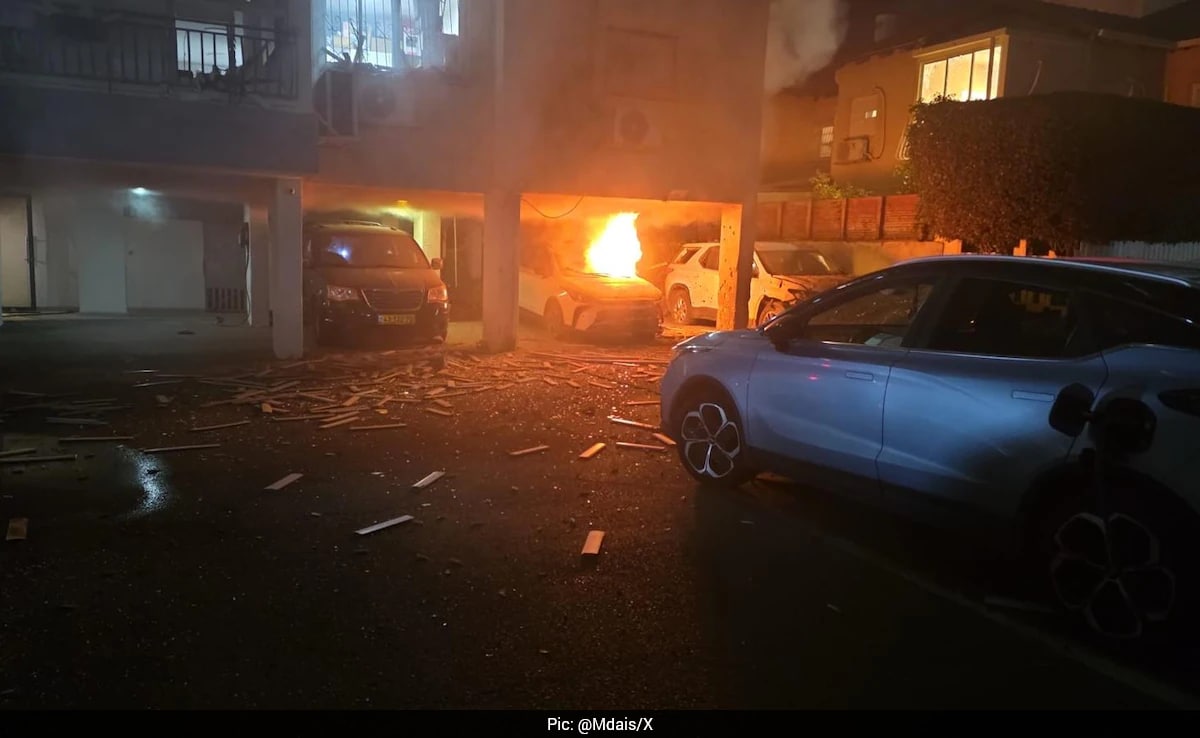
The transition from proxy-led skirmishes to direct kinetic exchange between sovereign states represents a fundamental shift in the Middle Eastern security architecture. When Iranian-launched projectiles impact metropolitan centers like Tel Aviv, the primary metric of success is not the localized casualty count—though the reported death of two individuals serves as a definitive tactical data point—but rather the stress test of integrated air defense arrays and the subsequent recalibration of deterrence thresholds. This event signals that the "shadow war" has been superseded by a doctrine of direct visibility, where the technical performance of interceptor batteries dictates the political latitude for retaliation.
The Architecture of the Strike: Penetration Mechanics
To analyze the efficacy of an aerial assault on a dense urban center, one must deconstruct the strike into three distinct phases: the launch density, the mid-course navigation, and the terminal engagement.
- Saturation Volumetrics: The fundamental constraint of any missile defense system is the number of simultaneous tracks its radar can process and the number of interceptors available in the immediate launch cells. By deploying a mix of low-slow loitering munitions (drones) alongside high-velocity ballistic missiles, an aggressor attempts to force "interceptor exhaustion." The drone forces the defense to commit resources, potentially creating a window for a ballistic reentry vehicle to penetrate the screen.
- Terminal Phase Dynamics: The reported fatalities in Tel Aviv indicate a failure in the terminal interception phase. This failure usually stems from one of two variables: technical malfunction of the interceptor (e.g., an Iron Dome or David’s Sling battery failing to achieve a kinetic kill) or the "lethal debris" factor. In high-altitude interceptions over urban areas, the destruction of the missile body does not eliminate the kinetic energy of the remaining fragments.
- Guidance and Precision-Strike Capabilities: The shift from unguided rockets to Precision-Guided Munitions (PGMs) changes the cost-benefit analysis for the defender. If a missile possesses a Circular Error Probable (CEP) of less than 10 meters, it is no longer a "terror weapon" intended for general psychological impact but a "counter-value" or "counter-force" tool capable of hitting specific infrastructure.
The Economic Asymmetry of Aerial Defense
The defense of Tel Aviv rests on a multi-tiered array including Iron Dome (short-range), David’s Sling (medium-range), and Arrow 2/3 (exo-atmospheric). However, the fiscal and industrial logic favors the attacker.
The cost of a single Tamir interceptor used by the Iron Dome is estimated at $40,000 to $50,000, while a David’s Sling Stunner interceptor costs approximately $1 million. In contrast, the manufacturing cost of a basic Iranian-designed Shahed-series drone is a fraction of that, often cited between $20,000 and $30,000. This creates an Attrition Ratio where the defender spends exponentially more to maintain the status quo than the attacker spends to disrupt it.
This financial delta is compounded by "industrial lead times." Producing a sophisticated interceptor requires a complex supply chain of semiconductors, specialized propellants, and high-fidelity sensors. An aggressor utilizing mass-produced, lower-tech components can achieve a higher "replenishment rate" than a defender relying on high-precision systems. Therefore, the goal of the strike on Tel Aviv may not have been the two casualties themselves, but the forced depletion of Israel’s interceptor inventory.
The Psychology of the Threshold: Redefining Deterrence
Deterrence is a function of perceived capability multiplied by the perceived will to utilize it. For decades, the "Red Line" in regional politics was a direct strike from Iranian soil onto Israeli territory. By crossing this line, the Iranian command has effectively "normalized" a new level of violence.
- The Credibility Gap: If a state threatens "crushing consequences" for a specific action and that action occurs with limited immediate retribution, the deterrent value of the state’s rhetoric depreciates.
- The Calculus of Proportion: The death of two civilians provides a specific legal and political "justification hook" for a counter-strike. In international relations theory, this is known as the "tit-for-tat" strategy. However, the strategic challenge is to respond with enough force to restore deterrence without triggering a full-scale regional conflagration that draws in global superpowers.
The specific targeting of Tel Aviv—the economic and cultural heart of the state—is a deliberate choice to maximize political pressure on the Israeli government. It forces a binary choice: accept a new reality where the sovereign heartland is vulnerable or escalate to a high-intensity conflict to "reset" the border.
Technical Failure Points in Urban Interception
When analyzing why impacts occur despite advanced shielding, we must look at the Probability of Kill ($P_k$). No system maintains a $P_k$ of 1.0 (100%). Most modern systems operate between 0.85 and 0.95 under optimal conditions.
Factors that degrade $P_k$ include:
- Sensor Saturation: Too many targets entering the radar's field of view simultaneously.
- Electronic Countermeasures (ECM): On-board jammers on the incoming missiles that "blind" the interceptor’s seeker head.
- Clutter and Urban Topography: In a city like Tel Aviv, high-rise buildings and electromagnetic noise can interfere with low-altitude tracking, reducing the reaction time for short-range systems.
The mechanism of death in these strikes is often not a direct hit by the missile’s warhead, but the secondary effects of the interception. If an interceptor hits a missile directly over a residential block, the falling engine casing, unspent fuel, and fragmented shrapnel retain enough terminal velocity to be lethal. This creates a "Protected Zone Paradox": the more successful you are at hitting missiles over a city, the more debris you rain down upon the population you are trying to protect.
The Intelligence Bottleneck: Predicting the Next Salvo
Operational success in missile defense is 70% intelligence and 30% kinetics. The ability to intercept is predicated on "Launch Point Detection." Satellite-based infrared sensors must detect the heat bloom of a missile launch within seconds to calculate the projected trajectory.
The bottleneck occurs in the "Decision Loop." Once a launch is detected, automated systems must differentiate between a missile heading for an open field and one heading for a populated center. This "discrimination" process is vital for conserving interceptors. If the discrimination logic fails—either by miscalculating the impact point or by failing to identify a decoy—the defense system is effectively neutralized through tactical deception.
Tactical Realignment and the Shift to Offensive Defense
The failure to prevent the deaths of two individuals in Tel Aviv will likely catalyze a shift from "Passive Defense" (interceptors) to "Active Counter-force." In military doctrine, when the shield becomes too expensive or unreliable, the only remaining option is to "destroy the archer rather than the arrows."
This implies:
- Preemptive Launch-Site Neutralization: Utilizing stealth assets or long-range stand-off weapons to strike mobile TEL (Transporter Erector Launcher) units before they can cycle their payloads.
- Command and Control (C2) Disruption: Cyber-kinetic operations designed to sever the link between the high command and the launch crews.
- Hardened Infrastructure Mandates: A realization that even the best air defense cannot replace physical reinforcement (bunkers, reinforced glass, and blast-resistant architecture) in high-density zones.
The era of relying solely on the "technological bubble" of missile defense is ending. States facing sophisticated aerial threats must now prepare for a reality where "leaking" projectiles are a statistical certainty. Strategic planning must pivot toward maintaining societal and economic continuity under the shadow of persistent, direct-fire threats.
The immediate priority for regional actors is the hardening of "Dual-Use Infrastructure." Every civilian basement must function as a hardened shelter, and every radar array must be integrated into a decentralized, AI-driven sensor mesh to reduce reaction times below the current 60-to-90-second window. The objective is no longer total protection—which is mathematically improbable—but the mitigation of "Strategic Shock."