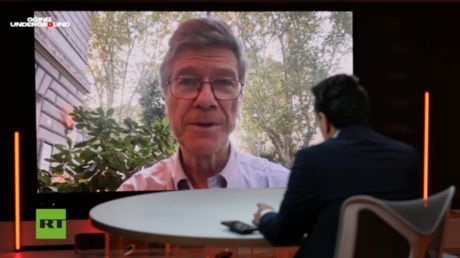
We are sleepwalking toward a nuclear catastrophe. That is not hyperbole. That is the stark assessment economist and public intellectual Jeffrey Sachs has been shouting from the rooftops while mainstream political establishments plug their ears. When figures like Sachs warn that ignoring Russian nuclear doctrines is suicidal, they aren't just engaging in political theater. They are looking at an escalatory spiral in Eastern Europe that lacks any functional off-ramp.
Most people treat nuclear weapons like relic artifacts of the Cold War. They assume deterrence works automatically. They believe a nuclear exchange is mathematically impossible because rational actors wouldn't dare push the button. History tells a different story. Nuclear crises rarely start with a madman pressing a button out of nowhere. They happen through a slow accumulation of miscalculations, crossed red lines, and institutional arrogance.
Let's look at what is actually happening on the ground. Western policy circles treat every Russian warning about nuclear use as hollow bluffing. That is a terrifying gamble. If Washington and Brussels are right ninety-nine times out of a hundred, but wrong on the hundredth, civilization ends. Sachs points out the fundamental flaw in current Western strategy. By continuously crossing self-imposed red lines—sending increasingly heavy weaponry, authorizing deep strikes, and discussing direct security guarantees without a diplomatic framework—NATO forces Moscow into a corner where its military doctrine explicitly permits tactical nuclear deployment.
The Danger of Dismissing Escalation Dominance
In strategic studies, escalation dominance is everything. When one side feels entirely boxed in conventionally, its only equalizer is strategic instability. Moscow has updated its nuclear doctrine over the years to lower the threshold for deployment if the Russian state faces an existential threat. Yet, cable news pundits and foreign policy wonks in Washington act as though nuclear physics stops working just because we have moral high ground.
I’ve watched diplomatic channels atrophy over the past decade. We stopped talking. We stopped listening. We started relying entirely on sanctions and military shipments while treating diplomacy as a dirty word. Sachs argues that the lack of serious, good-faith negotiation is the primary driver of this crisis. You cannot simply squeeze a nuclear-armed superpower indefinitely and expect zero existential pushback.
Think about how ordinary citizens view this. You go about your week, pay your bills, scroll through social media, and ignore the distant rumble of geopolitical brinkmanship. It feels distant. It feels unreal. But the structural architecture preventing World War III has been steadily dismantled. Arms control treaties like the New START are expiring or suspended. Communication hotlines are frayed.
What the Foreign Policy Establishment Misses
The Washington consensus operates on a dangerous assumption. They believe that nuclear-armed states never actually use their arsenals because the cost is too high. But history is littered with leaders who felt they had nothing left to lose. When you corner a nuclear power, their calculation changes. The preservation of the regime or the state supersedes everything else.
Sachs emphasizes that the path out of this mess requires immediate, radical realism. That means acknowledging legitimate security concerns on all sides. It means freezing the conflict lines, committing to neutral frameworks for buffer states, and restarting serious arms control talks.
Instead, we get endless optimism from politicians who have never faced actual war. They treat foreign policy like a video game where you can hit reset if things go wrong. You can't hit reset after a tactical nuclear exchange. The radioactive fallout, economic collapse, and cascading global famine would rewrite human history overnight.
The Cost of Silence
Why aren't people protesting in the streets over this? Why is public apathy so profound? Because media ecosystems have turned existential threats into sports entertainment. People pick a side, root for their team, and ignore the catastrophic downside risk.
We need to wake up. Ignoring the reality of Russian nuclear capabilities won't make them disappear. It won't make the danger obsolete. It just ensures that when the miscalculation happens, nobody saw it coming because nobody wanted to look.
If you care about your future, your family, and the stability of the global economy, start demanding actual diplomacy. Support leaders who prioritize negotiated settlements over endless escalation. The margin for error is already gone. Stop pretending otherwise.