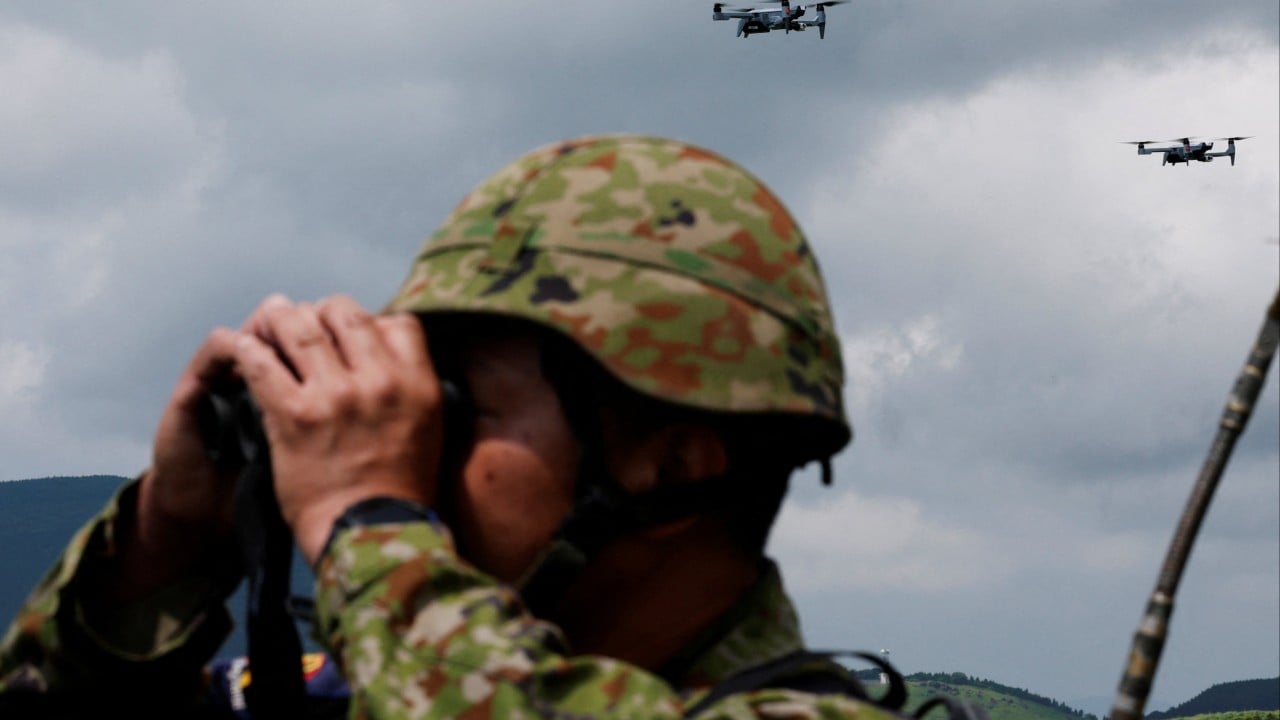
Spending billions of dollars on ultra-advanced military hardware doesn't mean much if a $1,000 piece of flying plastic can bypass it entirely.
Japan's military planners are facing that exact reality. For decades, Tokyo built its strategy around a high-tech, high-cost defense shield meant to deter giant neighbors. But look at eastern Europe. The air over Ukraine is thick with cheap, uncrewed weapons that completely invalidate traditional air defense economics. Spending $4 million on a Patriot missile to swat down a $5,000 loitering munition is a fast track to financial bankruptcy in a prolonged conflict.
Tokyo knows it's far behind. To catch up, Japan isn't just designing new tech in quiet domestic labs. They are actively funding and testing experimental hardware directly on Ukrainian battlefields to absorb raw, brutal lessons about what actually survives under heavy electronic jamming.
Moving Past The Expensive Missile Trap
Japan’s current strategy shift is driven by brutal math. The Ministry of Defense is pushing forward with its massive SHIELD Program, a ¥100 billion initiative aimed at building a layered defensive network of land, air, and sea drones by March 2028. But buying machines is the easy part. Building a working doctrine is where Japan is struggling.
Ukraine built a highly successful counter-drone architecture because it had no other choice. They bypassed expensive, slow-to-manufacture missiles by leaning into massive radar networks, local electronic warfare, and cheap interceptor drones. In January 2026 alone, Ukrainian forces downed a record 1,704 Shahed-type drones. Roughly 70% of those kills came from low-cost interceptors costing between $1,000 and $2,500.
That's the blueprint Tokyo wants. If a conflict breaks out in East Asia, regional adversaries can easily flood the skies with thousands of low-cost drones. Relying strictly on a limited stockpile of multi-million-dollar interceptor missiles means running out of ammo in the first week.
The Tokyo Startups Risking It In Kharkiv
Instead of waiting for slow, bureaucratic defense giants to build a solution, Tokyo is letting agile venture capital lead the way.
In March 2026, Japanese drone developer Terra Drone made a full-scale entry into the defense sector by taking a major strategic stake in Amazing Drones, a Ukrainian startup. By April, they deployed a brand-new, high-mobility rocket-type interceptor called the Terra A1 directly to the front lines.
The operational loop happening right now is fast:
- The Terra A1 is a short-range specialist. It screams from zero to 200 kilometers per hour in under 10 seconds, hits a top speed of 302 km/h, and hunts threats up to 32 kilometers away.
- The Terra A2, rolled out in May 2026 through an investment in WinnyLab (another Ukrainian tech firm), uses a fixed-wing design. It pushes the operational range to 75 kilometers with a 40-minute flight window.
- The Financials make total sense. Production costs sit around $2,500 for an A1 and $3,000 for an A2.
These systems aren't sitting in storage. They are hunting real threats in electronically contested environments. Terra Drone's CEO, Toru Tokushige, has made it clear that distributed, small-scale production inside Ukraine is the only way forward. They are moving manufacturing lines into deep, decentralized underground facilities around cities like Kharkiv to keep production moving despite constant missile strikes.
This isn't charity. It's an aggressive, hands-on R&D pipeline. Japan provides the capital and advanced component manufacturing, while Ukraine provides the ultimate proving ground. The data collected from these engagements goes directly back to Tokyo to build autonomous, AI-driven targeting algorithms that don't rely on human operators who can be cut off by radio jamming.
Overcoming The Policy Inertia
While the private sector is moving at a sprint, the official diplomatic framework is lagging. Japan's strict Three Principles on Transfer of Defense Equipment and Technology heavily limits sending lethal weapons to active combat zones.
Tokyo is working around this through non-lethal integration and intelligence sharing. Prime Minister Sanae Takaichi's administration has stepped up commitments, utilizing funding mechanisms like the PURL program specifically earmarked for non-lethal military gear. Even more telling is Tokyo's quiet dispatch of Japan Self-Defense Forces personnel to the NATO Security Assistance and Training for Ukraine (NSATU) headquarters in Wiesbaden, Germany.
The objective there is simple: gather raw electronic warfare data. Ukraine possesses the world's most comprehensive database on how modern uncrewed systems behave when their GPS signal is completely blocked. For Japan, acquiring that tactical data is worth more than buying a thousand ready-made foreign airframes.
Immediate Steps For Regional Preparedness
To turn these battlefield observations into genuine deterrence, regional defense planners must alter their procurement habits immediately.
- Shift from high-tech platforms to high-volume manufacturing. Japan can't rely on a handful of exquisite, bespoke defense platforms. The government needs to step in as a guaranteed, multi-year strategic buyer to force domestic companies to build mass-production assembly lines for expendable drones.
- Prioritize software interoperability over pristine hardware. A drone frame is just plastic and carbon fiber. The real value is in the software that allows a drone to recognize an enemy aircraft autonomously when human control links are severed.
- Establish forward manufacturing nodes. To ensure supply line resilience during a crisis, Tokyo should incentivize drone innovators from Taiwan, South Korea, and the US to establish manufacturing bases directly inside Japan, using localized component supply chains that cannot be easily choked out by maritime blockades.
The era of long-term, decade-long development cycles for aerial defense is over. The sky belongs to whoever can innovate, iterate, and mass-produce the fastest.
For a deep technical breakdown of how these low-cost interceptor systems are fundamentally shifting the financial balance of modern air defense, you can watch the comprehensive OSINT analysis on this Military Drone Technology Breakdown. This video goes into excellent detail regarding the specific electronic warfare environments these systems face on the front lines.