Salt spray coats the windshield of a patrol boat cutting through the gray swells of the East China Sea. Farther south, just a few hundred miles off the coast of Kyushu, the water hides secrets. Down there, fiber-optic cables pulse with data, while overhead, radar arrays spin in an endless, silent vigil.
To stand on the southernmost shores of Japan today is to feel a strange, vibrating stillness. It is the quiet before a thunderclap that everyone hopes will never arrive.
Walk through the narrow streets of Yonaguni, an island so close to Taiwan that on a clear day you can make out the mountains of a neighboring landmass, and you will notice a shift. The wind still carries the scent of subtropical flowers, but it also carries the low, heavy drone of transport aircraft touching down at expanded airstrips. Concrete bunkers are going into the earth. Fuel depots are rising behind coastal ridges.
This is not the Japan of cherry blossoms and quiet tea houses that brochures sell to tourists. This is a frontline.
The Arithmetic of Distance
Geography is a stubborn thing. You cannot negotiate with an ocean trench, nor can you wish away the proximity of islands that sit like stepping stones across a volatile maritime highway.
Consider a hypothetical radar technician stationed on Miyako Island. Let us call him Kenji. Every morning, Kenji drinks his canned coffee, stares at a bank of glowing green displays, and watches the ghosts of commercial freighters and coast guard cutters drift across his screens. He knows that the narrow gap of water outside his window—the Miyako Strait—is one of the few escape hatches for neighboring naval fleets trying to reach the open Pacific.
If a crisis erupts over Taiwan, that strait becomes the most dangerous water on earth.
Japan’s defense planners understand this arithmetic with terrifying clarity. For decades, Tokyo hid behind a pacifist constitution, focusing on territorial defense with polite restraint. But the map has not changed, and the neighbors have grown louder. Missiles test their range with unsettling regularity, splashing down uncomfortably close to exclusive economic zones.
So, the philosophy shifted. Defense is no longer just about guarding the main island of Honshu. It is about holding the line at the outer gates.
Reinforcing the Chain
Look closely at the Ryukyu Islands on a map. They stretch like a curved pearl necklace from the Kyushu mainland all the way down toward Taiwan. For years, these islands were lightly defended, treated as scenic outposts rather than strategic assets.
Now, concrete trucks grind up narrow coastal roads daily.
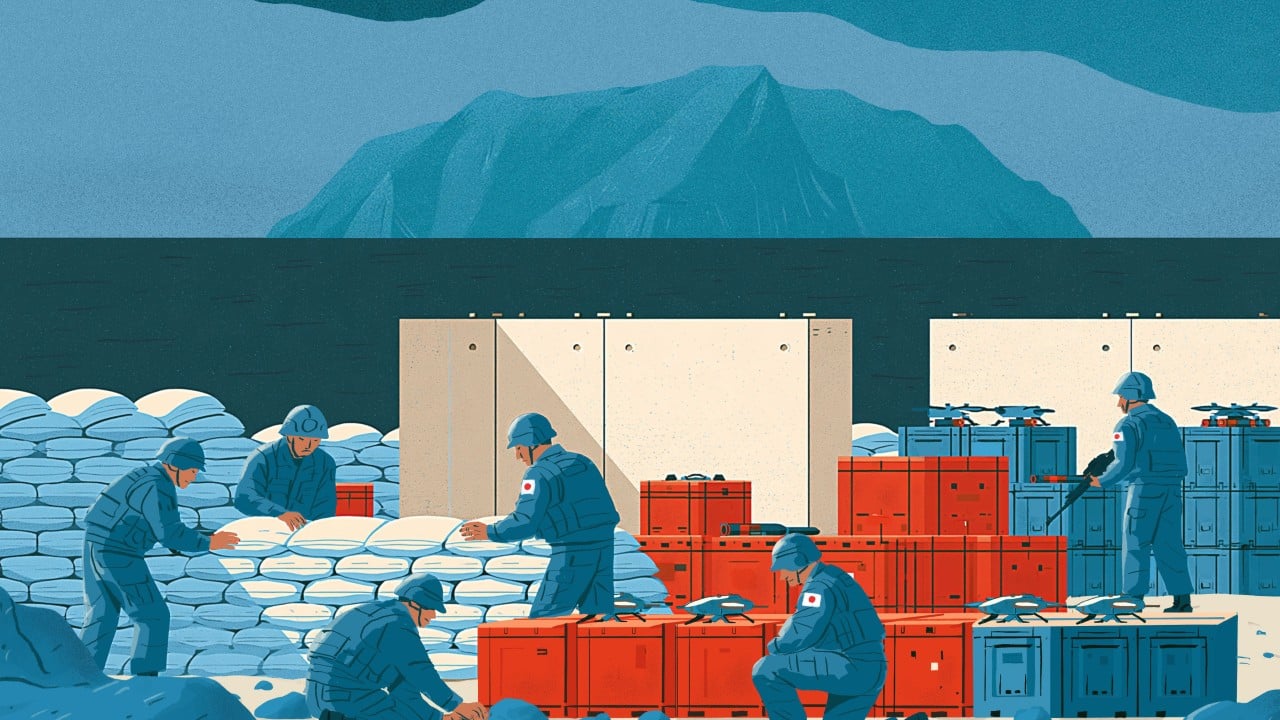
Battery installations for surface-to-ship and surface-to-air missiles are appearing in places that used to know only sugarcane farming and scuba tourism. Underground ammunition storage facilities are being blasted out of solid rock. These upgrades are designed to solve a brutal tactical reality: survivability. In the opening hours of any modern conflict, airfields and command centers are prime targets. By decentralizing forces, dispersing mobile missile launchers, and hardening communications, Tokyo is trying to build a hedgehog defense.
It hurts to watch a quiet island community change its character. Local fishermen talk about the rising number of military transport vessels docking at ports built for trawlers. Farmers shake their heads at the construction noise echoing across valleys where water buffalo once grazed in absolute peace.
Yet, the anxiety of what might happen if these preparations are not made outweighs the discomfort of the present. People here read the news. They see the amphibious assault exercises broadcast on television. They know that deterrence is expensive, but the alternative is unthinkable.
The Invisible Shield
A deterrent is a strange instrument. Its entire purpose is to prevent its own use. If Japan's new missile batteries, electronic warfare units, and hardened logistics networks do their job, they will never fire a single shot in anger.
Yet building that shield requires massive, systemic adaptation. Japan is quietly stockpiling replacement parts, securing long-term fuel reserves, and hardening civilian infrastructure. Hospitals on remote islands are being retrofitted to handle mass casualties. Evacuation plans for tens of thousands of residents living on the furthest outposts are being rehearsed with grim seriousness.
This is what preparedness looks like in the twenty-first century. It is not just about gray warships cutting through the surf. It is about logistics, redundancy, and the psychological endurance of a population learning to live with a permanent storm on the horizon.
When the sun sets behind the East China Sea, the water turns the color of a bruised plum. On Yonaguni, the lights of distant coastal towns across the water twinkle through the haze, so close and yet separated by a chasm of geopolitical dread. The patrol boats keep moving through the dark, their wakes cutting white scars across the surface, holding back the night one rotation at a time.