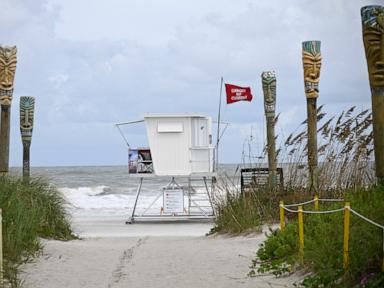
The Atlantic Ocean looks magnificent from a beach towel. The water transitions from a deep, bruised blue on the horizon to a brilliant emerald where the waves crest, before finally dissolving into a gentle, shifting froth at your feet. On a hot July afternoon, the sensory invitation is total. The heat radiates off the sand, vibrating the air, making the cool water seem less like a recreational choice and more like a psychological necessity.
You walk in. The transition is delicious. First the ankles, then the knees, then the waist. Building on this topic, you can also read: The Anatomy of Maritime Altercations How Cruise Lines Quantify and Mitigate Onboard Security Failures.
Let us name this swimmer Sarah. She is thirty-four, a strong pool swimmer who logs miles every winter at her local YMCA. She knows how to hold her breath, how to flip-turn, and how to execute a textbook breaststroke. She understands the water, or at least, she thinks she does.
Sarah takes four more steps forward, ready to dive under an oncoming wave. Observers at Lonely Planet have provided expertise on this matter.
Then, the ground disappears.
It does not drop off into a sudden marine trench. Instead, the very sand beneath her feet seems to liquefy and slide backward, pulling her heels with it. She submerges, surfaces, and shakes the saltwater from her eyes, expecting to see her family’s neon-pink beach umbrella exactly where she left it.
Instead, the umbrella is sixty yards away. It looks tiny.
Sarah turns toward the shore and begins to swim. She kicks hard. She pulls the water with her arms, executing that flawless YMCA technique. She breathes to the right, takes three strokes, and breathes again. After two minutes of intense, heart-pounding effort, she looks up to gauge her progress.
The pink umbrella is now eighty yards away.
She is moving backward.
The Illusion of the Safe Zone
The human brain is hardwired to seek patterns, and when we look at the ocean, we instinctively equate turbulence with danger. We look at the places where massive waves crash into white foam, throwing up spray and roaring like jet engines, and we think: Stay away from there.
Conversely, we look at the gaps between those crashing waves—the calm, darker patches of water where the surface is smooth, almost inviting—and we think: That looks safe. I will swim there.
This is the fundamental error that kills hundreds of people every year.
That calm, dark water is not a sanctuary. It is an exit ramp.
To understand what Sarah is trapped in, we have to understand the basic plumbing of a beach. Waves are not just moving energy; they are moving mass. Millions of gallons of water are continuously thrown onto the shore by breaking waves. That water cannot pile up indefinitely. It has to go back out.
Usually, the water flows back down the slope of the sand uniformly, a gentle undertow that tugs at your ankles. But the ocean floor is a shifting desert of sandbars. Under the right conditions, the returning water finds a low point in a sandbar—a trench carved out by previous tides.
Suddenly, the water from a hundred yards of beach converges into this narrow channel. It ceases to be a gentle recession and becomes a pressurized river flowing away from the land.
This is a rip current.
It is not an "undertow." It does not pull you underwater. If you are wearing a life jacket, or if you can float, a rip current will keep you perfectly at sea level. But it will move you away from the sand at a speed that defies human capability.
The United States Lifesaving Association tracks these incidents with sobering precision. Rip currents account for over eighty percent of all rescues performed by surf beach lifeguards. On average, they claim more than one hundred lives per year in the United States alone. They are the primary hazard at any surf beach, acting as a silent, hydraulic trap for the uninitiated.
The Physics of Exhaustion
Back in the water, Sarah is entering the most dangerous phase of the ordeal. It is not the water that is trying to kill her; it is her own biology.
When she realizes she is moving away from the shore despite her maximum effort, her sympathetic nervous system takes the wheel. A massive dose of adrenaline floods her bloodstream. Her heart rate spikes past one hundred and eighty beats per minute. Her breathing becomes shallow, rapid, and ragged.
Panic is a physical weight. It constricts the lungs and tightens the muscles, burning through precious oxygen supplies at an unsustainable rate.
Sarah is a victim of a cruel mathematical mismatch. A fit, well-trained swimmer can sustain a speed of about two miles per hour in a pool for a short duration. Olympic athletes might push that to over four miles per hour for a few minutes.
A standard rip current moves at roughly two feet per second. A strong one can top eight feet per second. That translates to over five miles per hour.
Consider that velocity. It means a rip current can easily outrun an Olympic sprinter trapped in the water. For an ordinary human being, swimming directly against a rip current is the mechanical equivalent of trying to run up a downward-moving escalator while wearing lead boots. You will lose. Every single time.
The tragedy is that the human instinct to survive is precisely what dooms the swimmer. The mind screams: The shore is safety, therefore I must swim toward the shore. The closer the danger feels, the harder the swimmer fights against the treadmill.
Within five to ten minutes, lactic acid builds up in the shoulders and thighs. The strokes become sloppy. The hips drop, dragging the body down into a vertical posture that creates even more drag. The swimmer swallows a mouthful of saltwater, coughs, loses their rhythm, and begins to drown from sheer, absolute physical exhaustion.
The ocean did not drag them under. They ran out of gas trying to fight a machine.
The Anatomy of the Escape
If you find yourself in this hydraulic conveyor belt, survival requires an act of radical counter-intuition. You must override every primitive survival instinct your ancestors passed down to you.
You must stop fighting.
Imagine the rip current not as an infinite abyss, but as a highway. It has a specific lane width, usually no more than thirty to a hundred feet across. It does not go out to the middle of the ocean; it typically dissipates just past the line of breaking waves, where the water finds its equilibrium.
There are two primary methodologies for escape, depending entirely on your swimming ability and physical condition.
Strategy One: The Lateral Exit
If you are a capable swimmer, the solution is to turn ninety degrees to the shore. Do not look at the beach umbrella. Look down the coast, parallel to the sand.
By swimming parallel to the beach, you are attempting to cross the highway rather than run backward against the traffic. Within thirty or forty yards, you will suddenly feel the water change. The backward tug will cease. You will find yourself back in the regular surf zone, where the waves are breaking toward the shore. From there, you can use the natural momentum of the waves to help carry you back to the beach.
Strategy Two: The Drift and Float
What if you are not a strong swimmer? What if you are already tired, or if the current is too wide and powerful to cross?
You do nothing.
You flip onto your back, spread your arms and legs like a starfish, and you float. You let the current take you. This feels like an act of suicide to the panicking mind. You are watching the shore recede, choosing to let the monster drag you away.
But consider what happens at the end of the channel. Once the rip current passes the sandbar, it fans out and loses its velocity. The river runs out of banks and becomes a quiet pool. The current stops.
Once the current lets go of you, you can then swim a wide circle around the channel, heading back to shore through the areas where the waves are breaking. If you cannot swim at all, floating keeps your airway clear, buys you time, preserves your energy, and keeps you visible to lifeguards who are launching jet skis or paddleboards to come get you.
Reading the Water Before You Step In
The best way to survive a rip current is to never be in one. This requires developing an eye for the coast, learning to read the text of the water before you strip off your sandals.
When you arrive at a surf beach, stand on the sand dunes or the boardwalk for five full minutes before you get changed. Look at the water as a whole system, not just as a place to cool off. Look for the anomalies.
- The Gap in the Foam: Look for a break in the incoming wave pattern. If waves are breaking consistently to the left and right, but there is a twenty-yard gap in the middle where no waves are cresting, that gap is likely a rip channel.
- The Discolored River: Rip currents churn up a massive amount of sand and debris from the bottom. Look for a lane of water that appears noticeably muddier, greener, or darker than the surrounding sea.
- The Churning Surface: Look for a line of seaweed, foam, or debris that is moving steadily away from the shore, out toward the open horizon.
- The Rippled Texture: Sometimes, the surface of a rip current looks jagged or choppy, completely out of sync with the smooth, rolling swells on either side of it.
If you see any of these signs, do not swim there. It is that simple. The most beautiful, calm, wave-free spot on the beach is often the exact place where the ocean is preparing to pull you out to sea.
The Pink Umbrella
Let us return to Sarah.
She is eighty yards out, her lungs burning, the taste of brine sharp in her throat. Her mind is screaming at her to keep clawing toward that distant pink umbrella. She is on the absolute precipice of tragedy.
But then, a memory flashes. A fragment of an article read years ago, or a warning from a lifeguard during a childhood summer trip. Swim parallel.
She stops. She forces her chest to expand, taking a deep, ragged breath. She turns her body ninety degrees to the right, facing down the shoreline, away from her family. She begins to swim a gentle, measured freestyle.
For the first twenty strokes, she still feels the ocean tugging at her left side, trying to pull her back out. She does not panic. She keeps her eyes fixed on a white hotel tower a mile down the coast, using it as her compass.
On the thirtieth stroke, the water changes. The invisible hand releases her waist.
Suddenly, a large, rolling wave catches her from behind, lifting her up and pushing her forward, toward the land. She turns toward the beach, her feet finding the hard, ribbed sand of a shallow sandbar.
She stands up. The water is only at her waist.
Sarah walks out of the surf, her legs shaking like jelly, her chest heaving. She drops onto the wet sand just above the water line, looking back at that smooth, dark, deceptively calm gap in the waves where she had been standing just ten minutes prior.
The beach is still beautiful. The music from a nearby radio is still playing. Her family is still sitting under the pink umbrella, oblivious to the fact that she had just fought a mortal duel with a river made of saltwater.
The ocean remains indifferent, waiting for the next person who confuses peace with safety.