Education has long been framed as a universal equalizer, a quiet engine of social mobility and human dignity. For generations of families living under military occupation in the West Bank and Gaza, the classroom represented an act of quiet defiance. It was a space where futures were built against the grain of continuous disruption. Today, that foundation is fracturing under a calculated policy of systemic dismantling. Schools are no longer sanctuaries of learning. They are focal points of direct targeting, administrative strangulation, and coercive displacement.
The crisis extends far beyond the immediate devastation of physical structures. While satellite imagery frequently captures the shattered concrete of bombed-out school complexes in Gaza, the erosion in the West Bank operates through bureaucratic warfare and localized intimidation. Curriculums face relentless scrutiny, funding channels are choked, and access routes are choked by checkpoints, concrete blocks, and sudden military closures. To understand the collapse of Palestinian schooling, one must examine a deliberate architecture designed to interrupt the transmission of knowledge and community memory from one generation to the next.
The Geography of Blocked Access
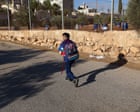
Getting to class is rarely a straightforward journey for a student in the West Bank. Military checkpoints slice through municipal boundaries, turning a ten-minute neighborhood walk into a multi-hour ordeal. Children carrying backpacks filled with notebooks regularly face armed soldiers, arbitrary detentions, and tear gas dispersion during morning commutes.
Consider the daily reality for secondary students in communities surrounding Hebron or the rural peripheries of Jenin. Randomly placed earthmounds and locked iron gates isolate villages, forcing teachers and pupils to navigate treacherous agricultural paths on foot. When a school bus is delayed for four hours because a military patrol has frozen movement on a rural access road, the lesson is effectively canceled before anyone reaches a desk.
This is spatial politics in action. By rendering physical movement erratic and exhausting, educational institutions experience chronic absenteeism. Attendance records fluctuate wildly not because of student apathy, but due to military fiat. Over time, the cumulative loss of instructional hours creates structural learning deficits that compound year after year.
Administrative Chokeholds and Funding Desolation
Beyond the physical barriers lies an equally potent administrative apparatus. The Palestinian education sector operates under severe financial strain, aggravated by revenue withholding and the systematic denial of building permits.
Local councils in Area C—comprising over sixty percent of the West Bank and placed under complete Israeli military control—are routinely barred from constructing new schools or expanding existing ones. When a community attempts to erect a modest corrugated-metal classroom without a permit, military bulldozers often arrive within days to demolish the structure.
International aid organizations face identical roadblocks. Prefabricated classrooms donated by European humanitarian agencies are routinely confiscated or destroyed under the legal pretext of unauthorized construction. This creates an acute overcrowding crisis. Classrooms designed for twenty children frequently house forty-five or fifty, sitting shoulder-to-shoulder in stifling heat without adequate ventilation or basic learning materials.
The financial viability of the entire system remains precarious. International donor fatigue, coupled with political maneuvers regarding tax revenue transfers, leaves teachers months without full salaries. Educators strike, schools close, and morale plummets. A teacher cannot focus on pedagogical methods when struggling to feed their own family. This economic attrition achieves what direct bans might accomplish more overtly: the gradual starvation of professional human capital.
The Psychological Toll on the Classroom
A child sitting in a classroom where the windows were blown out by a recent military raid absorbs more than math and grammar. They absorb hypervigilance. Post-traumatic stress is not an exception among Palestinian youth; it is the baseline environment.
School counselors report skyrocketing rates of anxiety, bedwetting, mutism, and severe behavioral disruption. Yet, the resources allocated for mental health support remain minuscule compared to the overwhelming need. When every night brings the sound of armored incursions, live ammunition, and stun grenades in nearby streets, the classroom cannot completely shut out the outside world.
Instead of being places of psychological safety, schools often become theaters of confrontation. Tear gas canisters routinely drift into school courtyards during clashes between youth and occupying forces. The disruption of an ongoing exam by the sound of gunfire outside has become a normalized, albeit deeply damaging, interruption.
This environment fosters a profound sense of temporal suspension. Students struggle to envision a long-term future when their immediate present is so violently unstable. Higher education aspirations are dampened by the realization that university campuses are equally vulnerable to raids, closures, and student arrests.
The Systematic Erasure of Institutional Memory
Education is fundamentally about continuity. It is the mechanism through which a society preserves its history, literature, and identity. When schools are disrupted, damaged, or shuttered, that historical chain breaks.
In Gaza, the destruction has reached an institutional level. Universities have been systematically mined, blown up, or converted into military barracks. Entire faculties—physicists, poets, historians, and physicians—have been killed alongside their families. The physical libraries containing rare manuscripts, local archives, and decades of academic research have been reduced to ash.
This is not collateral damage in the traditional sense. It is the functional eradication of the infrastructure of intellect. Without universities, laboratories, and functional secondary schools, an entire generation faces the deliberate impediment of its intellectual development.
The international community issues periodic statements of concern, condemning violations of international humanitarian law regarding the protection of educational facilities. Yet, these diplomatic rebukes are rarely matched by tangible enforcement mechanisms. Resolutions pass, reports are filed in Geneva and New York, and the bulldozers continue their work the following morning.
Resisting the Quiet Erasure
Despite the overwhelming odds, educational persistence remains a potent form of resistance. Makeshift tents serve as makeshift classrooms in rubble-strewn neighborhoods. Teachers volunteer their time without pay to keep basic literacy programs alive. Students study by the dim light of mobile phones during chronic electrical blackouts.
This refusal to stop learning underscores a grim truth. The architects of the siege understand that an educated populace is harder to subjugate, more articulate in its demands for rights, and better equipped to document injustices for global audiences. Conversely, those striving to maintain the schools recognize that yielding on education is equivalent to surrendering the future entirely.
The narrative surrounding this crisis must move beyond the paradigm of humanitarian pity. This is not merely a tragic byproduct of an intractable political conflict. It is a calculated, multi-tiered assault on the mind and future of a population. As long as classrooms remain primary targets of military and bureaucratic strategy, the struggle for basic human rights in the region will be fought, and often lost, at the wooden school desk.