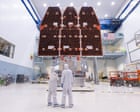
The Nancy Grace Roman Space Telescope sits encapsulated inside a SpaceX payload fairing at the Kennedy Space Center, moments away from a scheduled Falcon Heavy liftoff that nearly didn't happen. Surviving four separate White House attempts to zero out its funding or slash its resources, the observatory arrives at the launch pad not just bruised by political crosswinds, but bizarrely ahead of schedule.
For years, the multi-billion-dollar infrared observatory has served as a primary target in Washington budget battles. Yet its survival highlights a strange, recurring friction point between executive branch austerity and legislative protection for deep space science.
The Anatomy of a Repeated Near-Death Experience
A standard budget cycle in Washington moves with predictable sluggishness. For the Roman Space Telescope, however, every fiscal year brought an existential threat.
The White House targeted the observatory, formerly known as the Wide-Field Infrared Survey Telescope, across multiple budget iterations. Three consecutive annual requests proposed complete zero-dollar cancellations. A fourth effort arrived as a severe structural reduction during the closing phases of assembly and environmental testing.
Administration officials pointed to ballooning costs across federal science agencies. They argued that older, flagship programs like the Hubble Space Telescope and the James Webb Space Telescope already consumed vast operational footprints, leaving little room for new hardware.
Congress saw it differently. Every time an executive budget proposal suggested pulling the plug, appropriations committees wrote the funding back into federal spending bills. Lawmakers viewed the hardware—built largely around a donated surplus mirror hardware originally engineered for military reconnaissance—as too valuable to scrap after millions of hours of engineering.
Speeding Up to Outrun the Chopping Block
Faced with a hostile political environment, project managers at NASA’s Goddard Space Flight Center adopted an aggressive acceleration strategy. Engineers realized that keeping a project alive on paper required making it too expensive and too close to completion to cancel cleanly.
Component delivery schedules tightened. Testing protocols ran concurrently rather than sequentially. Teams worked around the clock to finish integration well ahead of initial baseline projections.
This acceleration created an unusual dynamic. While administrative policy debates raged over whether the observatory deserved to exist, the physical spacecraft moved through assembly at a blistering pace. By late 2025, construction wrapped up months ahead of original expectations.
Engineers effectively raced against the federal calendar. By pulling the target launch date forward into late August 2026, the mission team ensured that the majority of development costs were safely spent and locked in before subsequent fiscal cuts could paralyze the final stretch.
What Roman Will Actually Do
Critics of federal space spending often ask what a distant observatory delivers for a multi-billion-dollar price tag. In Roman’s case, the answer lies in scale and breadth.
Unlike Hubble, which peers deeply into narrow cosmic windows, or James Webb, which analyzes infrared snapshots of the earliest galaxies, Roman is built for cartography on a massive scale. Its Wide Field Instrument possesses a field of view at least one hundred times larger than Hubble's infrared equivalent.
The observatory will map billions of galaxies over a primary five-year mission. It aims to resolve two of modern astrophysics' most stubborn puzzles: dark energy and dark matter.
Dark energy forces the universe to expand at an accelerating rate. By tracking the precise distribution and movement of cosmic structures across vast stretches of time, Roman will test whether this mysterious force remains constant or changes. Simultaneously, the telescope will use gravitational lensing—the way massive unseen clumps of matter bend light from background sources—to map invisible dark matter across the sky.
Beyond cosmology, the mission will act as a prolific planet hunter. Utilizing gravitational microlensing techniques, the spacecraft is expected to discover tens of thousands of exoplanets hidden deep within the Milky Way.
The Wider Toll on Federal Science
While Roman managed to escape the budgetary axe through sheer congressional willpower and accelerated delivery, other federal science missions have not fared as well.
The survival of a single flagship observatory masks a broader contraction across space science. Proposals to slash agency funding footprints continue to threaten dozens of smaller, highly productive planetary and Earth science missions. Operating missions face mounting pressure, with grant funding for the scientists who actually analyze the data frequently targeted for reductions.
A space telescope is useless aluminum and glass without researchers funded to write observation software and interpret the telemetry. When operational grants shrink, the utility of orbital hardware plummets, turning multi-billion-dollar assets into silent monuments.
Roman beat the odds because its assembly line was too far advanced and its political coalition too entrenched to dismantle quietly. As the Falcon Heavy clears the tower, the observatory leaves behind an atmosphere of deep uncertainty for the next generation of discovery.


