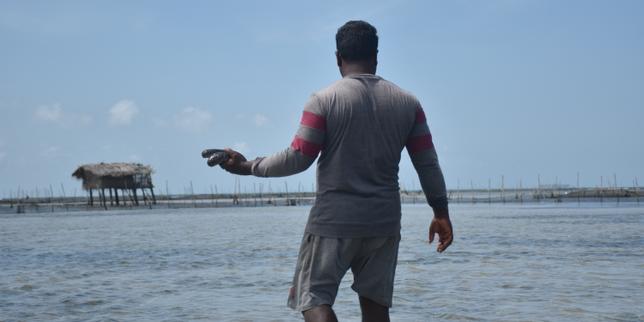
The sea cucumber boom in Sri Lanka represents a brutal collision between desperate macroeconomic survival and ecological ruin. As the island nation struggles to claw its way out of an unprecedented financial collapse, foreign exchange reserves remain painfully low. Enter the sea cucumber. Known locally as beche-de-mer, this sluggish marine invertebrate has transformed into black gold. Driven by surging demand from luxury markets in China and East Asia—where the animal is prized as both an expensive culinary delicacy and a traditional medicine staple—thousands of acres of Sri Lankan coastal waters have been cordoned off for commercial breeding.
For traditional fishermen in the northern and eastern provinces of Jaffna, Mannar, Kilinochchi, and Batticaloa, this foreign-backed aquaculture push is not an economic lifeline. It is an existential threat. Fences and nets now block access to traditional fishing grounds, shallow breeding lagoons are clouded by artificial waste, and thousands of artisanal fishing families face immediate displacement. The rush for high-value marine exports highlights a troubling reality. National solvency is being pursued by privatizing the commons and trading away the long-term health of coastal ecosystems for short-term foreign currency.
The Anatomy of an Extraction Economy
To understand how Sri Lanka became ground zero for this marine gold rush, one must look closely at the mechanics of the trade. Sea cucumbers are not charismatic megafauna. They lack the expressive eyes of dolphins or the majestic scale of whales. They are benthic scavengers that slowly crawl along the ocean floor, vacuuming up organic detritus and processing sediment in a manner functionally similar to earthworms.
Ecologically, they are essential. They cycle nutrients, excrete nitrogen and calcium carbonate, and help buffer surrounding waters against ocean acidification. Removing them en masse alters water chemistry and degrades the seabed. Yet their biological utility matters little to market forces. Dried high-grade specimens command astronomical prices, fetching hundreds of dollars per kilogram in international hubs like Hong Kong and Guangzhou.
When the Sri Lankan cabinet approved sweeping proposals to expand commercial sea cucumber and sea leech farming across thousands of acres of shallow coastal waters, bureaucrats framed the initiative as modern agricultural innovation. In practice, it functioned as an open invitation for foreign capital—frequently channeled through joint ventures and foreign corporations—to lock down public waters.
Local fishermen watch from the shores as outsiders monopolize bays that have sustained generations of families. The state collects export revenues, but the coastal communities absorb the ecological and economic fallout.
The Displacement of Traditional Livelihoods
The human cost of this aquaculture expansion is stark. Along the shallow coasts of Kilinochchi and Jaffna, entire villages find themselves fenced out of the very waters where they once cast their nets for prawns, crabs, and everyday fish.
Consider a hypothetical fishing household in the northern district of Mannar. For decades, the family relied on open-access commons, navigating seasonal shifts in fish stocks with simple outrigger canoes and gillnets. Today, that same family confronts perimeter fencing, private security markers, and intense artificial lighting deployed across commercial sea cucumber nurseries. These lights disrupt the nocturnal feeding and spawning cycles of wild fish, driving coastal populations into steep decline.
The economic promise made by proponents of the industry was simple: local employment. Yet the reality on the ground tells a different story. Out of thousands of traditional fishing families operating in the Northern Province, only a tiny fraction secure stable work inside the commercial farms. The rest are pushed out. Many younger workers, facing insurmountable debt and depleted local catches, sell their gear and migrate abroad or seek low-wage labor inland, abandoning a maritime heritage that spans centuries.
Protests have erupted across the northern littoral. Communities have organized months-long demonstrations demanding an end to unauthorized farm expansion and the dismantling of illegal enclosures. The state's response has frequently leaned on legal intimidation rather than regulatory reform, filing cases against vocal community leaders while turning a blind eye to the hundreds of unpermitted pens proliferating in shallow lagoons.
Regulatory Vacuum and Environmental Blind Spots
The regulatory framework governing Sri Lanka's marine resources is buckling under pressure. The National Aquaculture Development Authority issues operational permits, but monitoring capacity is virtually non-existent. Dozens of farms operate without formal environmental impact assessments, skirting oversight under the guise of post-crisis economic emergency measures.
Hatcheries and grow-out pens require specific environmental conditions. Maintaining juvenile sea cucumbers demands high energy inputs, continuous water filtration, and dense feeding schedules, which often introduce organic pollution into enclosed bays. Furthermore, the collection of broodstock—wild-caught adult sea cucumbers taken from natural reefs to stock the artificial farms—depletes remaining wild populations faster than nature can replenish them.
When wild populations crash, the ecosystem degradation accelerates. Water clarity drops, sediments turn anaerobic, and local biodiversity collapses. Similar trajectories have played out globally. In Mexico’s Yucatán Peninsula and across various Pacific island nations like Palau, past sea cucumber booms followed a predictable script: initial discovery, rapid capitalization, total overexploitation, economic collapse, and a permanently altered marine environment. Sri Lanka is actively speed-running this exact trajectory, ignoring historical lessons in favor of immediate export statistics.
The Geopolitical Undercurrent
This domestic resource grab cannot be divorced from broader geopolitical maneuvering in the Indian Ocean. Beijing's deepening footprint in Sri Lanka spans infrastructure projects, port development, and now strategic marine agriculture. Securing steady supplies of high-value seafood for mainland consumption aligns with broader commercial supply chain consolidation.
For a nation drowning in foreign debt, accepting capital from any willing partner often supersedes environmental prudence. Yet this dependency creates a dangerous vulnerability. When local resources are commodified entirely for external consumption, the host country absorbs permanent ecological damage while foreign markets capture the high-end value.
The path forward requires a fundamental reckoning. If Sri Lanka continues to treat its coastal waters as an expendable asset ledger to balance short-term sheets, the collateral damage will outlive any temporary macroeconomic gain. Artisanal fisheries will vanish, marine biodiversity will face systemic collapse, and coastal communities will be left to pick up the pieces of an exhausted sea.
Sri Lankan fishermen oppose exploitation of their maritime resources by China
This video provides an on-the-ground look at how local fishing communities in Sri Lanka are organizing against large-scale commercial aquaculture projects.
http://googleusercontent.com/youtube_content/1