A child has died of measles in New York, marking the state's first fatality from the virus in decades and exposing a deep fracture in modern public health infrastructure. While public health officials spent years warning that localized drops in routine childhood immunization would eventually breach the threshold of herd immunity, the reality of a preventable pediatric death in one of the wealthiest medical corridors in the world forces a reckoning. This tragedy is not an isolated medical anomaly; it is the predictable outcome of falling vaccination rates, global travel patterns, and a strained local surveillance system that failed to contain a known threat before it turned lethal.
How a Forgotten Virus Reclaimed Ground
Measles is not a mild childhood rash. Among infectious disease epidemiologists, it is widely considered the benchmark for extreme contagiousness, operating on a scale that makes seasonal influenza or even early strains of SARS-CoV-2 look sluggish by comparison. To understand how a single imported case can spiral into a fatal outbreak within weeks, you have to look at the basic reproduction number, known as R0. While seasonal flu typically has an R0 between 1 and 2, measles sits between 12 and 18. In a completely unprotected population, one infected person will pass the virus to up to eighteen others. You might also find this related coverage useful: The Quiet Mercy of a Negative Swab.
The transmission mechanism makes containment a nightmare for hospital administrators and school nurses alike. Unlike viruses that require close physical contact or heavy respiratory droplets to spread, the measles virus hangs suspended in the air as tiny aerosols. It can linger in an empty exam room, a subway car, or a grocery store aisle for up to two hours after an infected person has coughed and walked away. Roughly 90 percent of susceptible people who share airspace with an infected individual will contract the disease.
Because the virus is so aggressively efficient, the mathematical threshold required to stop it—herd immunity—is exceptionally high. Public health agencies like the Centers for Disease Control and Prevention establish that at least 95 percent of a community must be immune to prevent sustained transmission. When immunization rates in specific zip codes or school districts dip to 85 or 90 percent, the protective wall doesn't just weaken; it collapses entirely, creating dense pockets of vulnerability where the virus can burn through classrooms and households unchecked. As discussed in latest coverage by National Institutes of Health, the effects are notable.
The Anatomy of a Preventable Fatality
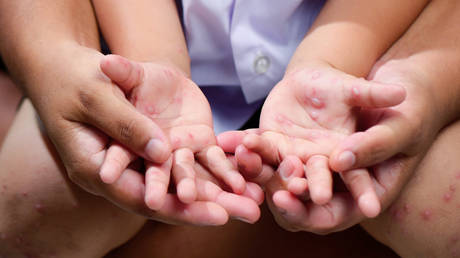
Most people who have never seen a clinical case of measles assume the danger lies in the high fever and the signature blotchy red rash that starts on the face and spreads downward. Those are merely the surface symptoms. Inside the body, the virus executes a systematic attack on the immune system and vital organs.
When the virus enters the respiratory tract, it targets specific immune cells, including macrophages and dendritic cells, using them as Trojan horses to travel to the lymph nodes. From there, it enters the bloodstream and spreads throughout the body. During this process, measles induces a phenomenon researchers call immune amnesia. The virus actively destroys memory B and T cells—the very cells that store the body's catalog of past infections and vaccinations. Survivors are often left vulnerable to secondary bacterial and viral infections for months or even years after the rash fades.
The immediate causes of death in pediatric measles cases almost always stem from two catastrophic complications:
- Measles Pneumonia: The virus causes severe inflammation in the lung tissue itself, or it opens the door for secondary bacterial pneumonia. This is the single most common cause of measles-related death in young children, leading to acute respiratory distress and oxygen deprivation.
- Acute Encephalitis: In roughly one out of every 1,000 cases, the virus triggers severe swelling of the brain. Even when children survive encephalitis, they frequently suffer permanent neurological damage, including deafness and intellectual disabilities.
In modern clinical settings with access to intensive care, mechanical ventilation, and intravenous fluids, mortality rates are lower than in developing nations, typically hovering around one to three deaths per 1,000 cases. That statistic gives many parents a false sense of security. When an outbreak hits an under-vaccinated community and infects hundreds of children, the math catches up quickly. Eventually, a child with an underlying vulnerability, or a toddler too young to have completed their vaccine series, pays the ultimate price.
The Structural Failures Behind New York’s Vulnerability
New York is no stranger to measles scares. During the 2018–2019 outbreaks, New York City and neighboring Rockland County became the epicenter of the largest measles resurgence in the United States since the disease was declared eliminated domestically in 2000. In response to that crisis, state lawmakers took aggressive legislative action in June 2019, repealing non-medical religious exemptions for school-required vaccinations. On paper, New York suddenly had some of the strictest immunization laws in the country.
Laws on paper do not automatically translate into needles in arms. Over the past several years, a quiet erosion has undermined those statutory protections, creating blind spots that health departments struggled to monitor.
First, the disruption to routine pediatric care during the early 2020s created a massive backlog in standard childhood immunizations. Millions of routine well-child visits were delayed or canceled nationwide, and while many families caught up, a stubborn percentage never returned to the pediatrician's office to complete the two-dose MMR (measles, mumps, and rubella) schedule. Under standard medical guidelines, children receive their first dose between 12 and 15 months of age, and the second between 4 and 6 years. One dose is roughly 93 percent effective; two doses push protection to 97 percent. Missing that second dose leaves a widening gap in school-age immunity.
Second, administrative enforcement has buckled under resource constraints. While public and private schools are legally required to audit immunization records and exclude unvaccinated students after a brief grace period, oversight varies wildly by district. Local health departments, exhausted by years of chronic underfunding and staff turnover, often lack the personnel to audit private institutions, homeschooling networks, and early childhood daycare centers where toddlers mingle before reaching mandatory school age.
Third, New York remains one of the primary international gateways in North America. Millions of travelers pass through JFK, LaGuardia, and Newark airports every month, arriving from regions where measles remains endemic or where recent global outbreaks have surged. A single unvaccinated traveler returning from abroad can introduce the virus into a tight-knit, under-immunized neighborhood within hours of landing.
Why Vaccine Hesitancy Evolved Into Institutional Distrust
Blaming this fatality solely on "anti-vaxxers" misses the broader sociological shift that has taken place over the last decade. In the late 1990s and early 2000s, measles vaccine skepticism was largely driven by a single, now-retracted 1998 study in The Lancet that falsely linked the MMR shot to autism. Even after exhaustive global studies involving millions of children definitively disproved any connection, that myth lingered on the fringes.
Today, the resistance is less about a single debunked paper and more about generalized institutional distrust. Public health messaging during recent respiratory pandemics alienated large segments of the population, turning routine medical compliance into a proxy for political or personal autonomy. For many hesitant parents, rejecting standard pediatric schedules is no longer viewed as a fringe alternative lifestyle; it is framed as consumer skepticism toward pharmaceutical companies and government mandates.
Pediatricians on the front lines report that the nature of exam-room conversations has changed dramatically. Twenty years ago, a hesitant parent might have asked about mercury preservatives—even though thimerosal was never used in the live-attenuated MMR vaccine. Today, physicians face sprawling, algorithm-driven narratives downloaded from social media wellness influencers who promote "natural immunity" through nutrition and supplements while downplaying the lethality of preventable diseases.
The tragedy is that the wellness narrative relies entirely on the invisible shield maintained by everyone else. Choosing to forego the MMR vaccine carries minimal risk only as long as 95 percent of your neighbors make the opposite choice. Once enough families opt out in the same school district or religious community, that collective shield dissolves, and the biological reality of the virus asserts itself without mercy.
The Clinical Blind Spot in Modern Medicine
There is another uncomfortable truth buried inside this tragedy: modern American doctors rarely see measles, and that lack of clinical familiarity slows down containment.
Because the MMR vaccine was so wildly successful for nearly half a century, entire generations of emergency room physicians, urgent care clinicians, and pediatricians went through medical school and residency without ever diagnosing a live case of measles. To a busy urgent care doctor seeing forty patients a shift, a toddler presenting with a high fever, cough, runny nose, and red, watery eyes looks identical to dozens of routine viral upper respiratory infections.
The characteristic red rash usually does not appear until three to five days after the initial symptoms begin. Crucially, the patient is already violently contagious for up to four days before the rash breaks out. By the time a parent brings a feverish, coughing child into a crowded pediatric waiting room, the virus has already been aerosolized into the ventilation system, exposing infants in carriers, immunocompromised chemotherapy patients, and pregnant women sitting feet away.
Even when the rash appears, clinicians unfamiliar with the textbook presentation—such as Koplik spots, tiny white lesions that appear inside the mouth just before the skin rash erupts—may misdiagnose it as a drug reaction, roseola, or scarlet fever. Every hour lost to misdiagnosis delays the mandatory public health notification, giving the virus an insurmountable head start in contact tracing.
What Public Health Systems Must Fix Immediately
Preventing another pediatric death in New York requires moving past generic public service announcements and executing targeted, operational reforms across healthcare and municipal agencies.
Rapid Wastewater and Clinical Surveillance
Waiting for confirmed lab reports from hospital wards is too slow for a virus with an R0 of 18. Municipal health departments must integrate measles viral targets into existing urban wastewater surveillance networks. Detecting viral shedding in neighborhood sewage systems gives epidemiologists a 7-to-10-day early warning before severe cases hit emergency rooms, allowing targeted outreach to specific zip codes.
Strict Enforcement of Waiting Room Triage
Hospitals and urgent care clinics must enforce rigid respiratory isolation protocols. Any patient presenting with fever and rash, or fever alongside recent international travel, must be masked immediately upon entry and routed directly into negative-pressure isolation rooms—never left in communal waiting areas.
Closing the Daycare and Homeschool Loopholes
State health authorities need dedicated auditing teams to verify MMR compliance in pre-kindergarten facilities, daycares, and private academies, where infants under 12 months—who are too young to be vaccinated—are most vulnerable to fatal exposure. Relying on self-reported school district spreadsheets has proven inadequate when localized pockets of non-compliance can trigger regional outbreaks.
Direct Clinician-to-Parent Re-engagement
Public health campaigns broadcast from government podiums rarely persuade skeptical parents. Data consistently shows that the single most trusted voice for vaccine-hesitant families is their own long-term pediatrician. Insurers and state health programs must reimburse pediatric practices for extended, dedicated counseling appointments so doctors have the time to address parental fears directly, without rushing through a 10-minute billing window.
The MMR vaccine has been safely administered to hundreds of millions of children since 1971, preventing an estimated 56 million deaths globally between 2000 and 2022 alone. We possess the exact tool required to render measles biologically irrelevant, yet a child in New York is dead because our institutional vigilance, clinical readiness, and public trust fractured at the exact same moment. Viruses do not negotiate with policy gaps or online misinformation; they simply find the unprotected host.