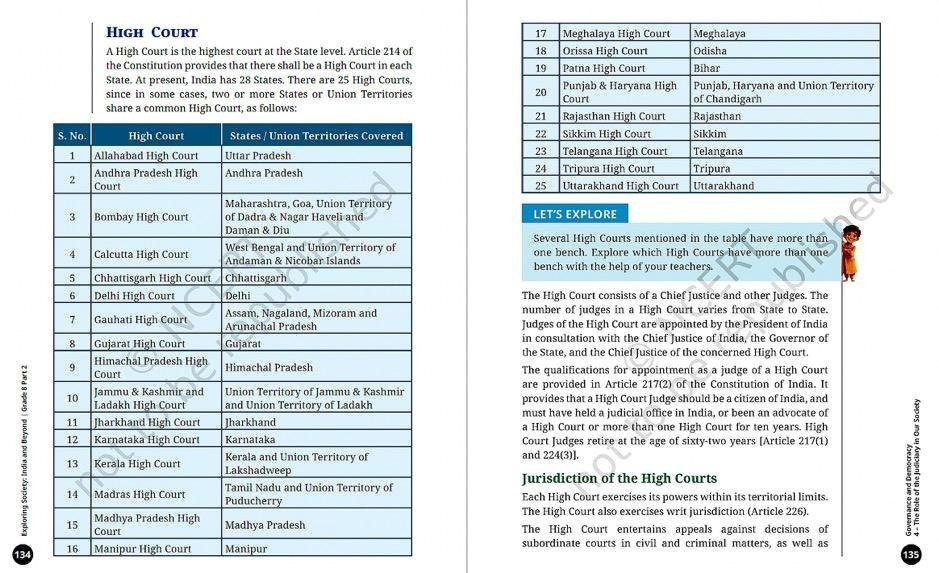
In February 2026, India's Supreme Court slapped a blanket ban on a newly published Class 8 social science textbook and threatened contempt action after the book mentioned judicial corruption, court backlogs, and judge shortages. Five months later, in July 2026, a sanitized revision rolled off the press with the contested material scrubbed and three contributors dropped from the masthead.
The textbook ban looks like a textbook clash over free speech on paper. Look closer at the paper trail and the institutional incentives, and it becomes a story about institutional self-preservation, fractured curriculum governance, and who gets to decide what Indian teenagers learn about power.
For decades, I have watched courts across South Asia draw sharp lines around their own authority while lecturing every other branch of government on transparency. When a bench led by Chief Justice Surya Kant moved suo motu—on its own motion—against the National Council of Educational Research and Training (NCERT) over Exploring Society: India and Beyond (Grade 8, Part 2), the speed was striking. A newspaper report sparked a constitutional storm within days.
The Flashpoint Inside a Middle-School Chapter
Middle-school civics in India has long lived in a strange bubble. Students memorize the separation of powers, fundamental rights, and writ jurisdiction as clean diagrams on a page. Real life in a district court or high court registry rarely looks like a flow chart.
The February 2026 Class 8 social science volume tried to bridge that gap in its discussion of the judiciary. By naming corruption, pendency, and shortages of judges alongside institutional duties, the text stepped straight into territory where judges sit as both aggrieved party and final umpire.
Courts hate being treated like ordinary public institutions when criticism leaves the courtroom and enters a classroom. A single critical op-ed can be shrugged off or answered in a speech. A state-printed textbook carries a different weight: it shapes millions of thirteen- and fourteen-year-olds before they ever hire a lawyer or file a petition.
Critics, including dozens of academics and scholars who petitioned the President in April 2026, called the intervention judicial overreach. Their argument is straightforward. If the National Education Policy (NEP 2020) and the National Curriculum Framework for School Education (NCFSE 2023) tell students to think critically and examine real democratic challenges, hiding systemic flaws behind a ban trains students in conformity rather than citizenship.
Why Procedure Gave the Court a Wedge
Free speech arguments only tell half the story. Courts rarely rely on hurt feelings alone when they want a measure to stick; they look for procedural cracks.
In the NCERT dispute, the Supreme Court pointed to how the chapter was prepared and vetted, noting that it had not gone properly through the National Syllabus and Teaching Committee (NSTC) and had been shared digitally among a select set of members. That procedural flaw gave the bench leverage it would not have had over a textbook vetted through every formal step.
Still, the remedy was blunt. Threatening criminal contempt against curriculum officials and ordering a complete recall of a book chills far more than one paragraph. In education publishing, once a book is pulled under judicial threat, editors stop taking risks across the entire catalog.
- Procedural shortcuts invite pushback: Informal drafting routes hand critics an easy target when a sensitive topic sparks backlash.
- Blanket bans create collateral damage: Pulling an entire volume halts classroom distribution and forces costly reprints across state and central channels.
- Reputational anxiety distorts pedagogy: Treating every mention of institutional failure as an attack on the rule of law confuses accountability with hostility.
Consider a hypothetical example outside education. Suppose a municipal water board publishes an annual engineering report noting rusted pipes, treatment delays, and budget leaks, and then obtains a court order barring distribution of the report because its tone might dent public confidence in tap water. Residents might lose access to useful data, yet the rusted pipes remain underground.
The July Sanitization and the Masthead Purge
By July 2026, the friction produced a quieter outcome. The revised Class 8 edition dropped the contentious judiciary material and trimmed the development team list from 51 names to 48, omitting Michel Danino, Suparna Diwakar, and Alok Prasanna Kumar—the figures tied to the disputed chapter.
Sanitization solves the immediate political headache for both sides. The judiciary gets its public dignity protected without having to litigate every detail of court administration in public view. The education bureaucracy gets back to printing books, filing compliance affidavits, and avoiding further courtroom summons.
Yet sanitization leaves a hard question unanswered. How do you teach young citizens about constitutional checks and balances if one of the three pillars is off-limits to candid examination?
What the Textbook Row Reveals About Power
Watch closely when an institution polices its own image this aggressively. Confidence rarely needs a ban. Anxiety does.
The Indian judiciary has done plenty of heavy lifting over the years on rights, infrastructure, and public interest litigation. Pretending it has no flaws—no delays, no vacancies, no ethical blind spots—does not make the institution stronger. It makes public trust brittle, because students who grow up hearing that a system is spotless often react with cynicism the first time they see a case drag on for a decade or a clerk demand a favor.
At the same time, textbook writers owe precision to young readers. Loose generalizations or lumping honest judges together with bad actors does poor service to civic education. Good curriculum writing distinguishes between structural bottlenecks, individual misconduct, and the constitutional design meant to correct both.
The real lesson of the February ban and July rewrite is not that eighth graders needed a harsher indictment of judges. It is that a democracy cannot build mature citizens on sanitized history and polite silences.