On November 19, 2026, the International Court of Justice did something it had never done in its eight-decade history. It found a sovereign state directly responsible for committing genocide. By a 9-6 margin, the judges in The Hague ruled that Myanmar violated the 1948 Genocide Convention during its brutal 2017 military operations against the Rohingya minority, triggering an immediate backlash from Naypyidaw's ruling junta, which dismissed the verdict as neither unanimous nor fair.
The generals have a talking point, and they are milking it for every ounce of diplomatic cover. A six-judge dissent on the world's highest bench is not a minor footnote. Yet focusing solely on the junta's predictable outrage misses the deeper legal earthquake happening beneath the surface of international law. The 9-6 split exposes a fierce, unresolved battle over how courts prove genocidal intent—and reveals why a binding victory in The Hague still collides with a brick wall of geopolitical reality.
The Anatomy of a Divided Bench
To understand why Myanmar’s military spokespersons immediately seized on the lack of unanimity, you have to look at the sheer complexity of the court's November 19 judgment in The Gambia v. Myanmar. This was not a blanket rubber-stamp of every accusation leveled against Naypyidaw since The Gambia filed the case in November 2019. The 15-member bench fractured along distinct legal fault lines across thirteen separate operative clauses.
The core finding—that Myanmar committed genocide through killing, causing serious bodily or mental harm, and deliberately inflicting destructive conditions of life under Article II of the Genocide Convention—passed by nine votes to six. President Yuji Iwasawa led the majority, joined by Judges Charlesworth, Brant, Gómez Robledo, Cleveland, Aurescu, Tladi, Hmoud, and Judge ad hoc Pillay.
Six judges pushed back hard. Vice-President Julia Sebutinde voted against the core genocide finding, joined by Judges Tomka, Abraham, Xue, Nolte, and Myanmar’s appointed Judge ad hoc Claus Kress.
Their objection was not a denial of bloodshed. Nobody on the bench disputed that Myanmar's security forces burned hundreds of villages, murdered at least 10,000 Rohingya, and drove more than 700,000 survivors across the border into Bangladesh in late 2017. Rather, the six dissenting judges argued that the majority lowered the evidentiary bar required to prove dolus specialis—the specific intent to physically or biologically destroy a protected group, in whole or in part.
In their dissenting opinions, the minority warned against making "sweeping inferences of genocidal intent" from widespread atrocities that could alternatively be explained as brutal counter-insurgency or forced displacement. Under the court's own strict precedent from the 2007 Bosnia v. Serbia ruling, genocidal intent must be the only reasonable inference drawn from a pattern of conduct. The majority decided that the sheer scale, coordination, and systematic targeting of Rohingya civilians met that threshold. The dissenters believed the court had blurred the legal line between ethnic cleansing and genocide.
Interestingly, the court found far greater consensus when rejecting other parts of The Gambia's case. By votes of 14-1 and 13-2, the judges agreed that Myanmar was not legally responsible for failing to prevent or punish public incitement to genocide by private actors, such as hardline nationalist monks, under the strict attribution rules of state responsibility. And on the procedural obligation to enact domestic legislation criminalizing genocide, the bench voted 14-1 against Myanmar, with only Judge Xue dissenting.
Naypyidaw's Calculated Spin
When a spokesperson for Senior General Min Aung Hlaing called the ruling "unfair" and a "great disappointment," the junta was playing a very specific game. It was not trying to convince human rights lawyers in Geneva or New York. It was speaking to its remaining diplomatic shields in Beijing and Moscow, as well as skeptical capitals across the Global South.
The junta's argument rests on a deliberate distortion of how international adjudication works. Under Article 55 of the ICJ Statute, all questions are decided by a majority of the judges present. Unanimity is neither required nor expected in landmark disputes involving state sovereignty. By framing a 9-6 decision as defective, Naypyidaw attempts to cast the court's majority as politically motivated while treating the six dissenters—including judges from China, France, Germany, Slovakia, and Uganda—as proof of reasonable doubt.
This rhetoric ignores an uncomfortable irony. Myanmar's current military regime seized power in a February 2021 coup, overthrowing the elected civilian government of Aung San Suu Kyi—the very leader who had personally traveled to The Hague in December 2019 to defend the military against these exact charges. Today, Aung San Suu Kyi sits in junta detention, while the generals who orchestrated the 2017 "clearance operations" inherit the legal liability of a state they rule by force.
Meanwhile, Myanmar's opposition National Unity Government (NUG), which claims legitimate authority over the country and formally withdrew Myanmar's preliminary objections to the ICJ's jurisdiction back in 2022, welcomed the verdict. Yet even the NUG admitted a stark truth in its response: legal rulings from the Netherlands cannot stop airstrikes in Rakhine State or dismantle a military apparatus that treats impunity as its birthright.
Why This Verdict Changes the Rules for Future Cases
For decades, the ICJ's evidentiary standard for proving state-sponsored genocide functioned like a locked vault. In both the 2007 Bosnia ruling and the 2015 Croatia-Serbia decision, the court confirmed mass atrocities while refusing to find the respondent states directly guilty of committing genocide, largely because smoking-gun orders explicitly demanding biological destruction rarely survive on paper.
That vault is now open.
By inferring specific genocidal intent from the totality of military conduct, hate campaigns, sexual violence, and the systematic destruction of life-sustaining infrastructure, the ICJ majority established a functional blueprint for proving state genocide without a written confession.
Four other active genocide cases sit on the ICJ docket right now: Ukraine v. Russia, South Africa v. Israel, Nicaragua v. Germany, and the Democratic Republic of the Congo v. Rwanda. Legal teams in every one of those disputes spent the days following November 19 dissecting every footnote of the Myanmar judgment. For applicants like South Africa and Ukraine, the 9-6 majority offers a vital lifeline—proof that a state cannot hide behind the fog of war or counter-terrorism rhetoric when its forces systematically obliterate a civilian population's means of survival.
Conversely, the six-judge dissent provides a ready-made defense playbook for respondent states. Future defendants will lean heavily on the arguments laid out by Vice-President Sebutinde and Judge ad hoc Kress, insisting that courts must not conflate mass displacement or disproportionate warfare with the biological destruction of a group.
The Enforcement Trap
A judgment from the International Court of Justice is final, binding, and cannot be appealed. On paper, Myanmar is now legally obligated to:
- Adopt concrete measures of restitution, compensation, and reparations for Rohingya victims (ordered by a 10-5 vote).
- Provide formal guarantees of non-repetition (ordered 9-6).
- Conduct genuine criminal investigations and prosecute perpetrators of genocidal acts.
- Enact domestic legislation that fully codifies the Genocide Convention.
Here is the catch. The ICJ has no police force, no bailiffs, and no mechanism to freeze state assets on its own.
Under Article 94(2) of the United Nations Charter, if a party fails to perform the obligations incumbent upon it under an ICJ judgment, the other party may have recourse to the UN Security Council. The Council can then make recommendations or decide upon measures to give effect to the judgment.
Anyone who has watched the Security Council over the past decade knows how that story ends. China and Russia hold permanent veto power. Both governments have consistently blocked binding Chapter VII resolutions against Myanmar's military junta, shielding Naypyidaw from arms embargoes and targeted UN sanctions even as the country spiraled into full-scale civil war following the 2021 coup.
When Security Council members raised the ICJ ruling under "Any Other Business" in late November, the familiar diplomatic paralysis immediately resurfaced. Western members pushed for concrete follow-up mechanisms tied to accountability and humanitarian access. Council allies of the junta emphasized sovereignty, dialogue, and the divided nature of the court's bench.
Without Security Council enforcement, compliance depends on indirect pressure. Regional blocs, international financial institutions, and individual states can use the ICJ judgment as legal bedrock to expand targeted sanctions, block development financing, and tighten restrictions on aviation fuel and weapons components flowing to the junta. Universal jurisdiction cases in national courts—such as ongoing proceedings in Argentina—also gain immense moral and evidentiary weight from an authoritative ICJ finding that genocide occurred.
What Justice Actually Looks Like on the Ground
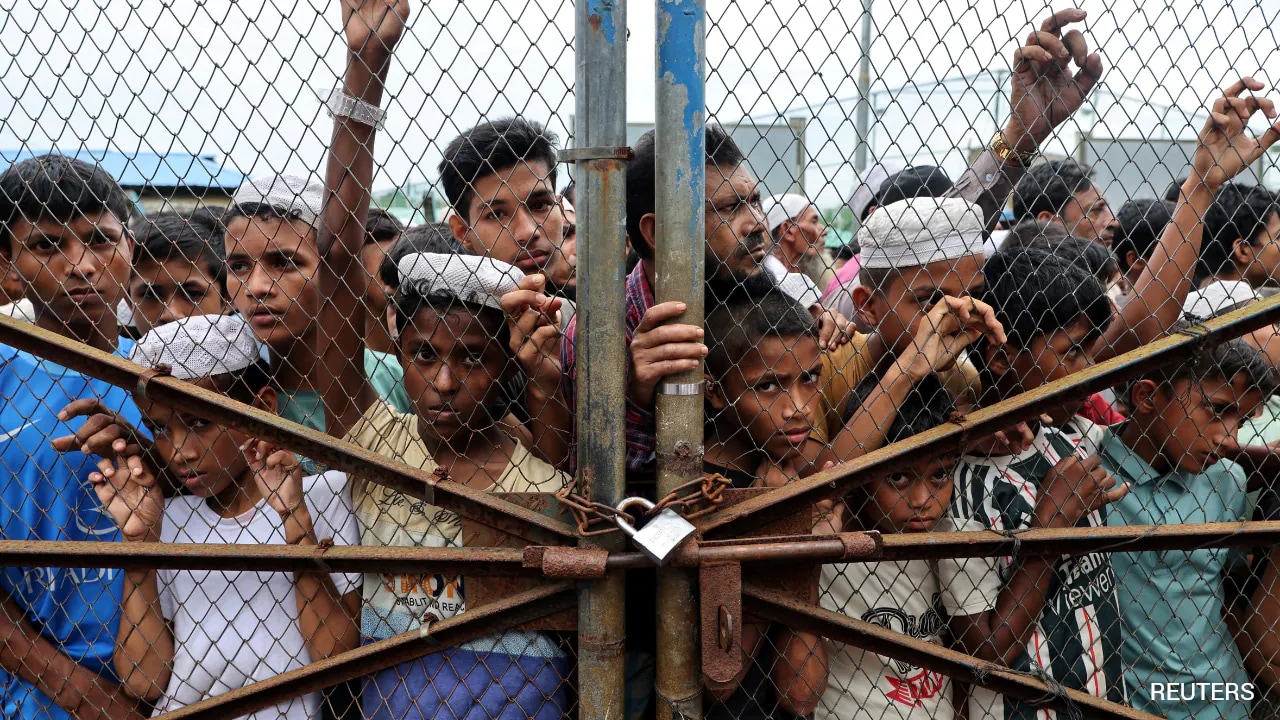
In the sprawling, overcrowded camps of Cox's Bazar in southern Bangladesh, where more than a million Rohingya refugees live behind barbed wire on shrinking humanitarian rations, the legal nuances of a 9-6 split in The Hague feel painfully distant.
For survivors, the ruling delivers something decades of state-sponsored erasure tried to steal: official, undeniable recognition. For generations, Myanmar's authorities stripped the Rohingya of citizenship under the 1982 Citizenship Law, deleted them from national census lists, and labeled them illegal "Bengali" interlopers. The world's highest court has now permanently etched into international law that the Rohingya are a distinct, protected group—and that the state of Myanmar tried to destroy them.
Yet recognition does not build safe homes in Rakhine State. Conditions on the ground in western Myanmar have actually deteriorated since 2017. Caught between the collapsing junta's brutal conscription drives and the territorial advances of the Arakan Army, tens of thousands of remaining Rohingya have faced fresh waves of displacement, forced recruitment, and village burnings throughout 2025 and 2026.
The junta can complain about fairness from its fortified capital in Naypyidaw, and legal scholars can debate the margins of a 9-6 vote for years to come. None of that changes the central reality facing international institutions today: a court in The Hague finally named the crime, and the political world still lacks the will to stop it.


