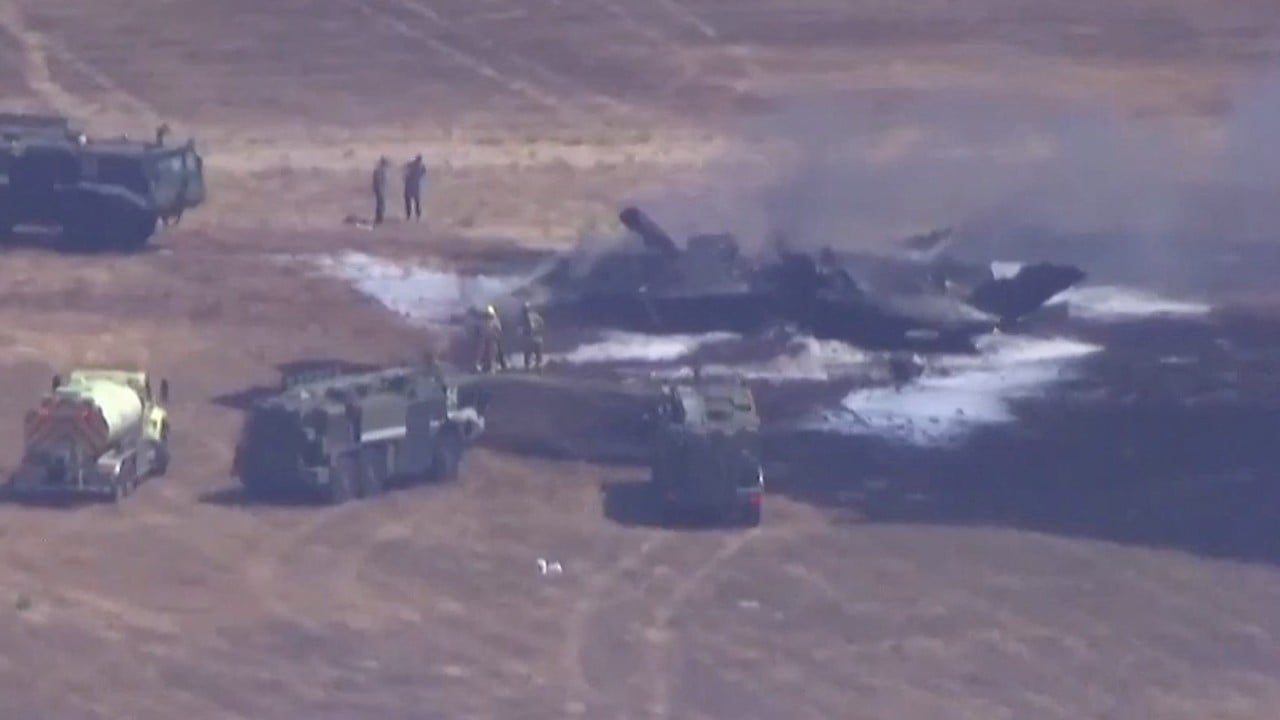
A multi-million-dollar pillar of American air power disintegrated on a dirt field outside Marine Corps Air Station Miramar in San Diego. Another high-end stealth fighter down. Another pilot forced into a split-second ejection. Another administrative brush-off categorizing a smoking multi-million-dollar crater as a standard "Class A mishap".
When an F-35B Lightning II went down on a Friday morning, the immediate public relations machinery of the U.S. Marine Corps spun into its well-rehearsed routine. The pilot survived, escaping with non-life-threatening injuries before the airframe slammed into the ground and sparked a vegetation fire. Local emergency crews rushed to douse the flames. Plumes of dark smoke drifted over Southern California, mirroring a scene that has played out with alarming frequency across America's military installations.
Strip away the sanitized military press releases and look at the broader picture. This is not just an isolated incident of mechanical failure or pilot error. It is a glaring symptom of a deeper, systemic rot within the military-industrial complex's crown jewel. The F-35 program is the most expensive weapons system in human history, yet its operational readiness, supply chain stability, and safety metrics remain locked in a perpetual state of crisis.
The True Cost of Class A Mishaps
Military bureaucracy loves sterile terminology. By labeling the Miramar incident a Class A mishap, the Pentagon invokes a category reserved for the most catastrophic non-combat events: incidents involving a fatality, permanent total disability, or property damage exceeding two and a half million dollars. Because the pilot successfully ejected, the headlines focused on the positive outcome of human survival.
That focus misses the structural reality. An aircraft with a price tag hovering around $109 million was completely obliterated. That is not merely a piece of equipment written off a ledger. It represents a permanent reduction in frontline tactical capacity at a time when global tensions are tightening across multiple theaters.
Consider the arithmetic of attrition. Modern stealth fighters are not mass-produced like artillery shells. They require specialized manufacturing lines, rare earth minerals, intricate software integrations, and thousands of man-hours to assemble. When a single F-35B is lost to a non-combat mishap, the replacement timeline stretches out for years. The supply chain cannot simply spin up a new airframe next Tuesday to fill the empty hangar.
Engineering Complexity Versus Operational Reality
The F-35B variant is an engineering marvel wrapped in an operational nightmare. Designed for the Marine Corps, the "B" model features a complex shaft-driven lift fan, a three-bearing swivel nozzle, and roll posts that allow it to execute short takeoffs and vertical landings. It is a vertical takeoff and landing machine capable of supersonic speeds.
That dual capability demands compromises in physics and mechanical design. The propulsion system relies on thousands of precision parts operating under extreme thermal and mechanical stress. Every time a pilot transitions from horizontal flight to vertical hover mode, the aircraft asks its mechanical subsystems to perform a microscopic tightrope walk.
Maintenance crews bear the brunt of this complexity. Conversations with active-duty and retired maintenance officers reveal a recurring nightmare of maintenance-to-flight-hour ratios that consistently miss statutory targets. Mechanics are forced to spend disproportionate hours troubleshooting diagnostic software errors, repairing specialized radar-absorbent skin coatings, and managing software blocks that frequently fail to communicate cleanly with legacy systems.
When a jet sits in a hangar waiting for specialized parts manufactured by a single defense contractor, readiness rates plummet. When those jets are forced into the rotation without adequate downtime, fatigue sets in. Metal, composites, electronics, and human beings all have breaking points.
The Shadow of Inadequate Oversight
For decades, the Pentagon and Lockheed Martin have defended the F-35 enterprise by pointing to its unrivaled sensor fusion and networking capabilities. The pitch is seductive. The jet acts as a flying computer node, gathering data, synthesizing battlefield environments, and sharing intelligence with surface ships, ground forces, and allied assets.
Yet, software superiority means nothing when an airframe hits the dirt. Government Accountability Office reports have repeatedly highlighted hundreds of unresolved deficiencies in the F-35's design. Autonomic Logistics Information System, the much-maligned maintenance tracking software meant to streamline upkeep, has chronically lagged behind expectations, often providing inaccurate diagnostics or sluggish data transfer.
When structural and software complexities compound, the margin for error shrinks to near zero. A minor hydraulic fluctuation, a transient electrical glitch, or a delayed sensor reading that might cause a momentary hiccup in a simpler fourth-generation aircraft can trigger cascading failures in a fifth-generation stealth platform.
The pilots flying these machines are among the best-trained tactical aviators on earth. They undergo rigorous simulators, emergency procedure drills, and survival training. They are conditioned to trust their aircraft implicitly. But trust is an eroding asset when incidents accumulate faster than definitive public answers.
Where Accountability Goes to Die
Following the Miramar crash, the standard protocol kicked into gear. An investigation team was assembled. Flight operations for certain cohorts may face temporary operational pauses or safety stand-downs, depending on initial telemetry findings. Months will pass. Eventually, a heavily redacted mishap report will trickle out to the public, attributing the cause to a combination of mechanical anomalies and contributing operational factors.
The names of the investigators change, but the conclusion remains uniform. The system protects itself. Accountability is diffused across a massive network of prime contractors, sub-tier suppliers, military procurement offices, and congressional oversight committees that have too much financial skin in the game to pull the plug.
Taxpayers fund the bill for every lost airframe, while defense sector stock prices remain insulated by multi-year procurement budgeting. Meanwhile, the Marine stationed at Miramar watches the black smoke clear, knowing that tomorrow the flight schedule starts all over again, using the same machines, facing the same mechanical unknowns, waiting for the next Class A designation to drop.