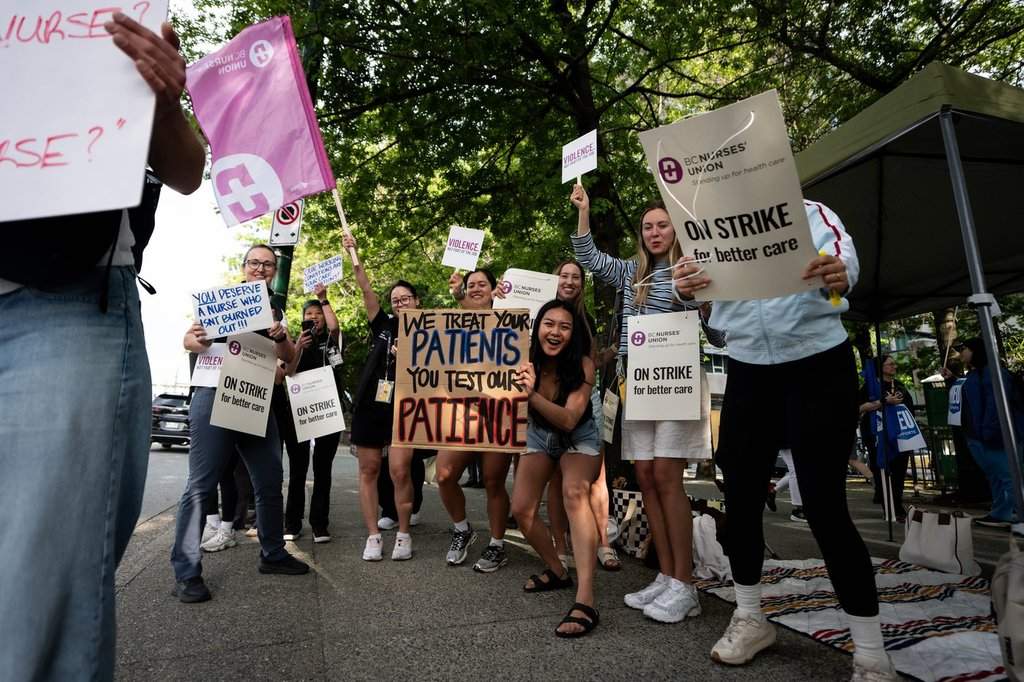
The escalating province-wide job action by the British Columbia Nurses’ Union is no longer a localized labor dispute. Picket lines that began at Vancouver General Hospital have rapidly expanded to Surrey Memorial Hospital and the Jim Pattison Outpatient Care and Surgery Center, with coordinated expansions targeted for Victoria General, Nanaimo Regional General, and Royal Jubilee Hospital. Confronted by a total collapse in contract negotiations after 67 percent of members rejected a tentative agreement, 60,000 nurses are drawing a hard line against chronic understaffing and workplace intimidation. This systemic fracture reveals a deeper crisis that goes far beyond a dispute over cost-of-living adjustments.
The public sees the immediate disruption. Outpatient laboratories are running at reduced capacities, non-essential administrative tasks are being left undone, and informational pickets are lining the perimeters of major medical complexes. Yet, emergency rooms remain open under strict essential services legislation. The real emergency is happening inside the wards, hidden behind privacy curtains and double-locked doors.
The Mirage of Mandated Staffing Ratios
In 2024, British Columbia made headlines by becoming the first Canadian province to commit to mandatory nurse-to-patient ratios. It was heralded by politicians as a profound victory for public health. On paper, the policy promised a safe, structured environment where acute care wards would never again find a single nurse managing a dozen complex patients simultaneously.
The reality on the ground has been entirely different. A ratio is nothing more than a mathematical wish if there are no physical bodies available to fulfill it. Hospitals across the province routinely violate these mandated ratios because the pool of available staff has completely evaporated. Nurses are not leaving the profession because they no longer care for patients. They are leaving because the daily operational baseline relies entirely on the extraction of forced overtime.
When a shift cannot be filled, administrators do not close beds or divert incoming ambulances. Instead, they turn to the remaining staff and demand that they stay for an extra four, eight, or twelve hours. A nurse who has already completed a grueling twelve-hour shift is regularly put in the position of choosing between severe exhaustion or abandoning vulnerable individuals. The moral injury resulting from this dynamic is driving the current rebellion.
The Secret Financial Drain of Private Agencies
While the provincial government points to its public-sector bargaining mandate of a twelve percent wage increase over four years as a fair offer, frontline workers are pointing directly at the province's books. The provincial health authorities are spending millions of taxpayer dollars every week on a highly inflated, parallel system of private agency nursing.
When a hospital faces a critical staffing shortage that cannot be covered by mandatory overtime, administrators call private for-profit registries. These agencies supply travel nurses who work alongside staff nurses. The fiscal disparity is staggering. A staff nurse bound by the provincial collective agreement might earn forty-five dollars an hour. The agency nurse standing next to them, performing identical duties, often commands more than double that rate, with their lodging, travel, and daily stipends fully covered by public funds.
This creates a toxic workplace dynamic. Staff nurses are witnessing their own employer spend exorbitant sums on temporary private labor while simultaneously arguing that there is no money left in the public treasury to improve the baseline wages and benefits of permanent employees. This short-term financial band-aid has become a permanent crutch. It actively incentivizes staff nurses to resign from stable health authority positions to join private agencies, where they can enjoy better pay and total control over their schedules.
Allegations of Systematic Workplace Intimidation
The rapid expansion of the current picket lines was not triggered solely by wage stagnation. According to union leadership, the escalation was heavily accelerated by a wave of administrative heavy-handedness that borders on systemic coercion. Since the initial phase of job action commenced, the union has logged more than 2,300 distinct reports from members alleging intimidation, threats, and workplace bullying by health authority managers.
Nurses who have exercised their legal right to participate in the strike by refusing non-nursing duties—such as clerical work, cleaning floors, or moving heavy furniture—report being targeted. Frontline workers have faced explicit threats of immediate disciplinary action. Some managers have gone so far as to warn staff that their professional licenses could be permanently revoked by the BC College of Nurses and Midwives for participating in a lawful job action.
This administrative strategy has completely backfired. Rather than compliance, it has produced deep resentment. A workforce that was already pushed to its absolute limit during years of pandemic strain is now facing an employer that uses punitive tactics to force compliance. The expansion of picket lines to Vancouver Island is a direct defensive response to these managerial strategies.
The Unspoken Epidemic of Workplace Violence
The modern hospital ward has become one of the most hazardous work environments in the country. Statistics fail to capture the daily reality of verbal abuse, physical assaults, and systemic exposure to trauma that nurses face every single day. Emergency departments and psychiatric acute units have become clear flashpoints for this violence.
Understaffed units mean that security personnel are stretched thin, and agitated patients are left waiting for hours in crowded corridors. When frustration boils over, it is the nurse at the bedside who bears the brunt of the assault. The current contract dispute is deeply intertwined with this safety crisis. Frontline workers are demanding real, enforceable structural protections, not just passive security cameras or administrative committees.
They are demanding dedicated, trained security staff present on high-risk units around the clock. They want physical infrastructure designed to prevent assaults, and immediate, uncompromised support when an incident occurs. The current offer from the health employers treats workplace safety as an auxiliary issue to be managed through future consultations. For a nurse who was physically assaulted on her last shift, future consultations are completely meaningless.
A Broken Bargaining Structure
The structural impasse at the bargaining table stems from a rigid public-sector mandate that refuses to account for the unique operational realities of modern healthcare. The Health Employers Association of BC operates within strict fiscal boundaries dictated by the provincial government. This leaves almost no room for creative problem-solving or the targeted financial restructuring required to retain senior staff.
The union’s rejection of the tentative agreement by a significant majority demonstrates that the membership is entirely disconnected from the calculations of the bargaining committee. The frontline workforce is sending a clear signal that they are no longer willing to accept marginal improvements that fail to change the daily reality of their shifts. They are demanding an immediate, direct intervention from the provincial government to rewrite the bargaining mandate itself.
The province cannot afford a prolonged stalemate. The healthcare system is already operating at near-total capacity, with surgical backlogs remaining high and emergency rooms experiencing frequent temporary closures in rural areas. By expanding picket lines to major regional hubs like Victoria and Nanaimo, the union is intentionally increasing the political cost of government inaction. The strike will continue to grow, the pressure will continue to mount, and the systemic cracks in British Columbia's healthcare infrastructure will continue to widen until the underlying issues of retention, safety, and respect are directly addressed.