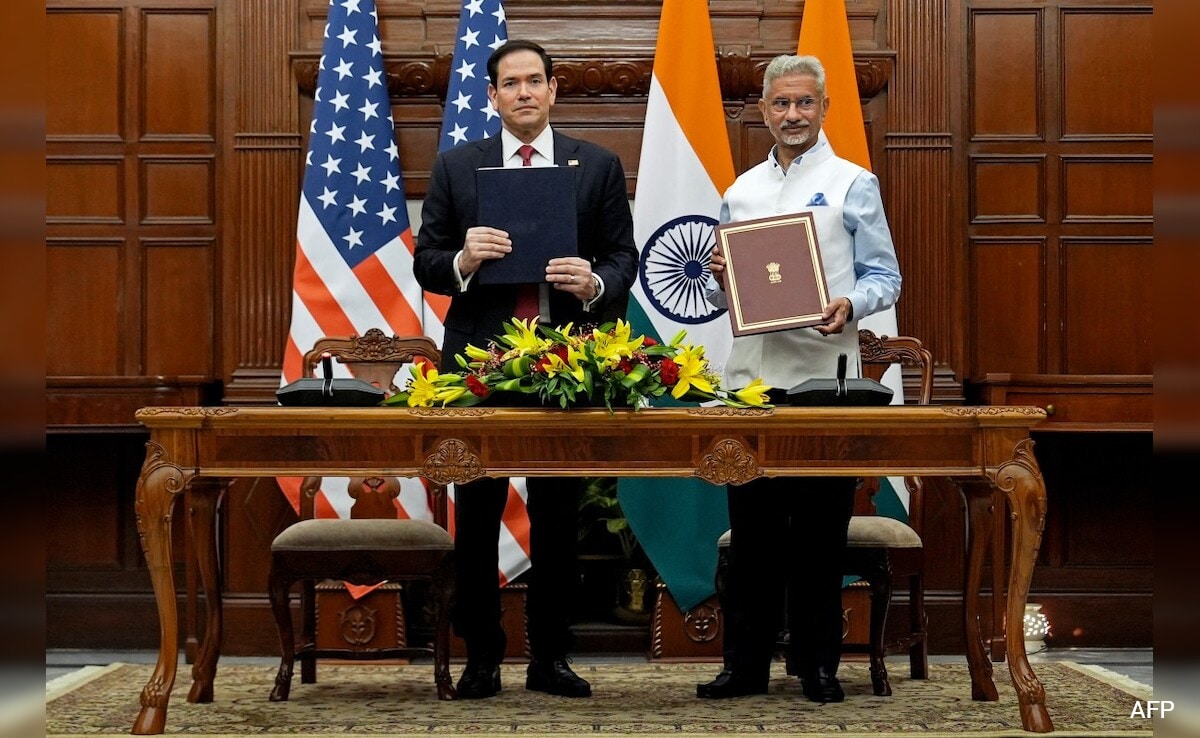
The press releases are glowing. The handshakes in Delhi were firm. Marco Rubio is heading back to D.C. with a signed memorandum of understanding (MoU) regarding critical minerals, and the media is treating it like the second coming of the Industrial Revolution. They want you to believe that India and the United States have just solved the supply chain crisis with a few strokes of a pen.
They haven't. This pact is a desperate attempt to legislate geology into existence. It is a paper shield against a titanium wall.
If you believe the headlines, this partnership will "break the Chinese monopoly" on the materials required for EVs, semiconductors, and defense tech. In reality, this agreement ignores the brutal physics of extraction and the decades of processing expertise that neither Washington nor Delhi currently possesses. We aren't building a supply chain; we are building a fantasy.
The Myth of the "Counter-China" Bloc
The prevailing narrative suggests that if you aggregate enough democratic nations into a trade group, lithium and cobalt will magically appear in their warehouses. It doesn't work that way. China didn't win the minerals race because they were "first." They won because they spent thirty years doing the dirty, low-margin, ecologically devastating work of refining that the West was too "refined" to touch.
Currently, China controls roughly 60% of world rare earth production and over 85% of processing capacity. An MoU between India and the US doesn't change the fact that if India digs up raw ore tomorrow, they will likely have to ship it to a Chinese-owned facility to turn it into something useful.
I have watched dozens of these "strategic partnerships" fizzle out over the last decade. They fail because they focus on the diplomacy of minerals rather than the metallurgy of them. You cannot "friend-shore" your way out of a 20-year lead in chemical engineering.
India Is Not the Mining Giant You Think It Is
The hype surrounding India’s mineral wealth is largely based on "inferred" resources—a geological term for "we think something is there, but we haven't proven it's worth the cost to get it."
Take the much-vaunted lithium discovery in Jammu and Kashmir. The headlines screamed about 5.9 million tonnes. Investors salivated. But anyone who has actually stood on a drill pad knows that "G3" (inferred) resources are a long, expensive road away from "G1" (proven) reserves.
- The Extraction Gap: India’s mining sector is bogged down by archaic land acquisition laws and environmental litigation that can last decades.
- The Quality Problem: Much of the domestic supply is low-grade. Refining low-grade ore requires massive amounts of energy and produces toxic byproducts that India’s current infrastructure isn't equipped to handle.
- The Investment Paradox: Western capital is hesitant to pour billions into Indian mining when the regulatory goalposts move every time a new local government takes power.
Rubio’s visit was about optics. He needs to show voters that the US is "de-risking." India needs to show the world it’s a viable alternative to the Middle Kingdom. But signing a pact is not the same as building a refinery.
The Cost of the "Clean" Illusion
We talk about critical minerals as the "green" solution. This is the ultimate industry lie. Extracting lithium, copper, and neodymium is a violent, carbon-intensive process.
To produce one ton of lithium, you need approximately 500,000 gallons of water. In regions of India already facing acute water stress, the idea of massive lithium extraction is a social powder keg. The US-India pact ignores the local reality: you cannot have a "Green Revolution" without turning vast swaths of the earth into a moonscape.
When we talk about "securing the supply chain," what we are really saying is "we want the batteries, but we want someone else to deal with the tailings ponds." The US isn't looking for a partner; it’s looking for a sacrificial geography. India, eager for the status of a global power, is auditioning for the role without calculating the environmental debt.
Stop Asking if the Pact is "Strategic"
The questions being asked in boardrooms right now are wrong. CEOs are asking, "Does this pact make our supply chain safer?"
The answer is no. It makes your supply chain more complex and more expensive.
If you shift your sourcing from a streamlined (albeit hostile) Chinese supply chain to a fragmented, nascent, and unproven Indian-American hybrid, your costs will skyrocket. $Lithium$ carbonate prices are already volatile. Adding "geopolitical premiums" to every gram of material in a Tesla or a Tomahawk missile is a recipe for hyper-inflation in the tech sector.
We should be asking: Why are we trying to recreate a 19th-century extraction model for 21st-century technology?
The Fallacy of the Critical Mineral List
The US government keeps expanding its list of "critical" minerals. It’s now over 50 items long. When everything is critical, nothing is.
By spreading resources across dozens of materials—from $Gallium$ to $Graphite$—this pact ensures that neither country achieves the scale necessary to compete with China’s specialized industrial clusters. China wins because they pick two or three bottlenecks and dominate them. The US and India are trying to build a "holistic" (to use a term I despise) solution that covers everything and masters nothing.
The Brutal Reality of the Timeline
Even if the funding was released today, and even if the environmental permits were fast-tracked in both nations, you are looking at a minimum of 10 to 15 years before a single ounce of battery-grade material hits the market from a new mine.
- Exploration & Feasibility: 3-5 years.
- Permitting & Social License: 2-7 years (longer in democratic India).
- Construction: 2-3 years.
- Ramping & Commissioning: 1-2 years.
By the time this pact produces results, the technology it aims to support—current lithium-ion chemistry—might already be obsolete. We are fighting the last war with the next war's budget.
The Only Way Out is Through Innovation, Not Extraction
If the US and India actually wanted to disrupt the status quo, they would stop talking about mines and start talking about substitution.
The real "game-changer"—if I were allowed to use that tired phrase—isn't finding more cobalt. It’s inventing a battery that doesn't need it. But there is no political glory in funding a laboratory for twenty years. There is immediate political glory in a photo-op with a foreign dignitary and a document that promises "cooperation."
We are subsidizing the past. We are betting on holes in the ground when we should be betting on the periodic table.
The Trade-Off Nobody Admits
For this pact to work, the US has to be willing to transfer high-end processing IP to India, and India has to be willing to gut its own environmental protections to compete with Chinese pricing.
Neither is going to happen.
The US will hoard the IP to protect its "national security interests," and India will remain a vibrant, chaotic democracy where local farmers will (rightfully) protest the poisoning of their groundwater for the sake of a New York hedge fund’s ESG portfolio.
This pact isn't a bridge; it’s a press release. It’s a way for politicians to look busy while the actual industrial capacity of the world remains firmly anchored in the East. You can't mine minerals with a pen, and you can't build a superpower on an MoU.
Stop looking at the signatures. Start looking at the chemistry. Until there are chimneys smoking and acid leaching into tanks in Chennai or Cleveland, China isn't even breaking a sweat.
The minerals aren't moving. The only thing being extracted here is your attention.