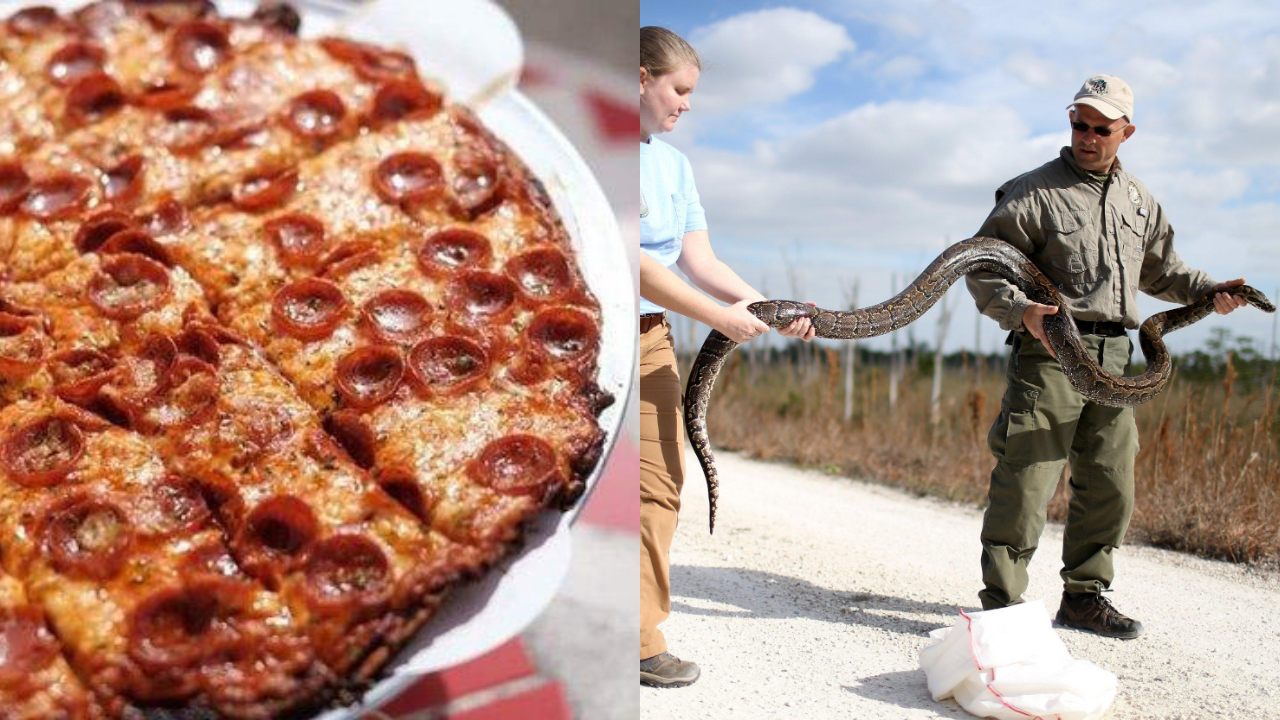
The convergence of culinary marketing and invasive species management highlights a critical challenge in modern environmental economics: the misalignment of crowd-sourced incentives. When a Florida restaurant offers a free "python pizza" in exchange for a harvested Burmese python, the transaction bridges microeconomics and ecological containment. While superficially positioned as a community-driven conservation effort, a structural analysis reveals that such promotions function primarily as high-margin marketing campaigns rather than scalable ecological interventions. Deconstructing this mechanism requires analyzing the cost-benefit asymmetry for participants, the operational dynamics of the restaurant, and the ultimate efficacy of localized bounties.
The Microeconomic Friction of the Python Hunt
To understand why a culinary bounty fails as a primary ecological solution, one must analyze the participant's cost function. The acquisition of a Burmese python (Python bivittatus) from the Florida Everglades demands significant resource allocation. This creates a steep barrier to entry that a low-value commodity prize cannot offset.
The cost function of the hunter comprises three distinct variables:
- Direct Operational Capital: Fuel for specialized vehicles, navigation equipment, personal protective gear, and specialized capture tools.
- Opportunity Cost of Time: The hours expended tracking a camouflaged, apex predator in challenging terrain. The detection probability of Burmese pythons in the Everglades is notoriously low, often requiring dozens of hours of search time per successful capture.
- Risk Premium: The physical hazards associated with navigating the wetlands, including heat exhaustion, biological vectors, and the inherent dangers of handling large constrictors or encountering other apex predators like alligators.
Against this high-cost input, the incentive offered is a single pizza, a commodity with a retail value typically ranging between $15 and $30, and a marginal production cost to the restaurant of less than $5.
This stark asymmetry means the promotion cannot incentivize new market entrants to hunt pythons. Instead, the incentive structure appeals exclusively to hobbyists or existing state-contracted hunters who are already deployed in the field and happen to incur zero marginal costs to participate in the promotion. The promotion functions not as a catalyst for environmental action, but as a novelty rebate for an existing demographic.
The Restaurant's Arbitrage: High-Yield Marketing
From the perspective of the food service operator, the "python pizza" campaign represents a highly optimized customer acquisition strategy. The restaurant leverages a pressing regional environmental crisis to generate earned media value that far outstrips the paid media equivalent.
[Publicity / Media Coverage] ──> [Increased Foot Traffic] ──> [High-Margin Ancillary Sales]
            │                                                                ▲
            └───────────> [Redemption of Free Pizza ($5 Cost)] ──────────────┘
The financial mechanics of this strategy rely on three operational pillars:
Earned Media Capture
An unconventional headline involving invasive species and novelty dining naturally captures local and national journalistic interest. The restaurant converts this novelty into free press coverage, bypassing traditional advertising expenditures. The cost of a few redeemed pizzas is negligible compared to the thousands of dollars required for an equivalent digital or print ad campaign.
Foot Traffic and Ticket Driver
Redeeming a bounty requires physical attendance at the establishment. Rare is the consumer who dines alone or consumes exclusively the promotional item. The free pizza serves as a loss leader, driving the acquisition of high-margin ancillary items such as alcoholic beverages, side dishes, and additional menu items purchased by dining companions.
Novelty Differentiation
By incorporating the harvested python meat back into the menu (assuming compliance with local health regulations and sourcing standards), the restaurant creates a unique selling proposition. The novelty factor attracts culinary tourists and adventure diners, transforming an ecological menace into a distinct brand differentiator.
The Structural Failure of Localized Bounties
Ecological literature demonstrates that unstructured, low-value bounties rarely result in population suppression of invasive species. This systemic failure stems from specific biological and behavioral bottlenecks.
The reproductive strategy of the Burmese python is highly resilient. Females can lay between 50 and 100 eggs per clutch. To achieve actual population decline, harvesting models indicate that a massive percentage of the ambient population must be removed annually. A localized restaurant promotion lacks the geographic scope and scaling capacity to impact these macro-demographics.
Furthermore, the incentive structure creates unintended operational vectors. When the economic value of the bounty is low, it relies entirely on proximity. Hunters will only harvest from easily accessible perimeter zones (such as roadsides and levee banks), leaving the core breeding populations deep within the interior wetlands entirely undisturbed. This creates a harvest sink effect: individuals are removed from the margins, but the core population continuously replenishes the vacuum.
Strategic Optimization for Conservation Partnerships
For corporate-led ecological incentives to transcend mere public relations and contribute measurably to conservation, the framework must be restructured.
Corporate entities must integrate their promotional efforts directly with state wildlife agencies, such as the Florida Fish and Wildlife Conservation Commission (FWC). Instead of independent, low-value rewards, businesses should function as multiplier funds. For example, a restaurant could pledge a percentage of all novelty menu sales to top-performing state-sanctioned hunters, transforming consumer interest into direct capital for professional eradication.
Additionally, optimization requires shifting the focus from volume to data. The value of a harvested python to researchers lies in its biological metrics—location data, stomach contents, and genetic markers. A highly sophisticated corporate partner would condition its incentives on the provision of verifiable geospatial data, turning every amateur hunter into a distributed node for scientific data collection.
Without these structural adjustments, the python pizza phenomenon remains an entertaining footnote in marketing strategy: highly efficient at generating revenue for the operator, but mathematically irrelevant to the ecosystem it claims to protect.