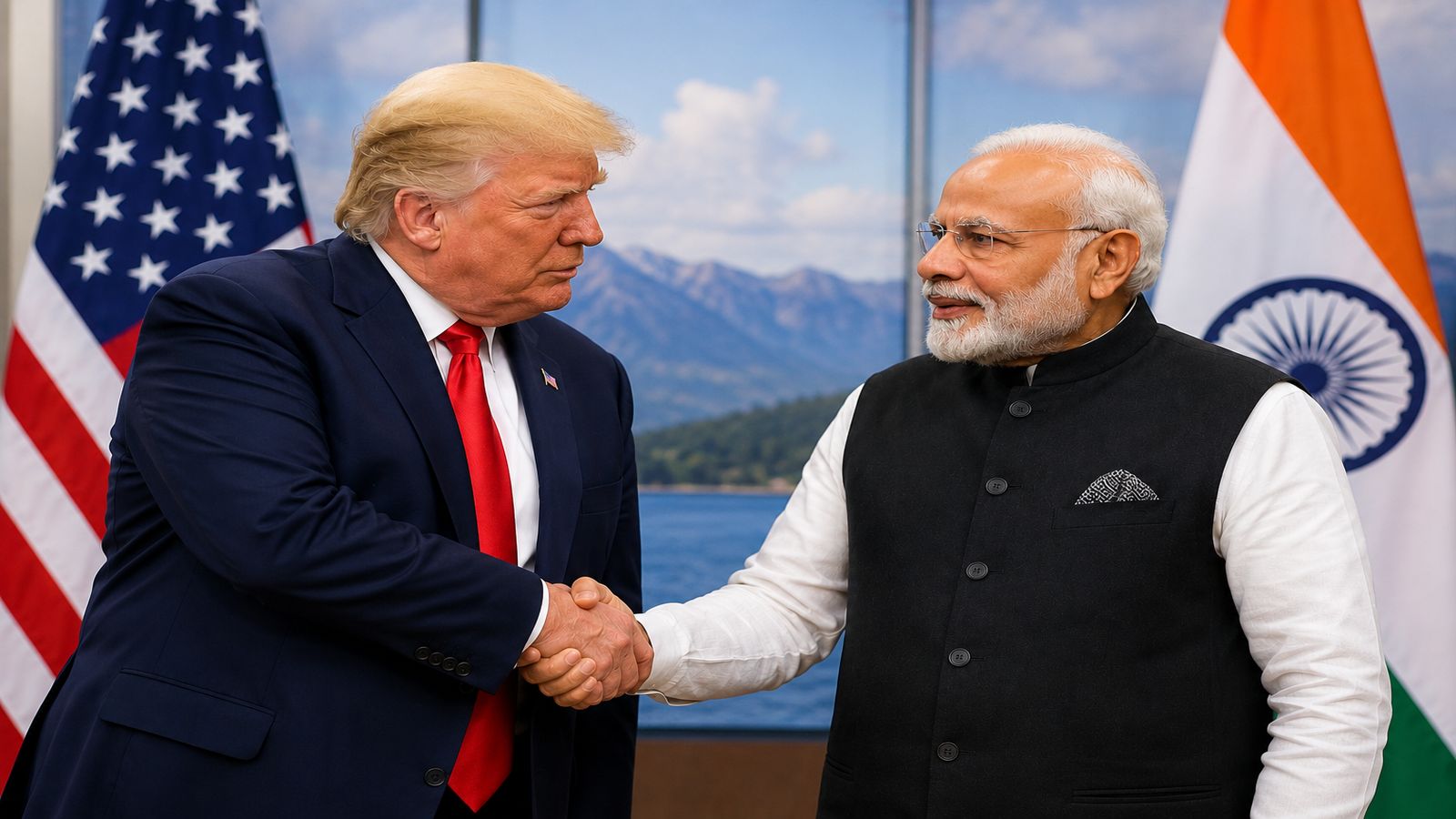
A grand political theater played out on the sidelines of the G7 Summit in Evian, France, where Donald Trump and Narendra Modi declared they are "very close" to a historic bilateral trade agreement. Behind the warm public handshakes and mutual praise lies a more volatile reality. The proclaimed breakthrough remains a fragile framework held together by political convenience rather than economic consensus. Trade negotiators are scrambling to salvage a deal that has been repeatedly upended by shifting tariff regimes, domestic protectionism, and severe geopolitical friction.
The primary query dominating corporate boardrooms in New Delhi and Washington is simple: Will the public camaraderie between these two leaders finally produce a binding trade pact?
The short answer is no, not in the comprehensive form being marketed. While an interim agreement may be signed before July 24 to avoid impending tariff deadlines, the fundamental structural rifts between the two economies remain unresolved. Washington wants deep market access to India’s protected agricultural and technology sectors, while New Delhi refuses to completely abandon its strategic autonomy or its cheap energy supply chains.
The Fiction of ninety nine percent Done
For months, Indian Commerce Minister Piyush Goyal and American officials have insisted that negotiators are merely arguing over commas and full stops, claiming ninety-nine percent of the text is finalized. This narrative ignores a brutal reality. The remaining one percent comprises the entire substance of the dispute.
The structural friction dates back to early 2025, when both leaders launched ambitious negotiations for a Bilateral Trade Agreement. By late 2025, that ambition devolved into economic warfare when Washington slapped punitive tariffs on Indian exports, which briefly hit fifty percent. Though U.S. courts eventually struck down those specific executive orders, the administration pivoted to a blanket ten percent tariff regime. This constant unpredictability broke the momentum of the talks.
The current framework requires India to lower or eliminate tariffs on American industrial goods, medical devices, and information technology hardware. In return, Washington promises to cap its reciprocal tariff rate at eighteen percent. But the fine print reveals that the actual implementation mechanisms are non-existent. A closer look at U.S. Customs directives shows that the harsher, retaliatory tariff rates remain active on Indian goods, regardless of the political rhetoric in France.
The Shadow of the Middle East War
Economic negotiations do not occur in a vacuum, and recent military developments have severely strained the diplomatic trust necessary to finalize an agreement. The ongoing conflict in West Asia has directly harmed Indian economic and human interests. Just days before the Evian summit, three Indian sailors were killed when a U.S. military strike hit a commercial vessel off the coast of Oman.
Modi raised this issue directly during his closed-door meeting with Trump, demanding safety guarantees for Indian seafarers. The wider maritime crisis, sparked by the closure of the Strait of Hormuz, has choked twenty percent of global oil transport and severely impacted the Global South. For India, this has translated into skyrocketing costs for fuel and fertilizers.
"The disruptions in fuel, fertilizer, and food supply chains caused by the crisis will continue to impact the Global South for a considerable period," Modi warned publicly.
This economic pain makes India even less likely to capitulate to Washington’s demands regarding its energy procurement. The U.S. has pressured India to completely cease its purchases of discounted Russian crude oil as a prerequisite for a broader trade partnership. New Delhi considers this demand a direct infringement on its national sovereignty. Indian officials have quietly refused to include explicit energy purchase bans in any official trade text, preferring to preserve their access to cheaper Russian fuel to shield their domestic economy from the global supply shock.
Agriculture and Data Sovereignty
Even if the geopolitical tensions subside, the domestic policy roadblocks are formidable. The American agricultural lobby wields immense influence over Washington's trade policy. U.S. Trade Representative Jamieson Greer, who is scheduled to land in New Delhi for critical talks, carries a mandate to force open India's heavily protected agricultural markets. Specifically, Washington wants unrestricted access for American dairy, poultry, and genetically modified crops.
For the Indian government, opening these doors is a political non-starter. Millions of small-scale farmers form a powerful voting bloc in India, and exposing them to subsidized American agribusiness would trigger domestic chaos.
A similar wall exists in the digital sphere. The current U.S. administration wants to dismantle India's strict data localization laws, which force global tech firms to store Indian user data within national borders. New Delhi views data sovereignty as a security imperative and a tool to cultivate its domestic tech industry. Washington views it as a protectionist barrier designed to penalize American tech companies.
The July Twenty Four Deadline
Time is running out for the negotiators. The temporary ten percent tariff regime implemented by Washington is scheduled to expire on July 24. If an interim deal is not signed by then, both nations face an immediate escalation of trade hostilities.
What is likely to emerge is a watered-down, face-saving mini-deal rather than a comprehensive economic partnership. This interim arrangement will likely reduce tariffs on a handful of non-sensitive industrial goods, make vague promises about future tech cooperation, and defer the real fights over agriculture, digital trade, and energy to an indefinite future.
The public displays of friendship in Evian cannot mask the divergence in national priorities. Trump's transactional approach to foreign policy means that personal warmth is easily discarded the moment domestic industrial numbers look unfavorable. Modi's primary obligation remains protecting India's domestic manufacturing and securing cheap energy, regardless of Washington's strategic preferences.
The upcoming visit of the U.S. Trade Representative to New Delhi will strip away the diplomatic theater. Negotiators will be forced to confront the reality that a genuine, deep trade integration between an isolationist Washington and a protective New Delhi cannot be built on personal chemistry alone. The clock is ticking toward the July deadline, and the corporate world should prepare for an underwhelming compromise rather than an economic revolution.