For decades, the robotics industry has suffered from a lack of imagination. We build machines in our own image or copy our pets. Billions of dollars pour into humanoid assemblies with two legs, two arms, and a distinct front and back, all because executives believe a robot must look like a factory worker to replace one.
It is a design flaw born of vanity.
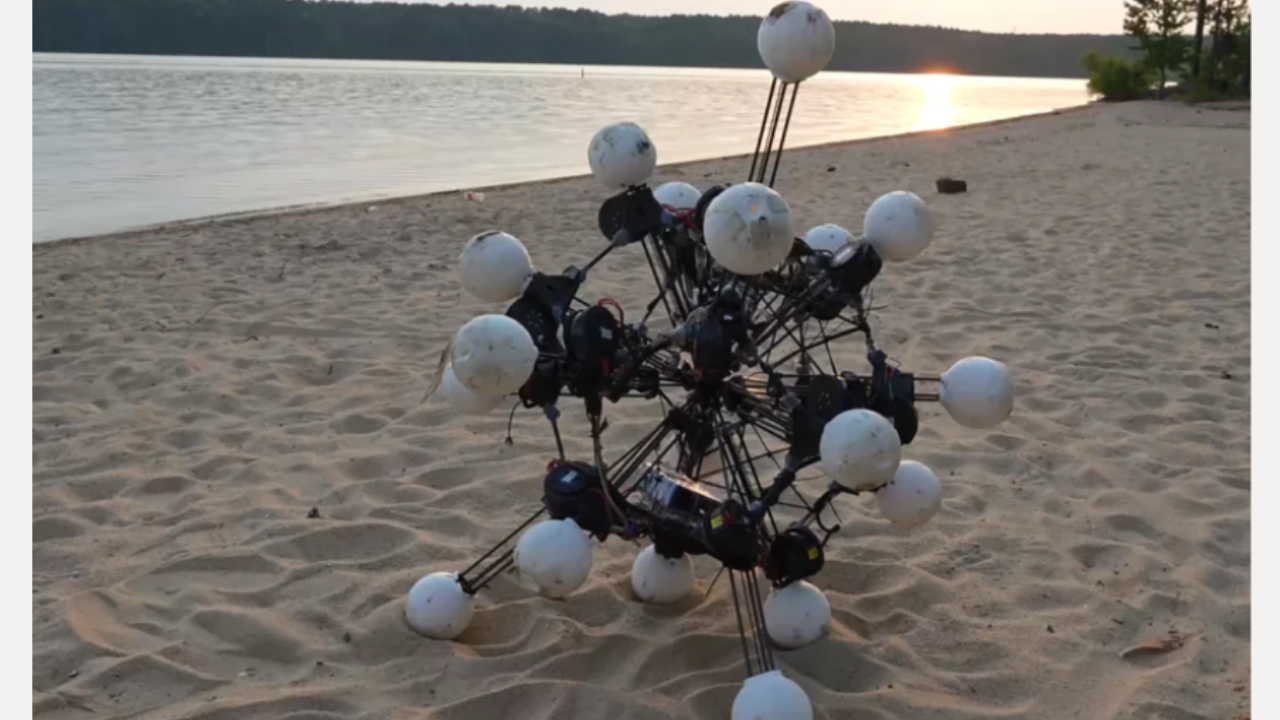
A research team at Duke University's General Robotics Lab recently published a study in Science Robotics that exposes this obsession with biological imitation. They built Argus, a machine composed of 20 telescoping, cable-driven legs radiating from a central core, each tipped with a depth-sensing camera. It looks like a mechanical sea urchin. It has no face, no front, no back, no top, and no bottom.
Argus represents a fundamental break from bilateral symmetry. While tech giants spend massive computing power trying to keep two-legged humanoids from falling over when bumped, this spike-covered sphere eliminates the problem by making direction irrelevant. If you push it, it does not trip. It simply rolls, recalculates, and continues moving at 0.6 meters per second without needing to turn around.
The Tyranny of Directional Design
Most mobile machines are slaves to their orientation. A quadcopter drone must tilt forward to advance. A humanoid must pivot its hips to change direction. A Boston Dynamics dog must turn its entire chassis to face a new threat.
In engineering terms, this is an inefficient way to move through an unpredictable world. When a robot spends energy and time merely orienting its body or its sensors toward an objective, it introduces failure points. If a bipedal robot slips on ice, its control algorithms must rapidly figure out how to swing its specific limbs to catch its center of mass before it hits the ground.
The Duke University team, led by engineering professor Boyuan Chen, doctoral student Jiaxun Liu, and postdoctoral researcher Boxi Xia, approached the problem through pure physics rather than biological mimicry. They developed a metric called dynamic isotropy.
Dynamic isotropy measures how uniformly a machine can accelerate its center of mass in any given direction in a three-dimensional space. The scale runs from 0 to 1. A theoretical perfect sphere that can move instantly in any direction with equal force scores a 1.0.
The industry standard is surprisingly poor. Most advanced quadrupeds, drones, and humanoids score below 0.6 because their mechanics inherently favor forward movement over sideways or backward movement.
Argus scores 0.91.
Robot Design Type        | Dynamic Isotropy Score (0.0 - 1.0)
-------------------------------------------------------------
Standard Humanoid / Drone| Below 0.60
Theoretical Maximum      | 1.00
Argus Prototype          | 0.91
By prioritizing the physics of omnidirectional acceleration over the aesthetics of biology, the researchers bypassed the most complex computational bottlenecks in modern robotics. When a machine can accelerate equally well in any direction, forward and backward cease to exist. The control architecture becomes vastly less complicated because the machine never needs to turn.
The Dodecahedron Geometry
To build a machine capable of a 0.91 isotropy score, the researchers ran more than 1,500 computer simulations testing different leg configurations, ranging from eight limbs to 40.
Adding more legs increases structural uniformity, but it also introduces a massive weight penalty and multiplies mechanical points of failure. The sweet spot turned out to be 20.
The team arranged these 20 identical limbs at the vertices of a regular dodecahedron, a 12-sided geometric solid. This specific layout ensures that no matter how the robot rolls, tumbles, or lands, the distribution of ground-contact points remains almost perfectly uniform.
Actuation and Perception Mechanics
Each of the 20 limbs operates on a cable-driven linear mechanism, allowing them to extend and retract rapidly to push off surfaces, absorb impacts, or alter the robot’s effective diameter.
The true breakthrough is how the machine perceives its environment. Every single leg tip houses its own dedicated depth-sensing camera. Instead of a single "head" containing a limited field-of-view camera that must pan left and right, Argus possesses a spherical sensor array.
Perception and movement are locked in perfect alignment. Wherever a leg can reach, a camera can see. This allowed the prototype to track, approach, and manipulate a one-meter wooden cube while rolling continuously, a task that would require complex coordination between a humanoid’s neck motors, waist joints, and arms.
The Cost of Breaking the Mold
It is easy to look at laboratory footage of a new robot and assume it is ready for deployment. The reality is always messier.
During field tests on the Duke campus, Argus navigated loose gravel, dense foliage, soft sand, and wet bark. It cleared five-inch obstacles and carried a 10-pound payload without significant slowdown. It even demonstrated the ability to climb vertical spaces by wedging itself between two parallel brick walls, using a sequence of bracing and thrusting motions with opposing subsets of legs.
More importantly, it proved highly resilient. When the researchers intentionally disabled three of its 20 legs, the internal control loop redistributed the workload across the remaining 17 limbs. The robot kept moving. Try cutting off a leg or disabling a joint on a humanoid robot, and the machine becomes expensive scrap metal until a technician arrives.
Yet, the sea-urchin design carries distinct disadvantages that its creators openly acknowledge:
- Energy Consumption: Keeping 20 telescoping limbs and 20 individual depth cameras powered simultaneously drains batteries fast. A biped can stand completely still and consume minimal power; a 20-legged sphere must constantly modulate its limbs to maintain a static posture on uneven terrain.
- Mechanical Complexity: While the control software is simplified by the lack of orientation, the physical build is a maintenance nightmare. There are 20 separate cable drives, 20 motors, and 20 lenses exposed to dust, mud, and water at ground level.
- Payload Limitations: Because the robot rolls and changes its ground-contact points constantly, mounting a traditional cargo container or a delicate sensor payload is difficult. The payload must either sit inside the central core—limiting its size—or the robot must use its entire body to push an object, as it did with the test cube.
Beyond Anthropomorphism
The obsession with human-shaped robots is driven by marketing, not utility. Companies want to show off machines that look like sci-fi humanoids because it makes for great promotional videos and attracts venture capital. We are told these shapes are necessary because our world is built for humans.
Argus proves that argument lazy. A search-and-rescue robot navigating the collapsed rubble of an earthquake zone does not need to climb a ladder like a human. It needs to squeeze into shifting gaps, survive crushing tumbles, and push off walls in zero-visibility environments. A planetary rover exploring the low-gravity, jagged caverns of the Moon does not need two feet. It needs to never worry about getting stuck upside down.
By abandoning the requirement that a machine must have a face and a forward stride, the Duke University team did something far more valuable than inventing a quirky prototype. They provided a new yardstick for the entire industry. The future of autonomous exploration will not be defined by how well a machine mimics our walk, but by how effectively it ignores our geometry.