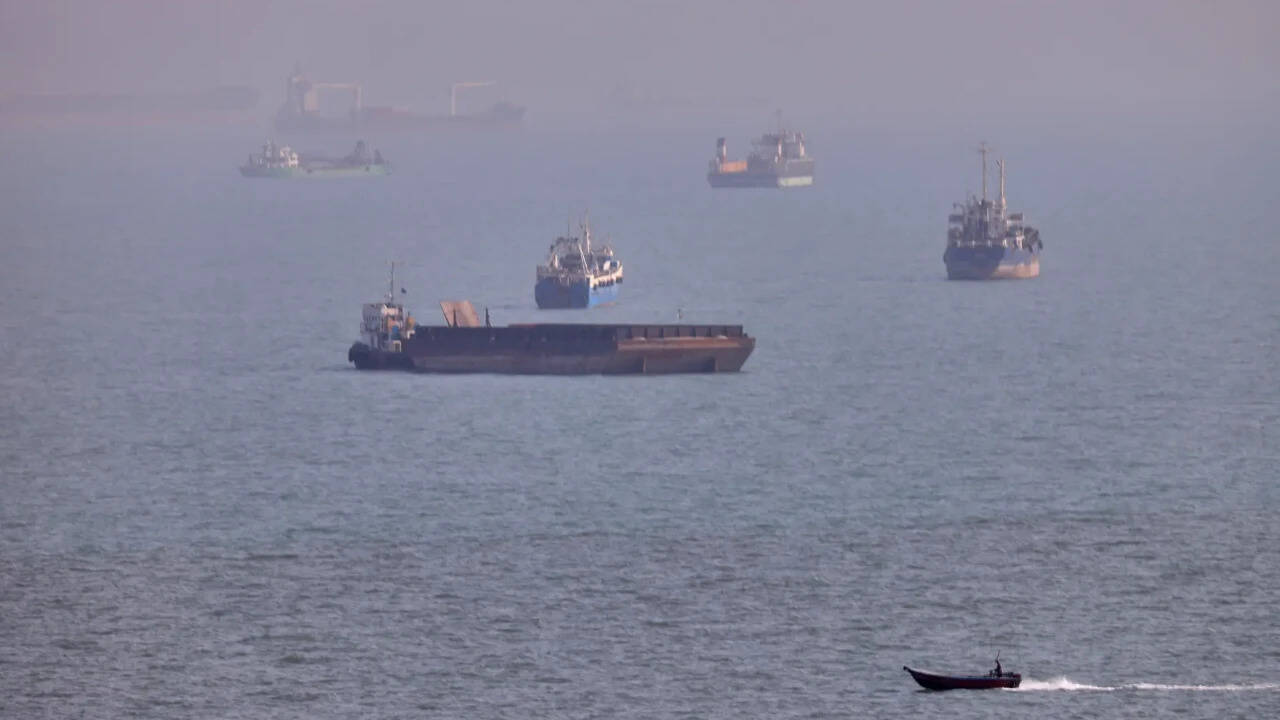
The maritime corridor separating Iran from the Arabian Peninsula has become the world’s most dangerous theater of posturing. While rhetoric from Washington claims absolute dominance over the Strait of Hormuz, the reality on the water tells a story of persistent, localized influence that neither side can fully suppress. President Donald Trump’s recent assertions of "total control" and his promise to declare the waterway United States territory have collided with a grounded, albeit defiant, stance from Tehran. This clash is not merely a diplomatic spat; it is a high-stakes standoff involving the primary artery for roughly 25 percent of the world’s maritime oil trade.
Global markets are currently reacting to a volatile mixture of bravado and naval maneuvering. When a major power declares a "wall of steel" while the opposing state demands transit fees and enforces its own inspection protocols, the result for commercial shipping is a state of perpetual, high-cost uncertainty. Investors are watching closely, as the fundamental issue remains unchanged: despite the presence of foreign naval assets, the geography of the strait provides the party on its northern shore with an asymmetric advantage that cannot be erased by social media pronouncements or maritime blockade alone.
The history of the Strait of Hormuz is defined by its status as an inescapable chokepoint. Unlike other global passages that offer alternative routes, the Persian Gulf has few exits. For nations like Saudi Arabia, Kuwait, and the United Arab Emirates, this narrow strip of water is the only viable path to export the bulk of their energy wealth. For decades, the strategic doctrine of the Islamic Republic has been built around the capability to influence, restrict, or entirely halt this flow. By maintaining a presence that requires tankers to seek permission, Iran has turned a routine passage into a political instrument.
Consider the logistics. A massive crude oil tanker is a slow-moving, vulnerable target. Even with a military escort, a vessel navigating a waterway roughly 21 miles wide at its narrowest point is susceptible to drone technology, fast-attack craft, and naval mines. The "total control" described by the White House ignores this tactical reality. A naval blockade might deter major hostilities, but it does little to prevent the subtler, more disruptive forms of interference that Tehran has mastered. If an Iranian fast-attack craft maneuvers within proximity of a commercial vessel, the legal and safety protocols of international shipping are immediately triggered, forcing a slowdown or an diversion that serves as a victory for the side demanding acknowledgment.
The economic fallout is quantifiable. Since the outbreak of hostilities in February 2026, shipping patterns have shifted dramatically. Data indicates that over 95 percent of transit traffic has been diverted or delayed at various points to avoid potential engagement, leading to immediate spikes in insurance premiums and regional shortages of refined petroleum products. This is not just a military conflict; it is an tax on the global economy. When policymakers speak of "crushing" sanctions or "total control," they are often disconnected from the daily calculations of a ship captain who must weigh the risk of a potential boarding against the massive cost of delaying a multi-million-dollar cargo.
There is a clear disconnect between the rhetoric of total victory and the operational status of the waterway. The 14-point Memorandum of Understanding mentioned by Iranian officials represents a set of conditions that, if ignored, ensure the status quo of tension continues. These demands, which include the lifting of oil sanctions and the release of frozen assets, are presented by Tehran as the only key to a stable passage. Washington, conversely, characterizes these demands as the tactics of a cornered state. The result is a stalemate where neither party is willing to back down, and the maritime industry is forced to operate in the gray area between two conflicting definitions of authority.
The obsession with the "wall of steel" narrative serves a domestic political purpose, providing a sense of security and strength to a voting public concerned about energy prices and national stature. However, in the realm of maritime security, optics do not stop a missile, nor do they clear a minefield. The danger lies in the assumption that superiority in fleet size equates to the ability to dictate terms in a narrow, contested, and hostile environment.
The current escalation has pushed international diplomacy to the sidelines, replacing it with a language of threats and counter-threats. As the midterms approach, the pressure to secure a "win" in the Persian Gulf will likely grow, potentially leading to even more aggressive naval postures. This cycle of escalation creates a feedback loop where each new assertion of control invites a corresponding act of defiance. The world is left to wait, watching the fuel prices rise, while the actual control of the Strait remains trapped in a state of suspended reality, dictated not by who has the most ships, but by who is willing to endure the highest level of risk. The situation will not resolve through declarations of ownership. It will resolve when the cost of maintaining the current standoff exceeds the perceived benefit of the struggle, a point that both sides seem dangerously far from reaching.