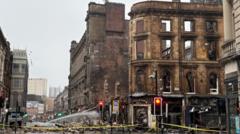
Rain in this city does not just fall. It bleeds into the sandstone. If you stand outside the taped-off perimeter on Union Street, right where the grand 1851 Union Corner building used to anchor the block, you can smell it. Not just the dampness of a classic Scottish afternoon, but something acrid, heavy, and permanently bruised. It is the scent of wet ash, scorched timber, and burned lithium.
Months have passed since the March inferno. Yet, the main entrance to Glasgow Central Station under the Gordon Street canopy remains stubbornly locked.
Commuters don't walk; they detour. They hustle around the corner, heads down against the wind, rerouted through Hope Street like water forced through a broken pipe. The rhythm of the city is off. You can see it in the eyes of the shopkeepers whose footfall vanished overnight. You can hear it in the silence of a street that used to echo with the roar of black cabs and the chatter of thousands of daily travelers.
To the casual observer, the empty space next to Scotland's busiest railway hub is just a construction delay. A line item on a council agenda. A standard, bureaucratic waiting game.
But talk to the people who live the reality of this block, and you quickly learn that the void is much deeper than a hole in the ground. It is a legal, architectural, and emotional labyrinth. And the sobering truth is that this wound in the city center will likely remain open for years to come.
The Day the Clock Stopped
Consider a Sunday afternoon that felt entirely ordinary until it wasn't.
A standard weekend crowd hummed through Union Corner. Then, a spark in a ground-floor vape shop. Within minutes, an ordinary accidental fire transformed into an uncontrollable monster. The culprit was a modern nightmare hidden inside historic walls: lithium-ion batteries entering thermal runaway.
Firefighters arrived rapidly, but the physics were against them. When these batteries fail, they don't just burn; they self-generate heat and flammable gases, fighting back against oxygen deprivation.
The building itself compounded the disaster. From the outside, Victorian commercial architecture looks immortal. The heavy masonry facades project total permanence. But behind those stoic stone faces lies a delicate skeleton of 19th-century timber floors and roof structures. Once the fire ate through the wood, the internal support vanished.
The distinctive Victorian dome collapsed inward. Over 250 firefighters battled the blaze. It took days to fully cool the smoldering carcass of the building.
When the smoke finally cleared, the damage extended far beyond the scorched stone. The heart of Glasgow’s transit network was paralyzed. Trains stopped running. Hotels evacuated. A multi-agency investigation scrambled to find answers.
Emergency crews eventually demolished the highly dangerous remains, leaving nothing but a cleared, vacant gap site and a profoundly unstable western gable wall leaning against the Central Station Hotel. Until that complex wall is stabilized, the safety cordons cannot move. The station cannot breathe. The city cannot heal.
The Paradox of Ownership
Why not just rebuild immediately?
The answer lies in a complex web of modern commerce clashing with historic reality. If Union Corner had belonged to a single entity, the path forward might be straight. But it didn't.
Like many historic urban blocks, the building was a jigsaw puzzle of fragmented titles. One person owned a ground-floor retail unit. Another owned the upper office levels. A third held a leasehold.
Now, imagine sitting in a room with a dozen different property owners, dozens of insurance loss adjusters, independent engineers, and corporate lawyers. Everyone is pointing a finger. Who pays to stabilize a shared wall when the building that supported it is gone? How do you assess liability when the fire started in one specific shop but erased an entire city block?
The legal friction is agonizingly slow. It creates a state of paralysis where no single owner has the capital, the authority, or the incentive to move the first stone.
The Civic Rescue Plan
Recognizing this deadlock, Glasgow City Council floated a radical mechanism: the Compulsory Purchase Order (CPO).
The strategy makes logical sense. By using legal powers to forcibly buy out the fractured landowners, the city can take public control of the cleared site. Once the ground is unified under a single entity, a masterplan can finally begin. Ideas have already been tossed into the wind, including whispers of a five-star hotel to fill the city’s high-end tourism deficit.
But a CPO is not a magic wand. It is a slow, legal sledgehammer.
Every single property owner has the right to object, to negotiate, and to drag the process through the courts to maximize their payout. The council is already stretched thin, fighting a parallel, multi-year CPO battle down the street to save the historic Egyptian Halls. Adding Union Corner to the docket multiplies the strain on an already overburdened municipal system.
Even with a massive ten-million-pound recovery package backed by the Scottish Government, money cannot buy speed in a court of law.
The Invisible Stakes
Meanwhile, the true cost of the delay is paid by the people who rely on this street for their survival.
Think of a hypothetical independent coffee shop owner just outside the immediate cordon. Let’s call her Fiona. For ten years, Fiona’s business model relied entirely on the morning rush exiting the Gordon Street canopy. She knew the exact timing of the commuter trains by the sudden surge of people through her front door.
Today, those people are routed blocks away. Her revenue didn’t just drop; it plummeted. The council’s temporary fire recovery fund provided a brief lifeline to dozens of local businesses, but that money is gone.
Fiona looks out her window at the empty space and the chain-link fences. She isn't thinking about a five-star hotel or a masterplan for 2030. She is wondering if she can pay rent next month.
The upcoming Commonwealth Games mean visitors will pour into Glasgow Central Station. They will step off the trains and be funneled away from the historic main entrances, greeted instead by detours, scaffolding, and a raw gap site. It is a bruising introduction to a city that prides itself on its architectural grandeur.
Preserving a Ghost
Then comes the architectural dilemma. What should rise from the ashes?
Heritage bodies like Historic Environment Scotland hold immense sway. Union Corner was a B-listed gem. There will be intense, passionate pressure from preservationists to recreate the original Victorian facade stone by stone, restoring the lost dome to the skyline.
But leading architects argue that replicating the past is a mistake. They see an opportunity for a sensitive, modern intervention that respects the scale of Central Station but reflects the century we actually live in.
This philosophical debate will take months, if not years, of public consultations, design competitions, and planning committee arguments. Every sketch will be scrutinized. Every window placement will be debated.
A Final Chord
Walk down to the Hope Street entrance at dusk. Watch the commuters rush to catch the late train back to the suburbs. They walk past the closed doors, past the signs directing them away from the ghost of Union Corner.
The great masonry walls of Glasgow Central Station still stand, solid and monumental. But just past the edge of the stone, where a masterpiece of 1851 craftsmanship once met the sky, there is only gray space.
The true tragedy of the Union Corner fire isn't just the afternoon the building fell. It is the realization that the systems we have built to manage our cities—our insurance policies, our property laws, our bureaucratic processes—are fundamentally unsuited for the speed of modern recovery.
Until the lawyers finish arguing, until the council secures the deeds, and until the engineers stabilize the fragile gables, Glasgow must learn to live with a hole in its heart. The rain will continue to fall, washing the ash deeper into the pavement, while a vital corner of the city waits for a future that remains frustratingly out of reach.


:max_bytes(150000):strip_icc():focal(665x0:667x2)/gettyimages-50733149-2000-8b129a2475974982a915418ce92a73d8.jpg)