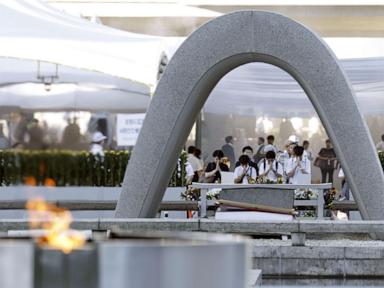
Seventy-one years after the morning sky tore open over the Motoyasu River, the peace park in Hiroshima fills with white chrysanthemums and the slow, heavy toll of the Peace Bell. Dignitaries bow. Choirs sing of a world without borders. Mayors read declarations drafted with the careful syntax of diplomatic survival. Then the crowds disperse, the television vans pack their cables, and the nuclear arsenals sit quietly in their silos, ticking away beneath the Nevada desert, the Barents Sea, and the central steppes of Asia.
This annual ritual of remembrance has become an exercise in institutional denial. On the eighty-first atomic bomb anniversary, Hiroshima Mayor Kazumi Matsui stood before the cenotaph and issued another stark warning against the accelerating pursuit of nuclear weapons by global superpowers. His words were sharp. They were also entirely predictable. Every August sixth, the international community nods solemnly at the survivors—the aging hibakusha whose skin still tells the story of thermal radiation—and then returns to the business of modernization programs worth trillions of dollars.
We have perfected the art of mourning the tragedy while funding the capability. The core reality of global security today is not that leaders have forgotten Hiroshima. It is that they have decided the math of deterrence outweighs the memory of ash.
To understand why nuclear weapons remain the ultimate currency of power, we have to look past the moral rhetoric of the annual peace declarations. The architecture of global stability rests on a grim foundation built during the Cold War. Mutually Assured Destruction was never a moral philosophy. It was an economic and strategic standoff. Two massive blocs realized that pushing the button meant national suicide, so they built thousands of warheads to ensure that nobody could win a first strike without inviting total annihilation.
That logic created a perverse kind of stability for half a century. Borders in Europe remained frozen. Proxy wars raged across the Global South, but Washington and Moscow never traded direct blows. When the Soviet Union collapsed, policymakers hoped the stockpiles would follow. Treaties were signed. Warheads were dismantled in converted factories where American and Russian technicians shared coffee and smoked cigarettes in old hangars.
That momentum died quietly. Today, every single nuclear-armed state is upgrading its arsenal. The United States is executing a multi-decade modernization plan projected to cost upwards of $1.5 trillion. Russia has integrated tactical nuclear doctrine into its conventional military exercises. China is expanding its silo fields at an unprecedented rate, transitioning from a minimal deterrent posture to a triad capable of prompt retaliation. India and Pakistan eye each other across the Line of Control with hair-trigger readiness, while North Korea tests solid-fuel intercontinental ballistic missiles designed to evade early warning radar.
The pursuit of nuclear weapons has not slowed down. It has accelerated under the cover of geopolitical friction.
The structural failure of international non-proliferation treaties is rooted in an inherent contradiction. The Nuclear Non-Proliferation Treaty, signed in 1968, was designed as a grand bargain. The five original nuclear powers—the United States, Russia, the United Kingdom, France, and China—promised to pursue disarmament in good faith. In exchange, non-nuclear states agreed never to acquire the bomb.
Nearly sixty years later, the non-nuclear nations look at Washington and Moscow and see hypocrisy codified into international law. The five recognized powers demand that Iran and North Korea abandon their enrichment programs while simultaneously investing billions in next-generation warheads, hypersonic delivery systems, and stealth bombers. From Tehran or Pyongyang, the message from the West sounds less like a principle and more like a monopoly.
When international law becomes a tool for preserving the military advantages of the strong, compliance erodes. Regional powers calculate that holding a handful of warheads is the only reliable insurance policy against regime change. Look at the ledger of the twenty-first century. Leaders who gave up their unconventional weapons programs, such as Saddam Hussein in Iraq or Muammar Gaddafi in Libya, were eventually removed by foreign military intervention. Leaders who built the bomb, such as Kim Jong Un, sit at negotiating tables as equals with American presidents.
That is the brutal lesson taught by modern statecraft. Proliferation is rationalized by the very failures of the disarmament framework.
The technical landscape of modern warfare has also stripped away the margins of safety that protected humanity during the twentieth century. During the Cuban Missile Crisis, leaders had hours—sometimes days—to interpret ambiguous radar contacts and debate diplomatic off-ramps. Today, the integration of automation and artificial intelligence into early-warning systems has compressed decision-making windows to minutes.
Hypersonic glide vehicles travel at Mach 5 or faster, maneuvering unpredictably in the upper atmosphere. They defeat traditional missile defense tracks and leave national leaders with virtually no time to verify whether an incoming blip on a screen is a flock of geese, a computer glitch, or a devastating first strike. When response times drop to under ten minutes, the doctrine of launch-on-warning becomes the default operational mode.
We have engineered a global security apparatus where a false alarm in a subterranean bunker outside Colorado Springs or Kaliningrad could end civilization before morning coffee. The margin of error has shrunk to zero, yet the number of fingers near the button is multiplying.
Financial incentives drive this machinery just as much as geopolitical paranoia. The nuclear enterprise is sustained by a vast industrial complex spanning defense contractors, research laboratories, and congressional districts where high-tech manufacturing jobs depend on military contracts.
When a defense contractor designs a new intermodal ballistic missile system, the supply chain spans dozens of states. Subcontractors supply guidance chips, titanium casings, and telemetry software. Local economies thrive on the steady cash flow of national security appropriations. Politicians across the political spectrum fight to protect these projects because canceling a missile program means closing factories and laying off constituents.
This creates an entrenched constituency for armaments. The weapons build themselves through the sheer momentum of bureaucratic self-preservation. Bureaucracy does not require an active enemy to justify its budget; it only requires the perpetual management of risk. Every new threat report from the intelligence agencies becomes justification for another tranche of funding, ensuring that the infrastructure of annihilation remains well-fed, innovative, and permanent.
The survivors of Hiroshima understand this better than anyone, which is why their warnings carry such heavy gravity. Every year, their numbers dwindle. The generation that walked through the firestorm of August 1945 is vanishing into history. Soon, there will be no living voice left to describe the shadows burned into stone by the flash of the uranium core known as Little Boy.
When the last witness is gone, the memory of Hiroshima risks turning into a footnote in a history textbook, stripped of its visceral horror. It becomes an abstraction, a date on a calendar, a historical data point rather than a human catastrophe.
That cultural forgetting is already underway. Younger generations, raised in the shadow of digital anxieties and climate disruptions, often view nuclear war as a relic of a bygone century, akin to trench warfare or biplanes. They do not realize that the global stockpile currently stands at roughly twelve thousand warheads, many of which possess explosive power hundreds of times greater than the device that leveled Hiroshima.
The danger is not merely that we will repeat history. The danger is that we have become bored with the catastrophe. We have normalized the existence of weapons that can render the northern hemisphere uninhabitable within hours. We have accepted the permanent presence of doomsday machines as the cost of doing business in a dangerous world.
Until we confront the economic interests, the systemic hypocrisy of non-proliferation laws, and the terrifying velocity of automated warfare, the annual ceremonies in Hiroshima will remain what they are today: quiet rehearsals for a disaster we continue to finance.