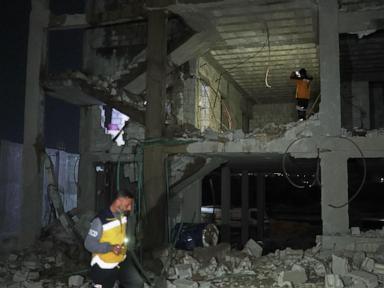
The asphalt smells of summer heat and old diesel. If you stand on the shoulder of the M5 highway near Hama, the silence is heavy, punctuated only by the occasional rattle of a long-haul truck. Ten years ago, this stretch of road was a graveyard of twisted metal and scorched earth. Today, it is a business plan.
Syria is a country that has been defined by its borders—how they were broken, how they were defended, and who held the keys to the gates. For over a decade, the world looked at this patch of the Levant and saw a dead end. A black hole on the map. But as the fire spreads to neighboring Lebanon and the regional chess board is kicked over, the unthinkable is happening. Damascus is dusting off its transit maps. The pariah state is re-branding as the bridge.
Consider a driver named Omar. He is a hypothetical composite of the men currently navigating the route from the Jordanian border to the Mediterranean coast. Omar doesn't care about geopolitics. He cares about the weight of his cargo and the number of checkpoints between him and his paycheck. Five years ago, Omar would have laughed at the idea of driving a commercial load through the heart of Syria. Now, he checks his mirrors, shifts gears, and watches the skeleton of a bombed-out apartment complex recede in his rearview. He is part of a quiet, desperate experiment: Can a war-zone become a corridor?
The Geography of Necessity
Geography is a stubborn thing. You can bomb a city into dust, but you cannot move the mountains or the sea. Syria sits at the literal crossroads of three continents. To the south lies the Gulf, brimming with goods and capital. To the north sits Turkey, the gateway to Europe. To the west, the Mediterranean ports of Lattakia and Tartous offer a window to the world.
When the regional conflict escalated recently, traditional routes began to choke. Flights were canceled. Ports became targets. Suddenly, the long, scarred roads of Syria looked less like a threat and more like a shortcut. The Syrian government, sensing a shift in the wind, began to pitch itself as the "safe" alternative. It is a grim irony. The very state that was synonymous with chaos for a generation is now marketing its hard-won, iron-fisted stability to international logistics firms.
This isn't about peace. It’s about the brutal math of trade.
The Invisible Stakes of the Toll Booth
For the authorities in Damascus, this transition from a battlefield to a thoroughfare is the ultimate play for legitimacy. Every truck that passes through the Nasib crossing on the Jordanian border is a micro-victory. It’s a stamp in a passport. It’s a fee paid in hard currency.
The stakes are invisible but massive. If Syria can prove it can protect a convoy of grain or electronics, it begins to chip away at the sanctions that have strangled its economy. It turns "safety" into a commodity. But this safety is a fragile thing, built on the presence of multiple foreign armies and a delicate balance of power. The road is open, but the shadows are long.
Think about the cost of a detour. When a regional war flares up, shipping insurance premiums skyrocket. Ships have to sail around entire peninsulas. Trucks have to wait for weeks at bottled-up borders. In that environment, a regime that can promise a straight line across the map suddenly has a product to sell.
A Landscape of Contradictions
To drive across Syria today is to move through a collage of eras. One moment, you are passing a shiny new gas station with digital displays. The next, you are rolling past a field where a rusted tank has become a trellis for wild vines.
The people living along these corridors watch the trucks go by with a mixture of hope and profound exhaustion. They see the containers marked with foreign logos and wonder if any of that wealth will ever stop. For the shopkeeper in a village outside Homs, a functioning highway means the possibility of oranges from the coast or spare parts from the north. It means the world is leaking back in, even if it’s just passing through at sixty miles per hour.
We often talk about reconstruction as a series of grand contracts and architectural renderings. The reality is much smaller. It is the sound of a tire hitting a pothole and the sight of a laborer filling that hole with gravel. It is the slow, grinding return of the mundane.
The Risk of the Open Road
The danger hasn't vanished; it has simply changed shape. The threat is no longer a front line moving toward you. It is the unpredictability of a regional shadow war. An airstrike on a nearby depot. A sudden closure of a mountain pass. A shift in the political winds in a capital a thousand miles away.
The Syrian government is betting that the world's desire for efficient trade will outweigh its memory of the last decade. It is a gamble on amnesia. They are counting on the fact that, eventually, the ledger always beats the headline.
Behind the official statements about "regional integration" and "logistics hubs," there is the human reality of the road. There is the grease on a mechanic's hands in a roadside shop. There is the steam from a plastic cup of tea held by a driver waiting for his paperwork to be cleared. These people are the ones actually building the corridor, one mile at a time, through a land that is still healing, still mourning, and still very much on edge.
The M5 is no longer just a supply line for the military. It is a vein attempting to carry blood back into a body that has been cold for a long time. Whether the heart can actually start beating again is a question that won't be answered by a press release. It will be answered by the thousands of Omars, shifting into fifth gear, keeping their eyes on the horizon, and hoping the road holds together just long enough to reach the other side.
The dust settles on the ruins, but the wheels keep turning. It is the most human of instincts: to find a way through, even when the world says there is no way back.


