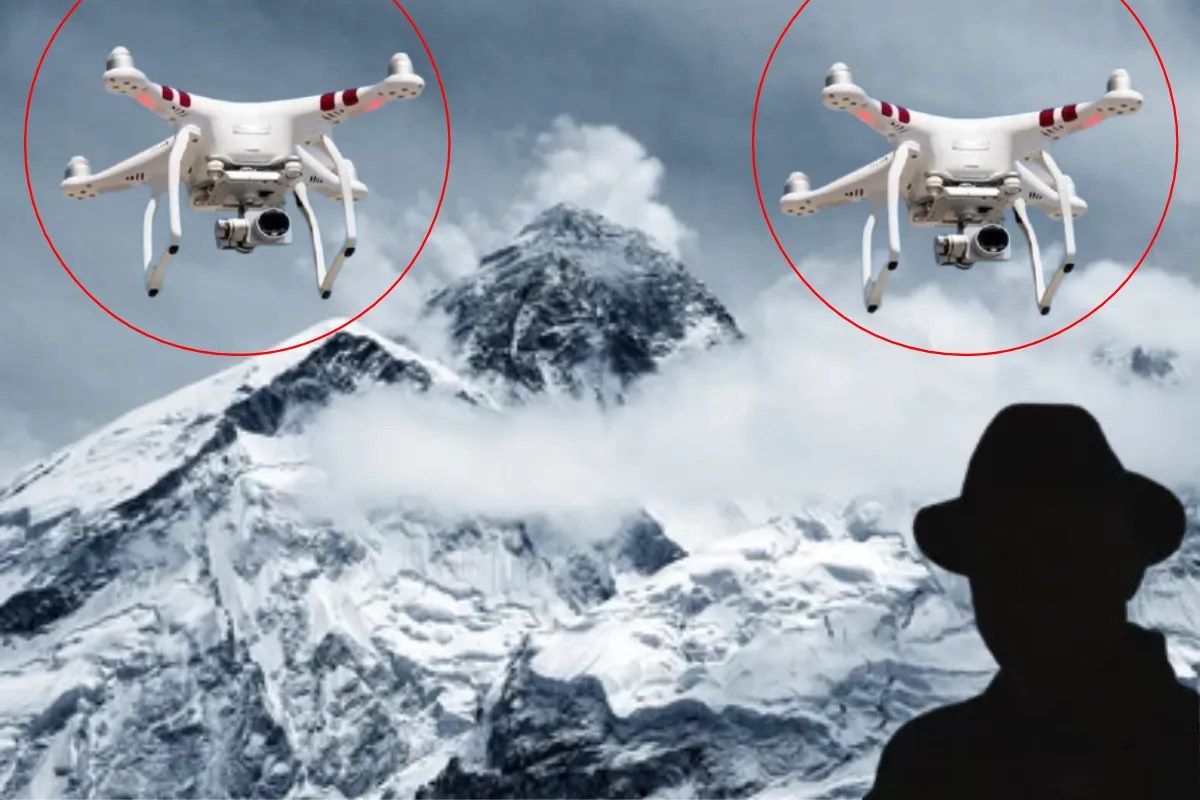
The deployment of unmanned aerial vehicles (UAVs) in the Himalayas represents a fundamental shift in regional power dynamics, moving from static border observation to active aerial dominance. While media narratives often focus on the "competition" between India and China within Nepal's borders, the technical reality is defined by a race to solve the aerodynamic and thermal constraints of high-altitude operations. The utilization of heavy-lift drones for Mount Everest logistics—specifically the DJI FlyCart 30—is not merely a commercial milestone; it serves as a live-fire demonstration of logistics capabilities that can be instantly weaponized or utilized for surveillance in terrain where traditional rotorcraft face catastrophic lift-loss.
The Aerodynamic Constraint and the Thin-Air Power Gap
The primary challenge of operating drones in Nepal, specifically on Everest, is the air density. At the Everest Base Camp (approx. 5,364m) and higher, the atmosphere is roughly 50% thinner than at sea level. This creates a "lift deficit" that forces manufacturers to redesign propulsion systems.
The Physics of High-Altitude UAV Operation
- Rotor RPM vs. Battery Thermal Management: To generate sufficient lift in thin air, drone rotors must spin at significantly higher revolutions per minute (RPM). This increases the discharge rate of lithium-polymer batteries, generating internal heat even as external temperatures drop below -20°C.
- The Payload-to-Power Ratio: Every gram of oxygen-deprived air becomes a precious resource for lift. The transition of drones from photography tools to "sherpa-drones" capable of carrying 15kg payloads across the Khumbu Icefall demonstrates that battery density and motor efficiency have finally crossed the threshold of operational viability at 6,000m+.
- Electronic Speed Controller (ESC) Sensitivity: Sudden gusts in the Himalayan wind tunnels require instantaneous motor adjustments. The latency in these adjustments determines whether a drone maintains its hover or enters a vortex ring state, leading to a total loss of control.
By establishing a drone logistics corridor on Everest, Chinese-manufactured technology is effectively mapping the thermal and wind patterns of the world’s most difficult terrain. This data is dual-use; the algorithms that help a drone carry trash down from Camp 1 are the same algorithms required to deliver a tactical sensor package to a remote mountain pass.
The Three Pillars of Geographic Encirclement
Nepal’s positioning between two nuclear powers—India and China—makes its airspace a laboratory for "gray zone" tactics. These are operations that remain below the threshold of open conflict but effectively change the status quo on the ground.
1. Infrastructure as a Proxy for Presence
China’s "Belt and Road" initiatives in Nepal often involve digital and physical infrastructure that facilitates drone operations. Building 5G base stations near the Everest region is not just for mountaineers; it provides the high-bandwidth, low-latency backbone required for FPV (First Person View) drone operations and real-time data relay to remote command centers.
2. The Indian Response and the "High-Altitude Buffer"
India’s security apparatus views drone proliferation in Nepal as a direct threat to its "open border" policy. Because the Indo-Nepal border is porous, the deployment of long-endurance drones on the northern side allows for a depth of surveillance that reaches far into the Gangetic plains. India is forced into a reactive cycle, investing in anti-drone systems (C-UAS) and indigenous high-altitude platforms like the 'Nagastra' loitering munitions to maintain a balance of power.
3. The Sovereignty Vacuum in Kathmandu
Nepal lacks the regulatory framework to monitor, identify, or intercept advanced UAVs in its high-altitude regions. This creates a "sovereignty vacuum." When a foreign-made drone flies over Everest, the Nepalese state has limited capacity to verify if the data harvested is environmental or military. This inability to police the sky effectively cedes control of the vertical dimension to the hardware providers.
The Cost Function of Human vs. Machine Logistics
The economic incentive to replace human labor with drones in the Himalayas is immense, yet it introduces a new variable into the regional security equation: the devaluation of traditional mountain warfare skills.
- The Sherpa Paradox: While drones reduce the death toll among high-altitude porters by taking over the dangerous Khumbu Icefall crossings, they also eliminate the primary economic leverage of the local population.
- Operational Attrition: A drone lost in a crevasse is a capital loss; a human lost is a geopolitical and humanitarian crisis. Military planners now favor the "attritable" nature of drones, allowing for high-risk surveillance missions along the Himalayan frontier that would have been unthinkable with manned helicopters like the HAL Dhruv or the Eurocopter AS350.
The shift toward drone-led logistics reduces the "political cost" of border incursions. If a drone is shot down, there is no pilot to repatriate and no body to recover, lowering the barrier for aggressive reconnaissance.
Technical Vulnerabilities and the Electronic Warfare Frontier
As drones become the backbone of Himalayan logistics and surveillance, the mountains become a theater for electronic warfare (EW). The reliance on GNSS (Global Navigation Satellite Systems) like GPS or BeiDou for mountain navigation creates a single point of failure.
Signal Reflection and Multi-Path Errors
In deep Himalayan valleys, satellite signals bounce off rock faces, causing "multi-path errors" where a drone perceives its position incorrectly by tens of meters. This makes precise landing and narrow-canyon flight nearly impossible without high-end Inertial Navigation Systems (INS).
The Spoofing Threat
The strategic "fog of war" in the region is now being augmented by GPS spoofing. A competitor can broadcast a fake signal that convinces a drone it is 500 meters away from its actual location, leading it to crash into a mountainside or stray into "enemy" airspace. This is a non-kinetic way to enforce a no-fly zone without firing a single missile.
The Structural Realignment of Himalayan Security
The "war for the Everest sky" is not a future possibility; it is a current operational reality. The transition from manual climbing to automated flight signifies the end of the Himalayas as a natural barrier.
- Vertical Encroachment: Borders were historically defined by ridges. Drones render these ridges obsolete, allowing for "vertical encroachment" where influence is projected over the ridge without a single soldier crossing the line.
- Data Colonialism: The entity that controls the most accurate 3D maps of the Himalayan peaks—captured via drone photogrammetry—controls the movement of all future autonomous systems in the region.
- The Proliferation of Loitering Munitions: The technology used for delivering oxygen cylinders to Camp 4 is 90% identical to the technology needed for a "kamikaze" drone. The modular nature of modern UAVs means a cargo drone today can be a strike platform tomorrow with a simple software update and a payload swap.
The strategic play for Nepal is no longer about balancing land-based diplomacy between Delhi and Beijing. It is about establishing "Electronic Sovereignty." To maintain its relevance, Nepal must demand control over the data streams generated by these drones and implement a mandatory transponder system for all high-altitude flights. Failure to do so will result in the Everest region becoming a permanent testing ground for foreign autonomous systems, where the "owner" of the mountain is whoever owns the frequency.
The next phase of this conflict will move from heavy-lift cargo to swarm intelligence. Large numbers of small, interconnected drones will soon be able to map entire glacial systems or monitor troop movements with a persistence that no satellite can match. This creates a permanent, unblinking eye over the world's highest peaks, fundamentally altering the concept of privacy and military secrecy in the high Himalayas.