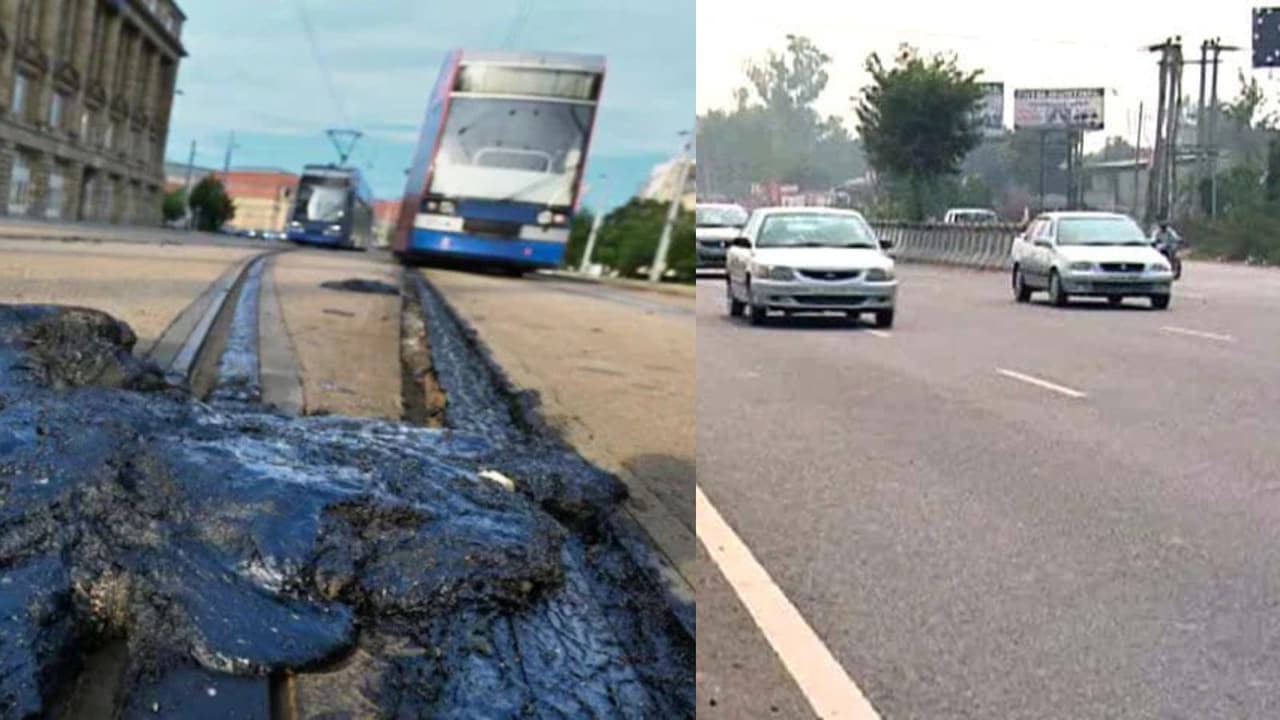
The sight has become a regular fixture of the British summer. Strips of tarmac turning into black, sticky goo under a sun that would barely register as a warm day in New Delhi or Dubai. When temperatures in the United Kingdom crept toward 40 degrees Celsius in recent summers, the national infrastructure began to visibly dissolve, prompting a wave of public bewilderment. Why does a nation with one of the world's oldest engineering traditions watch its highways liquefy at temperatures that other countries handle without a single traffic delay?
The answer is not a matter of engineering incompetence. It is an deliberate calculation of probability, economics, and chemistry. Roads are not universally built to withstand the elements; they are customized to a specific climate profile. For over a century, the UK built its network to survive prolonged, damp winters and mild summers. When the baseline of that climate profile shifts, the physical chemistry of the road surface fails by design.
To understand why British roads fail while Indian highways endure, one has to look beneath the surface at the hidden calculus of bitumen binders.
The Chemistry of the Softening Point
Roads are essentially a recipe of aggregate—crushed rock and gravel—held together by a glue called bitumen. Bitumen is a byproduct of crude oil refining, and it is highly temperature-sensitive. It is a viscoelastic material, meaning it behaves like an elastic solid when cold and a viscous liquid when hot.
Engineers select the grade of bitumen based on a metric known as the softening point. This is the temperature at which the binder loses its rigidity and begins to flow.
In the UK, the standard grade of bitumen used for decades was chosen to handle an average temperature range of minus 5 to around 25 degrees Celsius. The resulting asphalt has a softening point hovering around 50 degrees Celsius. That sounds high enough to withstand a 40-degree day, but air temperature is a deceptive metric.
Asphalt is a dense, black material. It absorbs roughly 90 percent of the solar radiation hitting it. On a day when the air thermometer reads 35 degrees Celsius, the solar radiation can easily push the surface temperature of the pavement past 50 or 60 degrees. Once the pavement crosses that threshold, the bitumen liquefies. The aggregate loses its structural grid. Heavy truck tires pull the aggregate apart, creating dangerous grooves, ruts, and bleeding—the term engineers use when pure oil seeps to the surface.
Contrast this with the engineering matrix used in places like India. There, highway authorities routinely face ambient temperatures exceeding 45 degrees Celsius, translating to pavement temperatures that regularly cross 70 degrees.
To prevent total structural failure, Indian road networks utilize much harder bitumen grades, often modified with polymers or waste plastics. These polymer-modified binders push the softening point well beyond 70 or 80 degrees Celsius. The roads remain rigid under intense heat because the chemical cross-links within the binder resist thermal deformation.
The Cold Weather Penalty
If the fix is as simple as switching to a harder binder, the obvious question is why the UK does not simply adopt Indian standards. The barrier is a phenomenon known as thermal cracking.
Engineering is an exercise in compromise. When you alter bitumen to resist extreme heat, you fundamentally sacrifice its performance in the cold. A road built to survive a Rajasthan summer would shatter during a Scottish winter.
Harder binders become incredibly brittle when the temperature drops toward freezing. As the ground expands and contracts with winter moisture and frost, a brittle road cannot flex. Instead, it cracks. Water enters those cracks, freezes, expands, and blows the road apart from the inside out, creating the potholes that already plague British motorists every spring.
For the last fifty years, British transport planning operated on a simple statistical bet. It was cheaper to patch the occasional melted road during a rare heatwave than it was to rebuild the entire network with a harder binder that would crack to pieces every winter.
The Economic Inertia of Retrofitting Infrastructure
The UK has roughly 250,000 miles of paved roads. Replacing the top layer of this network is not a project achieved by passing a new regulatory policy. It requires a massive deployment of capital and carbon emissions.
Road construction involves scraping away the existing worn surface—a process called milling—and laying down a fresh hot-mix asphalt layer. This requires specialized crews, heavy machinery, and massive amounts of energy to heat the mix to over 150 degrees Celsius before application. Given the state of local council budgets across the UK, widespread preventative resurfacing is an impossibility.
Local authorities are caught in a cycle of reactive maintenance. They spend their limited funds repairing existing damage rather than upgrading roads to survive future climate baselines. The result is a network running on borrowed time, using materials specified for a climate that no longer exists in Western Europe.
Changing the Mix Specifications
The regulatory framework is slowly beginning to shift, though the public rarely sees the mechanics of it. National Highways, the body responsible for England's motorways and major A-roads, updated its design standards to mandate harder binders like the 40/60 penetration grade for major projects, moving away from softer options.
These newer mixes are designed to offer a slightly wider performance window, utilizing chemical additives that attempt to preserve low-temperature flexibility while elevating the softening point. However, these premium materials come with a steep cost premium. When local authorities look at their budgets, they are frequently forced to choose between laying a mile of climate-resilient asphalt or two miles of standard, vulnerable mix to cover more ground.
There is also the challenge of the underlying road base. Many of Britain’s local roads evolved organically from old coaching routes. They lack the thick, engineered structural foundations found under modern Indian highways or the German Autobahn. When the surface layer softens on a road with a weak foundation, the failure cascades all the way down to the sub-base, requiring a full reconstruction rather than a simple resurface.
The Mirage of Alternative Solutions
Every time a road melts, public commentary fills with suggestions for quick fixes. Some suggest painting the roads white to reflect solar radiation, pointing to micro-trials conducted in cities like Los Angeles.
This approach fails to scale for high-speed, heavy-traffic networks. Reflective coatings wear off quickly under the friction of heavy freight tires, requiring constant reapplication that creates endless maintenance bottlenecks. Furthermore, the glare from highly reflective road surfaces introduces significant safety hazards for drivers during long, bright summer days.
Others point to the use of concrete. Concrete roads do not melt; they are highly resistant to thermal deformation because concrete is a rigid material bound by cement, not oil.
Yet concrete highways present a different set of liabilities for the British context. They are significantly more expensive to install initially, they generate substantial road noise that violates strict UK environmental noise regulations in populated areas, and they are prone to joint failures under extreme temperature swings if not laid with precise expansion gaps. The UK transport network tried concrete sections in the mid-twentieth century and spent subsequent decades overlaying them with asphalt to mitigate noise and maintenance issues.
The Real Cost of Climate Friction
The melting of British roads is a visible symptom of a broader structural issue facing legacy infrastructure across the Western world. Systems designed with high precision for stable, predictable weather bands cannot handle an increase in climatic volatility.
The financial calculation is shifting from the cost of materials to the cost of systemic disruption. When a major motorway lane melts, the economic damage is measured in hours of lost productivity, delayed freight, and emergency closure costs. The reactive approach to infrastructure management is becoming more expensive than the proactive upgrade.
National networks require a fundamental reassessment of how risk is calculated. Continuing to build for the historical average ensures that infrastructure will fail during the new extremes.
The path forward requires an acceptance that the old specifications are obsolete. Highways must be engineered for the maximum thermal thresholds of the future, even if that means funding shorter stretches of road at higher costs. Motorists will have to accept that the road surfaces of the coming decades will look, feel, and sound different as engineers balance the delicate chemistry of cold-weather flexibility against the reality of intense summer radiation. The cost of failing to adapt this chemical formula is a transportation system that literally dissolves when the sun comes out.


