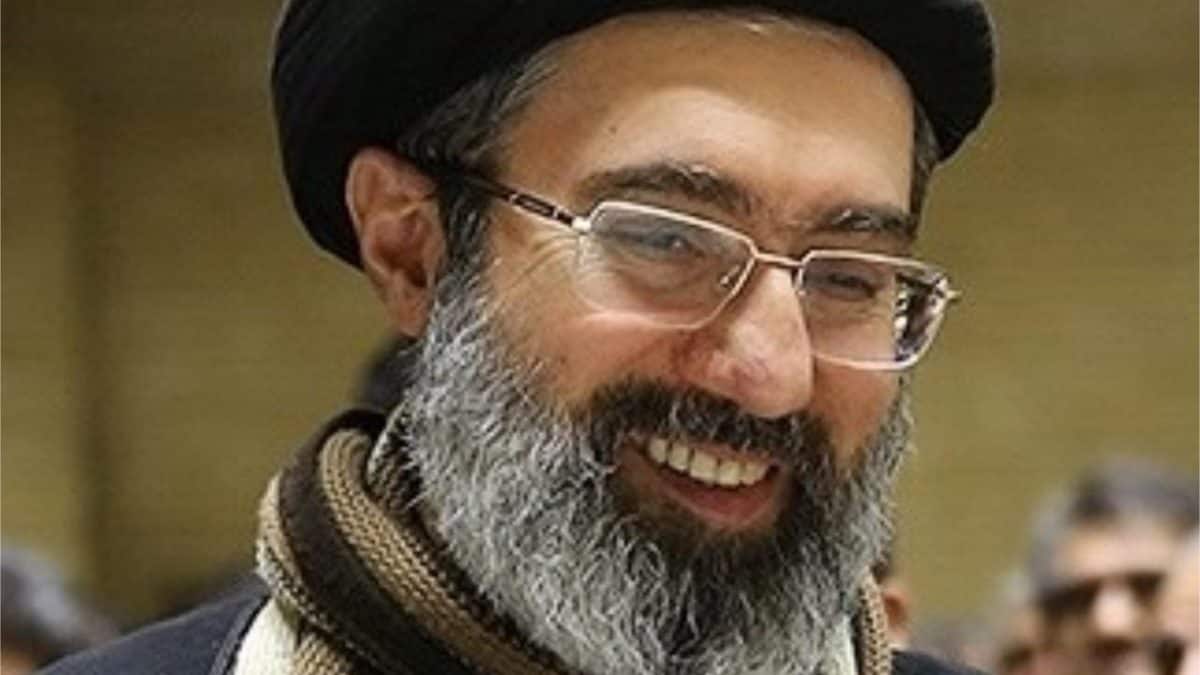
The air in Tehran does not just sit; it presses. On a humid afternoon, the smog clings to the Alborz Mountains like a shroud, and the silence in the corridors of power is louder than the chaotic honking of taxis on Vali-Asr Street. For decades, the people of Iran have looked toward the Bait-e Rahbari—the House of the Leader—with a mixture of fatigue, dread, and a question that no one dared ask too loudly.
Who comes after the Old Man?
The answer has arrived, not with a celebratory roar, but with the clinical efficiency of a closed-door assembly. Mojtaba Khamenei, the second son of the Supreme Leader, has reportedly been chosen to inherit the most absolute theocracy on earth. To understand this, you have to stop thinking about politics and start thinking about ghosts. Specifically, the ghost of a revolution that promised to end monarchy forever, only to find itself crowning a prince in everything but name.
The Invisible Architect
For years, Mojtaba was a ghost himself. While his father, Ali Khamenei, stood before the cameras with a wagging finger and a steady gaze, Mojtaba stayed in the periphery. He was the whisper in the ear. The hand on the lever. If you lived in Tehran during the 2009 Green Movement, you heard his name in the streets, shouted by protesters who sensed his influence behind the brutal crackdowns. They called him the "Commander of the Basij" without him ever wearing a formal uniform.
He is a man built of secrets.
Consider a hypothetical shopkeeper in the Grand Bazaar named Reza. Reza remembers 1979. He remembers the fire and the promise that the era of "Aghazadeh"—the children of the elite living like kings—was over. Now, as Reza wipes the dust off a bolt of silk, he hears the news on a smuggled satellite feed. The irony tastes like ash. The revolution was supposed to be a meritocracy of the soul, yet here we are, watching a family business consolidate its assets.
Mojtaba’s rise is not a story of charisma. He does not have his father’s oratorical flare or the revolutionary pedigree of the men who climbed through the trenches of the Iran-Iraq War. His power is administrative. It is architectural. He has spent thirty years weaving a web through the Islamic Revolutionary Guard Corps (IRGC) and the sprawling financial foundations that control billions of dollars in the Iranian economy.
The Anatomy of a Coronation
The reports indicating that the Assembly of Experts—an 88-member body of elderly clerics—has secretly tapped Mojtaba are more than just a personnel change. They represent a frantic attempt at survival.
The system is brittle. The Supreme Leader is 85. When a structure is that old and that top-heavy, the people inside the building aren't worried about the view; they are worried about the foundation. By choosing Mojtaba, the inner circle is choosing the status quo. They are betting that the son will protect the fathers.
But look closer at the mechanics of this choice. In the Shiite tradition, a Supreme Leader is supposed to be a Marja—a source of emulation, a top-tier grand ayatollah with decades of scholarly prestige. Mojtaba is a mid-ranking cleric. To elevate him, the state must once again bend the bars of its own religious cage. They did it for his father in 1989, and they are doing it again now. It proves a hard truth: in the Islamic Republic, the "Republic" is a suggestion, but the "Islamic" is a brand used to sell a very traditional form of power.
The Weight of the Turban
Imagine the first morning Mojtaba wakes up as the official successor. He steps onto a balcony and looks out over a city that is fundamentally different from the one his father inherited.
The Iran of 2026 is a nation of young people who speak the language of the internet, not the language of the seminary. They are the generation of "Woman, Life, Freedom." They have seen the currency tumble until their savings are worth less than the paper they are printed on. To them, the turban Mojtaba wears isn't a symbol of divine guidance; it’s a symbol of an internet blackout.
The stakes are invisible but heavy. If Mojtaba takes the throne and tries to rule exactly like his father, he faces a population that has run out of patience. If he tries to reform, he risks being devoured by the very hardliners—the IRGC generals—who put him there. It is the classic dictator’s dilemma, sharpened by the fact that he is following a legend.
The IRGC is the real player here. They are no longer just a military; they are a corporate conglomerate with tanks. They didn't choose Mojtaba because they love him. They chose him because he is a known quantity. He is the bridge between the clerical old guard and the military-industrial complex that actually keeps the lights on—and the protesters down.
The Ghost of the Shah
There is a poetic, almost Shakespearean tragedy to this. The current regime rose to power by toppling a hereditary monarchy. The Shah, Mohammad Reza Pahlavi, was criticized for being out of touch, for relying on a brutal secret police (SAVAK), and for grooming his son to take a throne the people no longer wanted.
History doesn't repeat, but it certainly rhymes.
By positioning Mojtaba as the successor, the Islamic Republic has completed its transition into the very thing it sought to destroy. The "Supreme Leader" has become a "Sultan." The religious justification has become a thin veneer over a dynastic reality.
For the average Iranian, this news isn't a shock. It's a confirmation. It's the sound of a door locking from the outside. When the report hit the wires, there were no celebrations in the streets of Mashhad or Isfahan. There was just the quiet, grim realization that the transition of power would not be an opening, but a closing.
The Quiet Before the Shift
The world watches this transition through the lens of geopolitics—nuclear deals, proxy wars, and regional hegemony. But the real story is happening in the kitchens of Tehran. It’s happening in the hushed conversations between students who realize that the face on the wall might change, but the wall remains.
Mojtaba Khamenei is now the most powerful man in waiting. He inherits a country that is a cultural superpower, a scientific hub, and a graveyard of crushed dreams. He inherits a legacy of defiance against the West and a legacy of defiance against his own people.
The question isn't whether he can lead. The question is whether the country will follow. Power is a fragile thing when it is handed down rather than earned. It requires a constant, exhausting application of force to keep the crown from slipping.
As the sun sets over the Alborz, the shadows grow long, stretching across the palaces and the slums alike. In the dark, it’s hard to tell the difference between a beginning and an end. The son has his father's name, his father's enemies, and his father's throne. But he does not have his father's time. The clock in the Grand Bazaar keeps ticking, indifferent to the names of kings or clerics, measuring only the length of the wait for a dawn that actually looks different from the night.
The ink is dry on the decree. The prince is ready. The people are waiting. And the mountain stays silent, watching the same play begin its final, weary act.