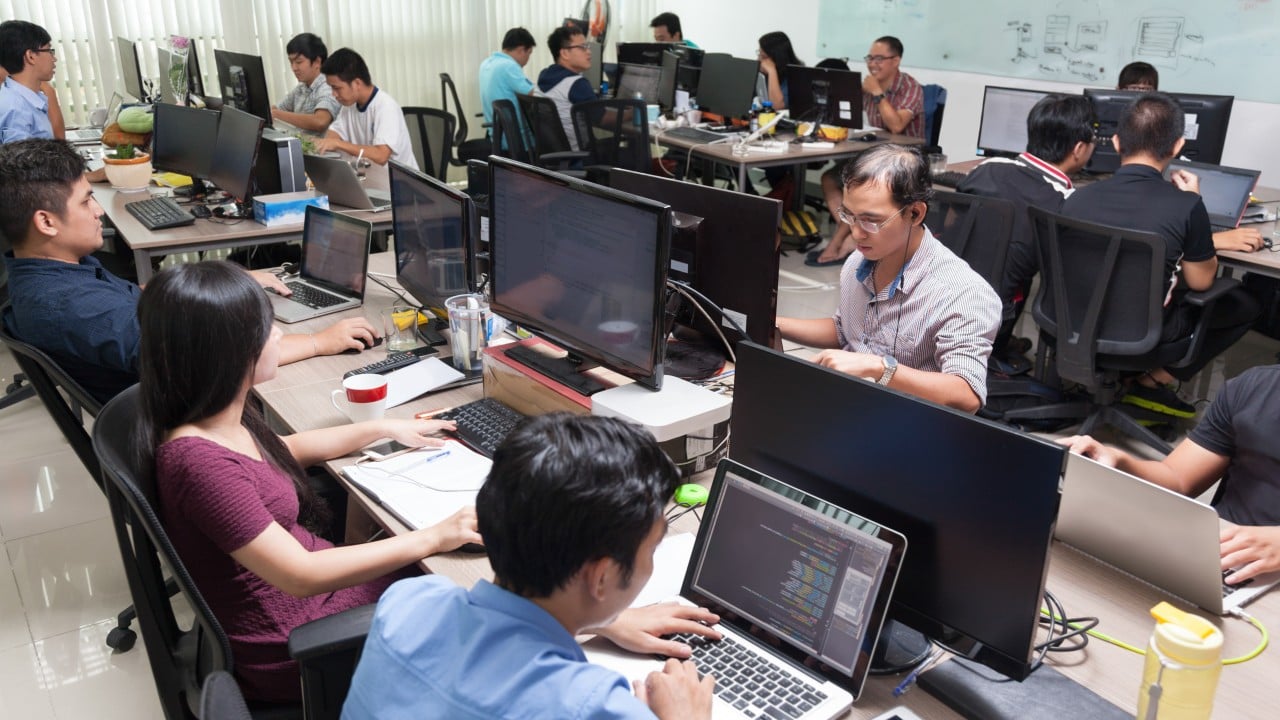
The fluorescent lights of a Shanghai office park don’t hum; they hiss. It is a dry, sterile sound that fills the gaps between keyboard clicks and the soft sighs of people who haven’t seen the sun in fourteen hours. Zhang Wei sat in that hiss, staring at a blue-and-white interface that promised to save his career. It was a tool called Colleague Skill, a seemingly innocuous feature on the workplace app Maimai. It didn’t ask for his resume. It didn’t ask for his references. It asked for his essence.
In the hyper-competitive pressure cooker of the Chinese tech sector, fear is the primary currency. When the economy stutters and the "996" culture—working 9 a.m. to 9 p.m., six days a week—shifts from a badge of honor to a desperate survival tactic, people look for an edge. They look for a way to prove they are indispensable. Colleague Skill arrived at exactly the right moment to exploit that desperation, masquerading as a professional development tool while acting as something far more predatory.
The premise was simple. The app invited users to "upload" the skills, workflows, and specific institutional knowledge of their coworkers. On the surface, it looked like a wiki for the workplace. Below the surface, it felt like a digital autopsy.
The Ghost in the Cubicle
Wei watched as a notification popped up. A colleague had "contributed" to his profile. He clicked through, expecting a compliment on his Python coding or his ability to manage frantic product launches. Instead, he found a granular breakdown of his specific logic for optimizing delivery algorithms—the very thing that made him "Wei."
It wasn't just a list. It was a blueprint.
Imagine a master carpenter who has spent thirty years learning exactly how a specific grain of oak reacts to a chisel. Now imagine a younger apprentice taking photos of every movement, recording the pressure of the blade, and feeding that data into a machine that can replicate the cut perfectly. The carpenter isn't being helped. He is being archived.
This is the central anxiety fueling the viral explosion of Colleague Skill across Chinese social media. In a world where Generative AI is no longer a futuristic threat but a present-day replacement, the act of "mapping" a human's professional value feels like preparing a will. If a machine can learn your "skill," does the company still need your heartbeat?
A Market Built on Paranoia
The viral spread of the "ability harvester" wasn’t accidental. It tapped into a deep-seated cultural nerve known as neijuan, or involution. It describes a process where everyone works harder and harder, but the total output remains the same, leading to a state of exhausted stagnation. When you are involuted, your coworker isn't your teammate; they are your benchmark. If they are faster, you are obsolete.
Maimai, the platform behind the tool, marketed it as a way to "enhance transparency" and "bridge the talent gap." But for the millions of white-collar workers in Beijing, Shenzhen, and Hangzhou, transparency looks a lot like a target.
The data being harvested isn't just "hard skills" like coding or accounting. It’s the "soft" institutional memory that used to be a worker's ultimate job security. It’s knowing which stakeholder needs a phone call instead of an email. It’s knowing the specific quirk in the legacy software that crashes the system every Tuesday. It’s the human intuition that AI still struggles to replicate—unless humans are tricked into feeding that intuition into the database themselves.
Consider the irony of the modern office. We are told to be "team players" and to "share knowledge" for the good of the collective. Yet, in the shadow of mass layoffs and the encroaching shadow of automation, knowledge is the only shield we have left. When that shield is stripped away under the guise of "collaboration," the worker is left standing naked in the path of the algorithm.
The Algorithm Doesn't Sleep
The psychological toll of this digital harvesting is subtle. It creates a "Panopticon" effect. In an 18th-century prison designed by Jeremy Bentham, a single guard could watch every prisoner from a central tower. The prisoners never knew if they were being watched, so they behaved as if they were monitored at all times.
Colleague Skill turns every coworker into a potential guard.
Wei found himself hesitating before sharing a shortcut with a junior dev. He paused before explaining a complex workaround in a group chat. The spirit of mentorship, the very glue that holds an organization together, began to dissolve. Silence replaced collaboration.
This is the hidden cost of the harvester. When we turn professional expertise into a commodity that can be scraped and stored, we destroy the trust required to create anything of value. You cannot build a future on a foundation of mutual suspicion.
The statistics back up the dread. In recent surveys of Chinese tech workers, over 60% expressed significant concern that AI would replace their core functions within the next five years. Tools like Colleague Skill act as the bridge to that replacement. They are the data-entry clerks for our own obsolescence.
The Illusion of Progress
We often mistake "efficiency" for "progress." A tool that allows a company to download the brains of its employees and store them on a server is certainly efficient. It protects the company from "key person risk"—the danger that a business will suffer if a vital employee leaves.
But a company is not just a collection of processes. It is a living organism. When you treat your people like hardware that needs its data backed up before being decommissioned, you lose the spark that creates the next big thing. You lose the "lucky mistakes," the "off-the-record breakthroughs," and the "unmapped genius" that an algorithm can't predict because it hasn't seen it yet.
The viral outrage in China isn't just about a single app. It’s a scream against the feeling of being quantified. It’s the realization that in the eyes of the modern corporation, a human being is just a "skill set" wrapped in skin.
The Resistance of the Real
There is a quiet counter-movement growing in the wake of the harvester. Workers are beginning to realize that their most valuable assets are the things that cannot be uploaded.
Empathy.
Humor.
The ability to navigate a crisis with grace.
The deep, messy relationships built over shared meals and late-night deadlines.
These are the things Colleague Skill cannot touch. They are the "un-harvestable" parts of the human experience.
Wei eventually closed the app. He didn’t delete his profile—that would draw too much attention—but he stopped contributing. He decided that if his value could be summed up in a few paragraphs of text on a blue-and-white screen, he was already gone. He started focusing on the things the app didn't ask for. He mentored the junior dev in person, away from the keyboards. He spoke to his boss about strategy in a way that required nuance and history, things a database can't simulate.
But the machine is still there. It is still hissing.
The harvest continues every time we trade our unique perspective for the convenience of a tool that claims to know us better than we know ourselves. We are living in an era where our own shadows are being sold back to us as "optimized versions" of who we are.
The tragedy of the ability harvester isn't that it might fail. The tragedy is that it might actually work, leaving us in a world where everything is known, everything is mapped, and no one is necessary.
Wei walked out of the office park at midnight. The Shanghai skyline was a neon forest, pulsing with the data of millions. Somewhere in those towers, a server was processing his "skills," turning his years of labor into a line of code. He felt a chill that had nothing to do with the night air. It was the feeling of being haunted by a version of himself that didn't need to breathe.