Dawn breaks over Interstate 25 with a low, copper glare that turns wet asphalt into a mirror. At seventy-five miles an hour, the world shrinks to the white dashes whipping past the bumper, the hum of tires on concrete, and the warm breath of a heater fighting off the chill of the Colorado high plains.
Silence.
Then the crunch of gravel, the shriek of locked brakes, and the sickening thud of steel meeting bone.
Anyone who has driven mountain highways at dusk or dawn knows that knot in the stomach. You scan the sagebrush along the shoulder. You watch the ditches where shadows pool like dark water. You hope a flash of white tail or a pair of amber eyes does not step out three car lengths ahead. Sometimes you get lucky. Sometimes a family car is totaled, a bumper is torn away, and a mule deer or an elk never makes it across the ridge.
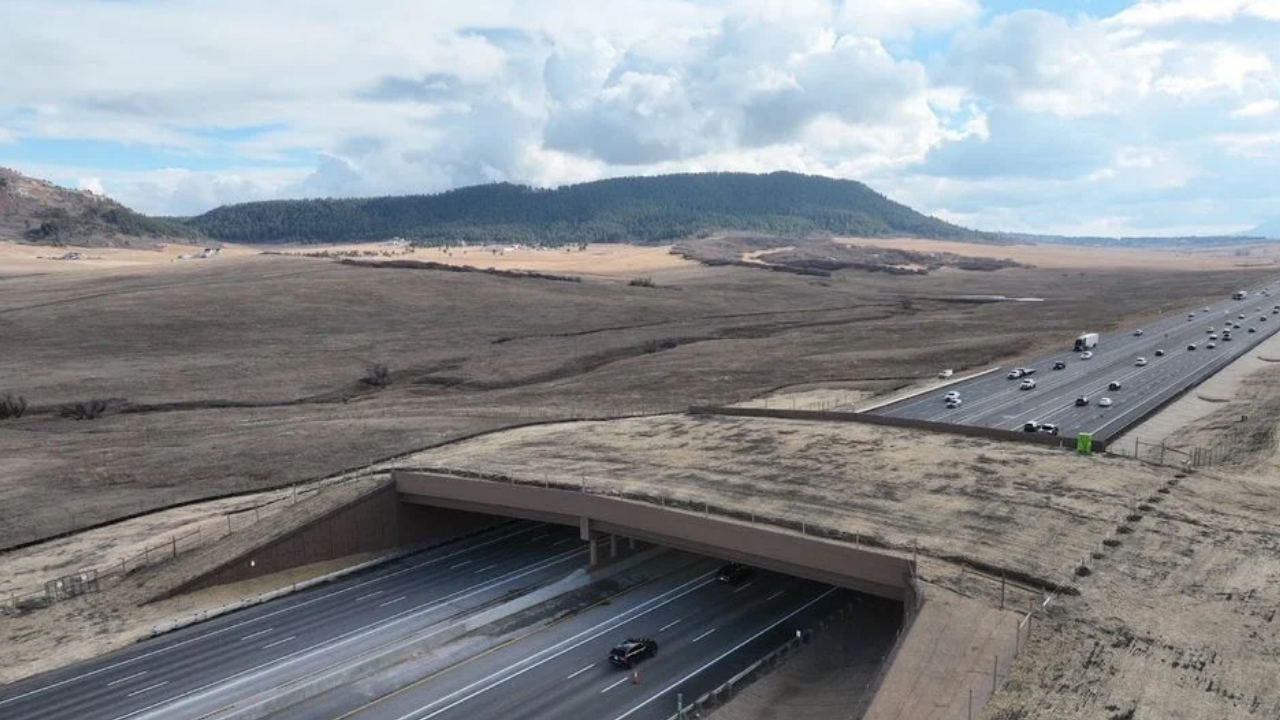
For decades, we treated those collisions as inevitable tax on modern travel. Asphalt went down; herds were split in two. Yet along stretches of I-25 in Colorado, something remarkable has been happening since wildlife overpasses and fencing went up. Vehicle-wildlife crashes on those crossings have dropped by up to 91 percent, and state planners are moving ahead with six more overpasses along the corridor.
Ninety-one percent is not a rounding error. It is the difference between a shattered windshield at midnight and a quiet drive home.
A River of Steel Meets an Ancient Trail
To understand why a bridge of dirt, stone, and native grass works so well, you have to think about what a highway actually is to an animal that has walked the same seasonal path for a thousand years.
To us, Interstate 25 is a ribbon of commerce connecting cities, ski towns, ranches, and state lines. To a mule deer moving from high summer pasture down into lower winter shelter as snow begins to pack the peaks, that same stretch of pavement is a sudden, roaring cliff face with no handholds.
For years, transportation engineers thought about movement in one direction: keeping cars moving fast and smooth. Fencing along highways was often patchy or low, funneling animals onto the pavement rather than guiding them safely away. Even when underpasses existed, many large animals hesitated to enter narrow concrete tunnels that echoed with traffic noise or smelled of exhaust and human activity.
(Note: The following character and drive are hypothetical, created to illustrate real patterns documented along mountain highway corridors.)
Picture Elena, a physical therapist driving south from Fort Collins toward Loveland before sunrise in late October. She has coffee in the cupholder, a podcast low on the speakers, and a shift at the clinic starting at seven. Two winters ago, a friend of hers swerved to miss a buck on a two-lane road, clipped a guardrail, and spent months in physical therapy with a shattered collarbone. Elena has felt tense at twilight ever since.
On an older stretch of highway without dedicated crossings, Elena’s eyes dart constantly between the lane ahead and the dark brush beside the road. Her shoulders sit two inches higher than they should. Every mile carries a quiet tax on attention and nerve.
Now shift that same drive to a corridor equipped with a vegetated wildlife overpass and linked exclusionary fencing. The fence does not just sit randomly by the weeds; it runs continuously along the right-of-way, turning the danger zone into a guided path. When a deer or elk follows that fence line, it does not run into a dead end of traffic. Instead, it finds a wide, earthen bridge planted with familiar grasses, shrubs, and rocks—a bridge that feels less like an artificial structure and more like a continuation of the hillside itself.
Cars thunder underneath at highway speed. Above them, hooves step softly onto soil.
Why Overpasses Beat Wishful Thinking
When people first hear about wildlife overpasses, skepticism is natural. Building a bridge just for animals sounds expensive—and fair enough, concrete, earthwork, drainage, and fencing are not cheap. A driver stuck in traffic or watching grocery prices climb has every right to ask whether the money pays off.
Here is where the math gets surprisingly grounded.
A single collision involving a large ungulate like a deer or elk can easily cost thousands of dollars once you add up vehicle repairs, towing, emergency response, medical bills, and lost workdays. Multiply that across hundreds or thousands of crashes every year along high-volume corridors, and the hidden price tag of "doing nothing" stops looking small.
Why do overpasses outperform simpler fixes? Because large wildlife are wired for survival, not guesswork. A narrow culvert under a road can feel like a trap to a prey animal that relies on sightlines and open space to spot predators. A wide overpass—often spanning across all lanes of traffic and landscaped to blend into surrounding terrain—gives animals room to move calmly, even in groups, without feeling cornered.
Consider what happens next when a herd can cross without being hit:
- Drivers stay safer. Fewer sudden swerves, fewer front-end impacts, fewer late-night emergencies on high-speed interstates.
- Herds stay connected. Seasonal migration routes stay intact, allowing populations to reach winter food and spring calving grounds instead of getting isolated on smaller patches of land.
- Communities save money over time. Fewer crashes mean fewer damaged vehicles, fewer injuries, and less strain on local emergency crews and highway maintenance.
Colorado’s push to add six more crossings along I-25 shows this is not a one-off experiment. When a safety measure cuts crashes on treated segments by up to 91 percent, planners stop treating it as a novelty and start treating it as core infrastructure.
The Invisible Stakes Behind Every Statistic
Stats are clean. Real life is messy.
A chart showing a 91 percent drop in collisions tells you the trend line went way down. It cannot show you the tow truck driver working in sleet at 2:00 a.m., the paramedic tending to a bruised driver whose airbag deployed, or the rancher watching fewer animals make it through a harsh winter.
Nor does a percentage capture the slow, quiet erosion of wildlife habitat. When a major highway cuts straight through migration territory, it acts like a dam on a river. Even animals that avoid getting hit may hesitate to cross, shrinking the territory they can use to find food, water, and mates. Over generations, fragmented habitat weakens herds and makes them more vulnerable to severe weather and disease.
I have stood beside rural highways at dusk and felt that eerie stillness right after traffic thins out. You hear the wind in dry grass. You see tire marks where someone braked hard. And you realize how thin the margin is between a normal evening and a ruined week.
Admitting that infrastructure is complicated does not weaken the case for wildlife crossings—it makes it honest. Building six more overpasses along a busy interstate takes years of planning, environmental review, engineering coordination, and funding. Not every mile of highway can get a bridge overnight, and fencing has to be maintained so gates are not left open and washouts do not create gaps.
Still, perfection is not the standard. Dramatically reducing crashes where animals actually cross is a concrete win you can measure in bent fenders avoided and lives spared.
What Drivers Still Need to Know
Even as Colorado expands its wildlife overpass network along I-25, bridges are not magic shields across every single mile of road. Until every high-risk stretch has full fencing and crossings, driving smart remains part of the equation.
Do overpasses work for more than just deer?
Yes. While mule deer and elk often make headlines because of their size and migration habits, wildlife overpasses and underpasses are used by a wide range of animals—from pronghorn and bighorn sheep to foxes, bobcats, coyotes, and smaller mammals—especially when fencing guides them toward safe crossing points.
Why pair fencing with an overpass?
An overpass by itself helps animals that happen to find it, but fencing is what makes the system work at scale. Fencing keeps animals off the pavement and channels them toward the bridge or underpass so they do not wander blindly into oncoming lanes.
What should a driver do if an animal appears ahead?
Brake firmly and stay in your lane if it is safe to do so. Swerving sharply at highway speed can send a vehicle rolling or push it into oncoming traffic or a concrete barrier—often causing worse injuries than a straight-ahead impact.
Does a 91 percent reduction mean zero crashes?
No. A drop of up to 91 percent on crossings means the vast majority of collisions that used to happen in those spots are prevented, not that every single animal follows the fence every single time. Vigilance at dawn, dusk, and night still matters.
A Different Kind of Bridge
Think about the word overpass for a second.
Usually, an overpass is something we build so we can get somewhere faster—a flyover ramp, a highway bridge, a shortcut over congestion. A wildlife overpass flips that habit on its head. It is a bridge built out of patience and foresight, a quiet acknowledgment that we share the mountains and plains with creatures that were here long before concrete mixers arrived.
Look out a car window on a crisp morning along I-25, past the guardrails and the sweeping sweep of the Front Range, and picture a doe stepping onto a sunlit bridge of sage and stone while traffic hums harmlessly beneath her hooves—neither side blocking the other, both finally able to keep moving.