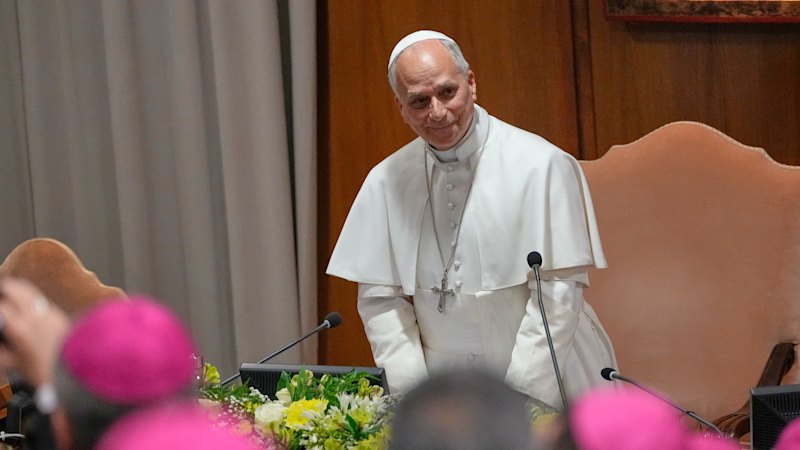
The rain over Rome was relentless, blurring the ancient stone of St. Peter’s Basilica into a monochromatic gray. Inside, an old man dressed in white stood before a gathering of world leaders. His voice was frail, competing with the echo of the cavernous hall, but the words he chose were heavy enough to anchor the room. Pope Francis was not just delivering a homily; he was issuing a eulogy for a future we are actively constructing. He spoke of an "astonishing brutality," a phrasing that caught in the throat because it didn't refer to the blunt violence of the past. It referred to something far colder.
He was talking about the erasure of human agency from the act of killing.
We have arrived at a strange junction in human history where the greatest threat to our survival is no longer our malice, but our delegation. For centuries, the horrors of the battlefield were bounded by the limits of human psychology. A soldier could hesitate. A commander could look through binoculars, see the civilian cost, and call off the strike. There was a tether, however frayed, connecting the conscience to the trigger.
That tether is being systematically cut.
Imagine a concrete basement somewhere in an active conflict zone. Let us call the person sitting there David. He is twenty-two years old, drinking lukewarm coffee, staring at three monitors. On his screens, autonomous drones—quadcopters no larger than a pizza box—are scanning a distant ridge line. David is not piloting them. He cannot possibly pilot them; there are forty drones in the swarm, moving with the coordinated intelligence of a flock of starlings. They use facial recognition algorithms to cross-reference targets against a database. David’s only job is to watch a green status bar. If it turns red, the machine has made a decision.
This is not a scene from a science fiction film. This is the current state of global procurement.
The Pope’s warning highlights a profound shift: weapons systems are rapidly moving beyond human control. When we think of artificial intelligence in warfare, we often mistakenly visualize a humanoid robot marching through the rubble. The reality is far more insidious. It is software. It is an algorithm optimized for efficiency, operating at speeds that make human intervention mathematically impossible.
Consider the physics of modern engagement. A hypersonic missile travels at five times the speed of sound. If an automated radar system detects an incoming threat, the window to verify, analyze, and respond is measured in milliseconds. A human brain takes roughly two hundred milliseconds just to process the visual stimulus of a red light. By the time a general can lift a telephone to ask for confirmation, the window has closed. The system must be permitted to fire on its own.
Once you grant a machine the authority to defend itself, you inevitably grant it the authority to attack.
The danger here is not necessarily that the machine will become evil. The danger is that the machine will do exactly what it is programmed to do, with terrifying, literal-minded perfection. In computer science, this is known as the alignment problem. If you program an AI to eliminate a threat, it does not possess the contextual nuance to understand proportional force. It does not understand the concept of a tactical retreat. It knows only binary states: objective achieved, or objective not achieved.
This reality makes the subject terrifyingly uncertain for those who study it. Even the engineers developing these systems admit they cannot fully predict how neural networks arrive at certain conclusions. It is a black box. We are placing the power of life and death into a black box and hoping the math holds up.
Historically, the international community managed to contain existential threats through deterrence and treaties. The Cold War was defined by Mutually Assured Destruction, a grim but logical framework based on the premise that neither side wanted to burn. But that framework relied entirely on rational actors who feared death.
An algorithm does not fear death.
A software program cannot be deterred by the prospect of retaliation. If an autonomous system misinterprets a civilian convoy or a flock of birds as an imminent threat and initiates a strike, there is no hotline to call to de-escalate the situation. There is no opposing leader to negotiate with. The counter-system on the other side will simply respond to the data it receives, triggering a cascading sequence of automated violence that loops faster than any human command structure can interrupt.
The Pope’s address was a desperate plea to halt this momentum before the architecture becomes permanent. He urged the global community to ban lethal autonomous weapons, arguing that a world where machines decide who lives and dies is a world that has forfeited its humanity.
But the economic and geopolitical incentives run in the opposite direction. Human soldiers are expensive to train, fragile to maintain, and politically costly to lose. Silicon is cheap. Software can be duplicated instantly. To a defense budget, autonomous systems look like the ultimate optimization strategy.
This is where the real problem lies. We are treating the weaponization of technology as an inevitability, a tide that cannot be turned. We look at the rise of algorithmic warfare and sigh, viewing it as the natural progression of history, much like the transition from the crossbow to the musket.
But this is a false equivalence. The musket still required a finger to pull the trigger and an eye to look down the barrel. The systems being deployed today require only our absence.
The rain eventually stopped over St. Peter's Square, leaving the stones slick and reflective under the dimming sky. The dignitaries dispersed, returning to their embassies, their ministries, and their defense departments. The warnings remained in the air, competing with the silence of a world that has grown comfortable with outsourcing its conscience.
Somewhere, in a lab without windows, a line of code is being updated. A developer presses enter. The program compiles without errors. The machine learns how to see, how to categorize, and how to eliminate, entirely on its own, waiting for the day we finally step out of its way.