Silence has a weight in the Okanogan Highlands. When you stand at the edge of Salmon Creek in north-central Washington, the wind moving through the Ponderosa pines does not sound like the wind in a city, nor does it sound like the wind over an empty prairie. It sounds like an exhalation. Beneath your boots, buried under decades of pine needles, bunchgrass, and the slow, patient reclamation of the forest floor, lies the foundation of a place that once refused to believe it could die.
Ruby City. Also making headlines in related news: Why Showing Up on Sunday Is the Only Way to Truly Understand Dia de los Muertos.
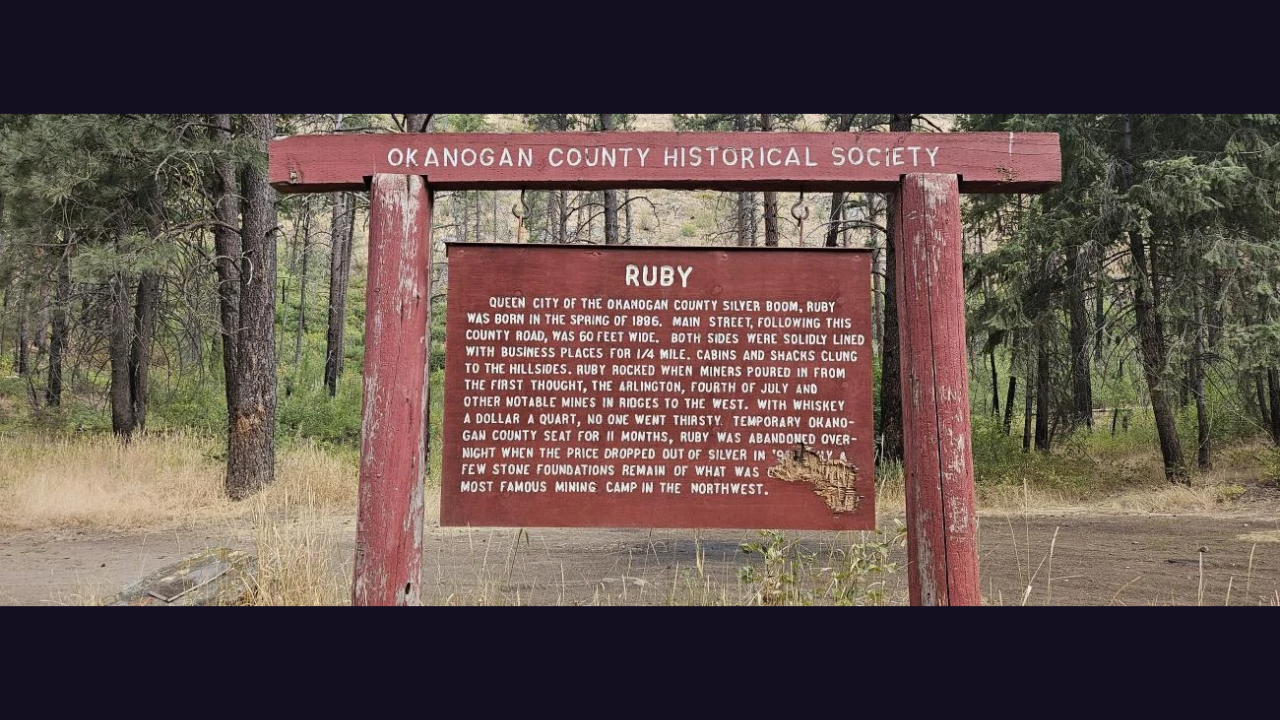
If you look at a standard historical marker or skim a dry encyclopedia entry, the story seems simple enough to fit on a postcard. In the late 1880s, prospectors found silver in the hills south of Conconully. A town erupted out of the dirt. At its peak, around a thousand people lived there. Then, in 1893, the price of silver crashed, the mines closed, and everyone left. Today, it is a ghost town.
That version of events is technically accurate, yet it misses the entire point. It treats Ruby City like a broken machine rather than a living organism that suffered a sudden, fatal cardiac arrest. To understand what actually happened in that narrow canyon—and why its empty dirt streets still matter to anyone living in a boom-and-bust economy today—you have to look past the ledger books of the mining syndicates. You have to look at the people who bet their entire existence on the permanence of a rock. Additional information into this topic are explored by Lonely Planet.
The Fever in the Canyon
Before 1886, the valley where Ruby City would rise belonged to the indigenous peoples of the Okanogan region, the wildlife, and the occasional solitary trapper passing through the sagebrush and timber. The mountains here are not the jagged, theatrical granite spires of the North Cascades further west; they are older, rounder, sun-baked slopes that look almost gentle until winter locks them in five feet of snow.
Then came the rumors of silver.
To understand the psychology of a silver rush, imagine a modern tech hub—say, a sudden artificial intelligence boom in a quiet midwestern town—stripped of all digital safety nets, municipal zoning, and banking insurance. When prospectors struck rich veins of ruby silver ore on Ruby Hill in 1886, the news traveled faster than the stagecoaches could carry the men chasing it.
Let us picture a composite man from that era, whom we will call Thomas—a hypothetical figure built from the census records and freight manifests of 1888. Thomas is thirty-two, a former timber worker from the Puget Sound who arrived in the Okanogan with forty dollars sewn into his coat lining, a borrowed mule, and the absolute certainty that his luck was about to turn. He was not alone. By 1887, Ruby City had been platted, and by the following year, the canyon floor was a chaotic, deafening symphony of broadaxes biting into pine, the ring of blacksmiths' anvils, and the relentless rumble of heavy freight wagons hauling timber and stamp-mill machinery up grades so steep the horses bled from their nostrils.
Brick buildings went up—a crucial detail. You do not haul fired brick into a remote mountain canyon in northern Washington if you think you are building a temporary camp. Wood is for tents and shanties; brick is a declaration of permanence.
By 1890, Ruby City was the largest town in Okanogan County, boasting roughly a thousand residents, though the transient population of miners, teamsters, and speculators drifting through its saloons and boarding houses likely pushed that number higher on any given Saturday night. The town had a newspaper, the Ruby Miner. It had a schoolhouse, a bank, hotels, general stores stocked with oysters shipped in on ice and fine woolens from back East, and no fewer than a dozen saloons where men drank whiskey out of thick tumblers while arguing over assay reports.
They even had electricity—or at least the glittering promise of modern infrastructure—and a telephone line connecting them to the outside world. When the town briefly held the title of county seat in 1888 before losing it to neighboring Conconully in a fiercely contested election, the citizens of Ruby City did not pack up. They doubled down. They were building the Spokane of the north.
The Invisible Leash
Standing on the site today, trying to trace the main street through the weeds, I felt a strange vertigo. Looking at the rusted iron scraps half-buried in the dirt, it is almost impossible to reconcile the quiet emptiness of the valley with the sheer, arrogant certainty those thousand people must have felt. They had solved the geography problem. They had conquered the isolation. They had pulled wealth directly out of the earth with black powder and hand drills.
What they could not see—what almost none of us ever see when we are inside a boom—was the invisible leash tied around their necks, stretching three thousand miles east to the marble halls of the United States Congress.
In economics, there is a concept known as single-commodity dependency, which sounds bloodless on a spreadsheet. In real life, it feels like living on a bridge while someone miles away decides whether to pull the pins out of the trusses. Ruby City existed for one reason: the United States government was artificially propping up the price of silver.
Under the Bland-Allison Act of 1878 and later the Sherman Silver Purchase Act of 1890, the federal Treasury was required to buy millions of ounces of silver every month to mint into coins and back paper currency. This policy was the lifeblood of the American West. It guaranteed a buyer for the ore coming out of the Arlington, the First Thought, and the Fourth of July mines on Ruby Hill. As long as Washington, D.C., kept buying, the stamp mills in Ruby City kept crushing rock, the payrolls met every Friday, and the brick storefronts stayed lit late into the night.
The miners working the dark, damp stopes beneath Ruby Hill knew how to read a quartz vein. They knew how to spot the dark red glint of pyrargyrite—ruby silver—in the flicker of a candle. They did not know how to read the panic spreading through the gold reserves of the New York banks.
The Year the Floor Dropped Out
That single year acts like a fault line running straight through the history of the Pacific Northwest. In the spring of 1893, the overbuilt railroad empire began to collapse, triggering a financial contagion that spiraled into the worst economic depression the United States had ever seen up to that point. Foreign investors, terrified that the U.S. would abandon the gold standard, began dumping American stocks and demanding gold in exchange for their dollars. The federal gold reserve plummeted toward a catastrophic low.
President Grover Cleveland, convinced that the mandatory silver purchases were draining the nation's gold, called a special session of Congress in the summer of 1893 and demanded the repeal of the Sherman Silver Purchase Act.
In November, Congress complied.
Think of that moment not as a legislative footnote, but as a guillotine dropping on a thousand lives in a canyon in Washington. Overnight, the primary buyer for Ruby City’s sole export vanished. The price of silver did not merely dip; it cratered, falling so low that pulling the ore out of the granite of Ruby Hill cost significantly more than the metal was worth on the open market.
Consider what happens next in a town like Ruby City. It does not happen over a decade. It happens over a season.
First, the mine owners stop paying in cash and start issuing scrip, promising to settle up "when the market stabilizes." Then, the big syndicates padlock the shaft houses and lay off the night shifts. Within weeks, the day shifts follow. The stamp mills, whose rhythmic pounding had been the literal heartbeat of the canyon for six years, fall dead silent. That sudden quiet must have been terrifying—the sound of a town's oxygen being shut off.
Our hypothetical timber worker, Thomas, suddenly finds himself holding paper scrip that the general store will no longer accept for flour or bacon. The saloon keepers, who extended credit to miners all winter, realize they will never collect a dime. The boarding house matrons are cooking for men who cannot pay rent.
There was no remote work to pivot to. There was no tourism industry waiting in the wings, no agricultural base in that narrow, rocky draw to absorb the unemployed. Ruby City was a pure extraction engine, and the fuel had just become worthless.
The Great Unbuilding
When a modern city declines, it rots slowly over decades. Buildings stand empty, windows get boarded up, and a skeleton crew of residents lingers on, fighting to save the local school or the post office.
Frontier ghost towns died differently. They were cannibalized.
By 1894, the exodus from Ruby City had turned into a stampede. Families loaded whatever they could fit onto wagons and headed south toward Wenatchee, east toward Spokane, or back over the Cascades to Seattle. Because lumber, window glass, and hardware were desperately expensive to haul into the Okanogan wilderness, leaving a building intact made no sense.
Men pried the floorboards out of their own homes to build rafts or wagon beds. They unhinged the doors, pulled the brick out of the chimneys, and dismantled the storefronts piece by piece, hauling the bones of Ruby City down the valley to rebuild in Conconully or Okanogan. Even the dead were not always left behind; some families exhumed their relatives from the hillside cemetery to take them along to their next lives.
By 1900, barely seven years after the silver crash, the thriving city of a thousand souls had been reduced to a handful of stubborn holdouts and decaying shells. Then came the final indignity: fire. Sweeping through the abandoned wooden structures, flames consumed whatever had not already been carried away, leaving behind only scorched foundations, brick rubble, and the rusted iron carcasses of mining machinery too heavy for a team of horses to drag out of the canyon.
Why the Dirt Still Remembers
If you drive up the Salmon Creek Road today, past the quiet waters of Conconully Reservoir, you might miss Ruby City entirely if you blink. There are no gift shops, no staged gunfights on dusty boardwalks, no velvet ropes keeping you away from restored saloons. Nature has been thorough. Sagebrush grows out of the cellar holes where kegs of beer were once kept cool. Cattle graze across the lots where real estate speculators once traded deeds for thousands of dollars.
I stood there on a late afternoon when the shadows were stretching long across the canyon floor, trying to make sense of the profound melancholy that hangs over places like this. It is easy to look at the people of Ruby City with a kind of retrospective pity, to shake our heads at their naivete for building brick banks on the back of a volatile commodity.
And then you look at the world we inhabit right now, and that pity curdles into recognition.
We have not outgrown Ruby City; we have simply digitized it. We still build entire communities, careers, and identities around single industries that feel permanent until the exact second they are not. We still mistake a temporary market anomaly for a permanent law of nature. Whether it is a single-factory town in the Rust Belt, a coastal community betting everything on real estate appreciation, or a generation of workers tethering their livelihoods to a single software platform or financial asset, the psychological architecture is identical to the one those miners erected in the Okanogan Highlands in 1888.
We haul in our metaphorical bricks. We lay our foundations. We convince ourselves that the stamp mills will never stop pounding.
Walking back toward my car as the temperature dropped in the canyon, my boot struck a piece of purpled glass half-embedded in the sandy soil—a shard from a bottle left behind in the 1890s, turned lavender by more than a century of high-desert sun. I picked it up, felt the smooth, worn edges against my thumb, and set it back down in the dirt where it belonged. The wind came down off Ruby Hill again, rattling the dry grass over the empty cellars, indifferent to the thousand ghosts who once believed they had built a city that would last forever.