The grease trap behind a bustling harbor-front restaurant in Wan Chai smells like memory and decay. It is a thick, amber sludge composed of yesterday’s deep-fried pork chop fat, soup stock skim, and the invisible debris of a city that never stops eating. Multiply that single basin by fifteen thousand. Add the cafeterias of skyscrapers, the woks of night markets, the corporate canteens of Kowloon, and the endless conveyor belts of industrial bakeries. Hong Kong produces thousands of tons of kitchen waste every single day, a greasy tide that usually finds its quiet, messy end in overcrowded landfills.
For decades, we treated this slick byproduct as an afterthought, something to be washed down a drain or buried out of sight. But the air above the city tells a different story.
Look up from the tarmac of Chek Lap Kok International Airport. A Cathay Pacific Boeing 777 tears through the humidity, trailing a plume of vapor and an economic question mark that grows heavier with every gallon of fossil fuel burned. Aviation is an industry trapped in a cruel paradox. We want to see the world, to bridge oceans in hours, to keep the global circulatory system pumping. Yet every flight draws down an invisible inheritance of carbon, writing a check against a future we cannot afford.
Enter the alchemists of the grease trap.
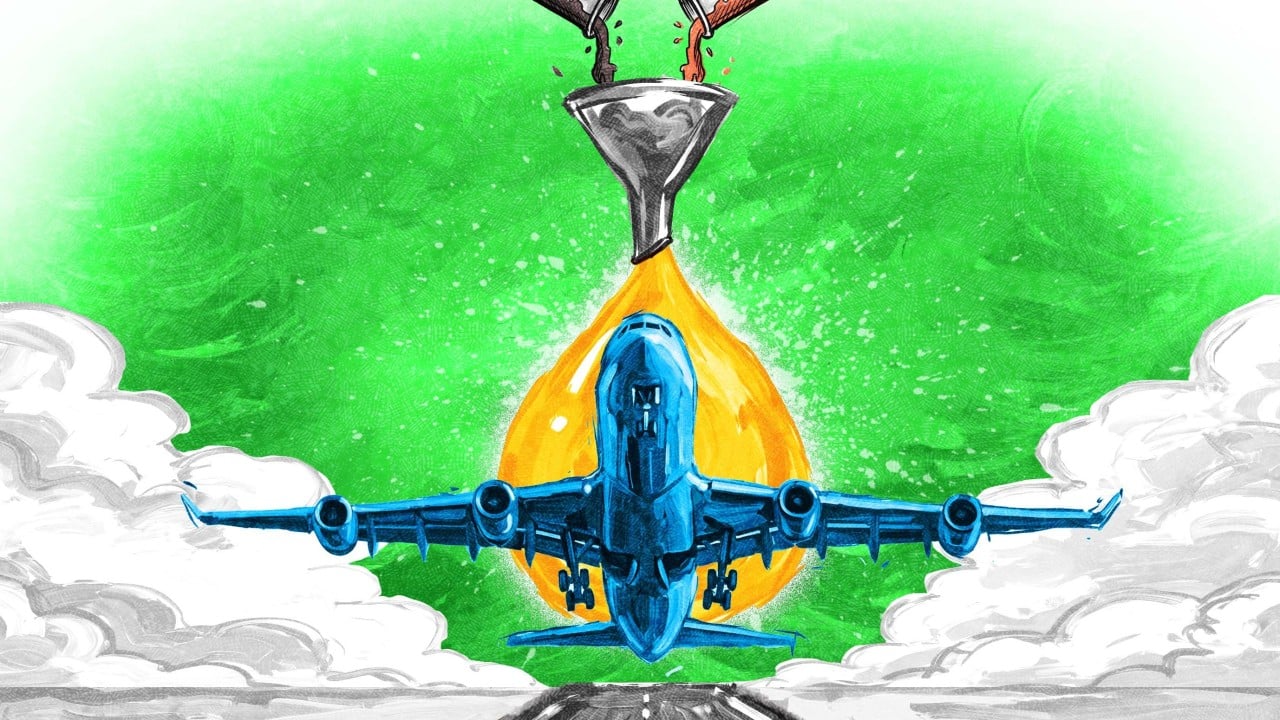
Imagine standing inside a modern processing facility where this discarded sludge arrives by the tanker load. It is dark, viscous, and unappealing. To the untrained eye, it is garbage. To a chemical engineer, it is liquid potential. Through a series of intense thermal treatments, cracking, and hydroprocessing, that rancid oil undergoes a molecular rebirth. The impurities are stripped away. The hydrogen atoms are rearranged. What emerges from the distillation columns is clear, clean, and chemically identical to conventional Jet A-1 fuel.
This is sustainable aviation fuel, or SAF. It is not a distant, utopian dream hatched in a Silicon Valley garage. It is bubbling right now in industrial vats, powered quite literally by the leftovers of a Cantonese stir-fry.
The math of this transformation is intoxicatingly simple on paper. When you fly an aircraft on cooking oil instead of crude extracted from deep beneath the earth’s crust, you slash lifecycle carbon emissions by up to eighty percent. You are closing a loop. The carbon released by the jet engine was recently absorbed by the soybean plants and oil palms grown across Asia before ending up on a dinner plate in Central. It is a closed circle, a biological ledger that balances itself out.
So why isn’t every plane in the sky drinking from the kitchen tap?
Cost. That is the ghost haunting every boardroom in aviation.
To understand the friction, consider a hypothetical airline executive named Marcus. Marcus sits in a glass-walled office overlooking Victoria Harbour, staring at a spreadsheet that keeps him awake at night. Fuel is already an airline's second-biggest operational expense, fluctuating wildly with geopolitical tremors and supply chain shocks. Conventional fossil jet fuel is cheap because the infrastructure has had a century to optimize its extraction and distribution.
Sustainable aviation fuel, by contrast, is an infant industry gasping for scale. Right now, buying SAF can cost two to five times more than standard jet fuel. For an airline operating on razor-thin margins—where a single percentage point swing in ticket sales can mean the difference between profit and bankruptcy—choosing the green option feels less like an environmental choice and more like commercial suicide.
Marcus looks at his passengers booking flights to London or Tokyo. He knows they want to save the planet. He knows they care about climate change. But when they go online to buy a ticket, their mouse hovers over the lowest price. They do not want to pay an extra three hundred dollars for their seat just to subsidize waste-to-fuel refineries in the New Territories.
This is the chasm we must cross. The technology works. The chemistry is proven. The supply of used cooking oil and animal fat, while finite, is substantial enough to make a serious dent in regional aviation needs if captured correctly. The missing ingredient is not ingenuity. It is economic architecture.
Governments around the world are waking up to this reality, though Hong Kong faces a unique set of pressures. As an ultra-dense aviation hub, its economic survival depends on remaining connected to the global grid. If international regulators begin imposing strict carbon mandates—penalizing airlines that fail to blend a mandatory percentage of green fuel into their tanks—Hong Kong cannot afford to be left behind. It cannot afford to be the port that ran out of clean energy.
Already, local pioneers are trying to build the bridge. Refineries are partnering with municipal waste management teams to intercept used cooking oil before it ever hits the illegal black market of gutter oil reuse. They are building the collection pipelines, certifying the supply chains, and proving to skeptical investors that garbage can indeed be turned into gold.
Step outside the processing plant and back into the humid embrace of the city streets. Neon signs flicker against the darkening sky. The smell of roasted meats and bubbling oil drifts from a streetside stall, mingling with the jet fuel exhaust drifting down from the upper atmosphere. They seem worlds apart—the humble wok and the transcontinental jetliner.
Yet they are intimately connected by the invisible threads of our modern hunger.
We built our global civilization on the easy energy of the past, pumping black liquid from prehistoric fossils. Now, we are tasked with the harder, more poetic work of engineering our future out of the refuse of our daily lives. It is messy, expensive, and profoundly difficult. But as the first commercial flights begin to lift off carrying the invisible ghost of yesterday's dinner in their fuel tanks, a quiet truth settles over the runway.
The future of flight was never waiting in some distant, untouched wilderness. It was sitting in the kitchen all along.