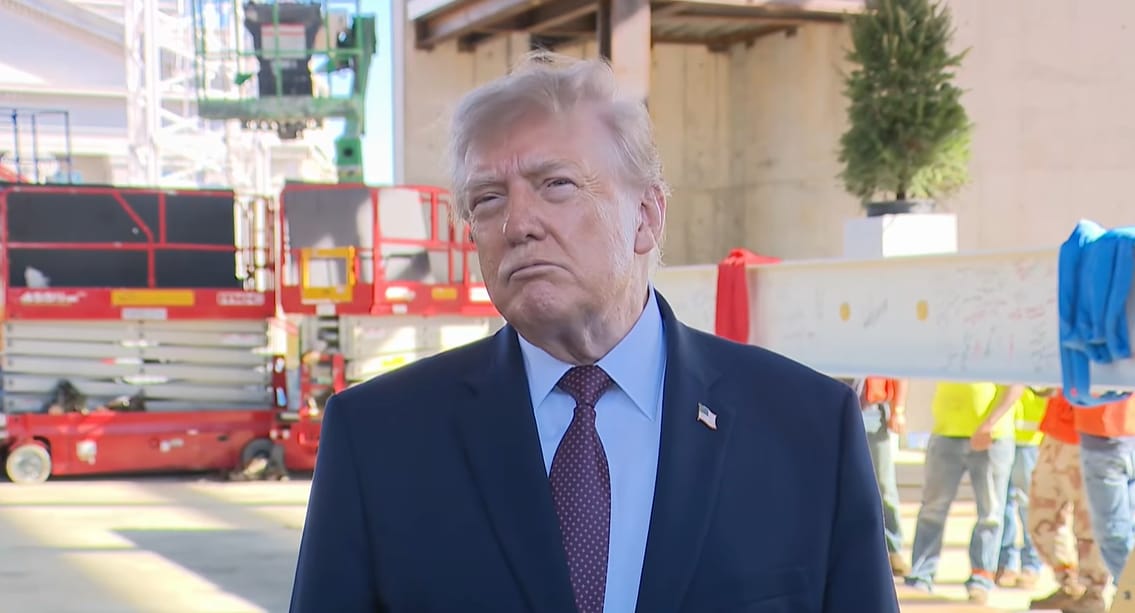
Two words.
That was all it took to puncture months of carefully scripted post-election spin, leaving strategists in Washington scrambling for cover while millions of exhausted voters simply nodded at their kitchen tables. "Largely true." When Donald Trump uttered those two words in response to a blunt question about whether the conflict with Iran had cost his party the midterm elections, he wasn't just offering an off-the-cuff soundbite for the evening news cycle; he was accidentally pulling back the curtain on the oldest, most unforgiving law in American politics. You can promise a golden age of domestic renewal, you can rally crowds with promises of closed borders and cheaper groceries, and you can build an entire political identity around keeping young Americans out of distant desert wars, yet the moment the missiles start flying and the price at the local gas pump ticks upward by forty cents overnight, the electorate stops listening to speeches and starts looking at their bank accounts. Meanwhile, you can explore other events here: The Ghost in the Wreckage.
To understand how a conflict half a world away managed to flip suburban congressional districts in Pennsylvania, Michigan, and Arizona, you have to step away from the cable news panels and look at a hypothetical Tuesday evening in a place like Macomb County, Michigan. Imagine a man named David, a forty-six-year-old tool-and-die maker who voted Republican in 2024 because he believed the promise that foreign entanglements were over and his paycheck would finally stretch past the third week of the month. For David, geopolitics isn't an abstract chess match played on maps of the Strait of Hormuz; it is the exact dollar amount printed on the digital screen at the Marathon station off I-94, and it is the sudden, quiet anxiety he feels when his nineteen-year-old nephew, a newly minted Navy machinist's mate, mentions during Sunday dinner that his carrier strike group's deployment orders just got extended indefinitely. When David walked into the high school gymnasium to cast his midterm ballot, he wasn't thinking about deterrence theory or regional hegemony in the Middle East. He was thinking about the fact that he had been promised peace and prosperity, and instead he got a war he didn't ask for and an inflation spike he couldn't afford.
The Anatomy of a Broken Promise
Every political movement rests on an unspoken contract with its voters, and for the modern populist right, that contract had one non-negotiable clause written in bold ink across the top page. No more endless wars. For nearly a decade, that single commitment served as the movement's sharpest weapon against the political establishment, allowing it to peel away working-class voters who had watched their sons and daughters return from Iraq and Afghanistan with invisible wounds while defense contractors in Northern Virginia bought up waterfront estates. It was a powerful, visceral appeal that cut straight through traditional party lines because it spoke to a bone-deep exhaustion shared by ordinary families from the Rust Belt to the Sun Belt. To explore the bigger picture, check out the detailed article by Associated Press.
Then reality intervened, as it always does when the machinery of global conflict starts turning.
The escalation with Iran did not happen in a vacuum, nor did it arrive without warnings from intelligence analysts and military planners who had spent years mapping out the hair-trigger dynamics of the Persian Gulf. Yet knowing the risks on paper is entirely different from experiencing the political fallout when naval skirmishes, retaliatory strikes, and disrupted shipping lanes collide with an American election calendar. Once the conflict crossed from shadow warfare into open military confrontation, the administration found itself trapped in a classic strategic vice. Backing down looked like weakness in front of domestic hawks and global adversaries alike, while pressing forward meant owning every consequence of a widening regional firestorm.
And those consequences arrived at the speed of global commodity markets. Within weeks of the initial exchanges in the Gulf, crude oil prices surged, erasing months of fragile progress on consumer inflation and sending shockwaves through supply chains that had barely recovered from the disruptions of the early 2020s. Freight costs climbed. Grocery margins tightened. Small business owners who had spent the spring planning to hire an extra driver or upgrade their equipment suddenly froze their budgets, waiting to see whether the Strait of Hormuz would remain open through the autumn. For a party running on economic competence and anti-interventionism, it was the political equivalent of trying to steer a speeding car on black ice while both front tires blew out at once.
Why Voters Punish the Party in Power Even When They Understand the Threat
One of the hardest truths for political insiders to swallow—and one that frequently leaves foreign policy experts baffled—is that voters rarely grade a presidency on the geopolitical necessity of a military crisis. You can spend hours explaining the strategic imperative of countering ballistic missile proliferation or protecting maritime chokepoints, and ninety percent of the electorate will agree with you in principle while still voting against your party in November.
Think of a household budget like a tightly strung suspension bridge. In calm weather, the bridge carries daily traffic without anyone noticing the tension in the steel cables. Add a sudden, violent crosswind—a spike in energy prices, a dip in the 401(k), a headline about reservists being called up—and the entire structure begins to sway, forcing everyone on it to grab the railings and look for someone to blame. In American midterm elections, the person standing at the tollbooth is always the president's party, regardless of who started the storm.
History is littered with the wreckage of administrations that assumed national security crises would automatically rally the public around the flag. In 1952, Harry Truman's approval ratings collapsed under the weight of a stalemated war in Korea and rising domestic prices, handing the White House to Dwight Eisenhower. In 1966, Lyndon Johnson watched his massive congressional majorities evaporate as the escalating war in Vietnam began draining both the Treasury and the patience of middle-class families. Even George H.W. Bush, fresh off a decisive military triumph in the 1991 Gulf War, discovered eighteen months later that victorious parades do not insulate an incumbent from an economic downturn at home.
What made the Iran conflict uniquely corrosive during this midterm cycle was the sharp sense of ideological betrayal it triggered among the base. Democrats didn't suddenly fall in love with the administration's critics, nor did progressive voters surge in unprecedented numbers to save the day for the opposition. Instead, tens of thousands of core populist voters simply stayed home, or left the congressional line blank while voting only on local ballot measures. When a political coalition is built on skepticism of Washington's foreign policy establishment, watching its own leaders adopt the exact playbook they once condemned creates a quiet, devastating demoralization that no amount of campaign advertising can cure.
The Invisible Toll Inside the Suburbs
If you want to know why a congressional race is lost, don't look at the fiery speeches delivered at airport rallies; look at the text messages exchanged between mothers in suburban school pickup lines at three o'clock in the afternoon.
I remember talking to a longtime precinct captain in suburban Ohio during an earlier cycle when foreign tensions were boiling over, and she described a phenomenon she called "the kitchen-table veto." Nobody in her neighborhood was marching in the streets with protest signs, and nobody was calling into local talk radio to debate enrichment centrifuges or naval rules of engagement. Instead, people were quietly cancelling summer road trips because gas had jumped past four dollars a gallon, and high school seniors were having tense, whispered conversations with their parents about whether joining the military reserve to pay for college still felt like a safe bet. That kind of low-grade, persistent dread doesn't show up cleanly in early polling, because voters are often reluctant to tell a stranger on the phone that they feel let down by the leader they championed two years earlier. It sits beneath the surface, unspoken and unresolved, until the curtain closes inside the voting booth.
When Trump acknowledged that the war with Iran was "largely" responsible for his party's midterm defeat, he broke one of Washington's cardinal rules: never admit that your own signature policy decision broke your coalition. Most politicians in his position would have blamed weak candidates, unfair media coverage, demographic shifts, or bad turnout models—anything to preserve the illusion of infallibility. By conceding the point so plainly, he inadvertently validated every frustrated voter who felt that the administration had lost sight of its original mission.
Yet that candor also exposed a deeper vulnerability that neither party has figured out how to solve. Modern American presidents have accumulated vast, nearly unchecked authority to initiate military action abroad without waiting for a formal declaration of war from Congress, allowing crises to escalate rapidly before the public even realizes the stakes. At the same time, the economic and human costs of those decisions remain stubbornly democratic, landing squarely on the shoulders of working families who have no seat in the Situation Room and no say in the targeting coordinates.
Where the Wreckage Leaves Washington
Inside the Beltway, the post-mortem finger-pointing began before the final absentee ballots were even counted. Party hawks insisted the mistake wasn't confronting Iran, but failing to prosecute the campaign aggressively enough to end it before autumn. Populist commentators fired back that the administration had allowed itself to be lured into a trap by entrenched defense interests, trading away a durable domestic majority for a quagmire in the Middle East. Meanwhile, opposition lawmakers who had spent months criticizing the handling of the crisis suddenly found themselves holding committee gavels, tasked with conducting oversight over a conflict that remained dangerously unresolved.
None of that institutional maneuvering changes the reality facing ordinary Americans watching from outside the capital. The midterms are over, the yard signs have been pulled from the lawns and stacked in the garage, and the pundits have already moved on to handicapping the next presidential cycle. Yet out in Macomb County, the price of diesel hasn't magically dropped back to where it was before the first missiles launched, and David's nephew is still standing watch on the deck of a warship six thousand miles from home, waiting for orders that nobody in Washington seems able to explain.


