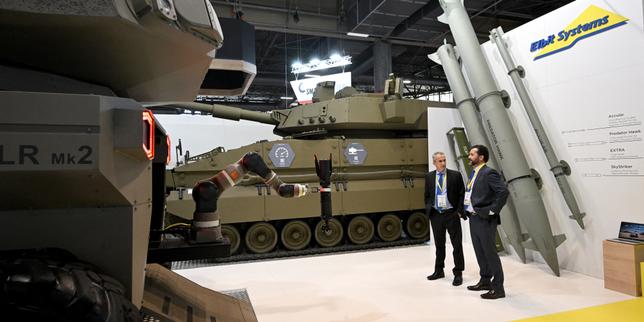
The decision by the French Ministry of Armed Forces and the Defense Council to restrict Israeli defense firms at the Eurosatory exhibition reveals a structural realignment where state diplomacy acts as a proxy for market protectionism. By banning government representatives, eliminating the Israeli national pavilion, and enforcing a strict binary partition between permissible air defense technologies and prohibited offensive weapons systems, Paris has executed a high-stakes intervention. The move goes beyond diplomatic posturing; it directly alters the competitive dynamics of the international arms trade.
The friction exposes a structural vulnerability in global defense marketplaces where state sovereignty and commercial competition intersect. While the official narrative anchors the decision to geopolitical escalation, an economic breakdown demonstrates that the restriction serves a dual purpose: enforcing state-level foreign policy objectives while insulating domestic defense primes from highly competitive non-European alternatives.
The Dual-Use Fallacy: Breaking Down the Defensive-Offensive Architecture
The core operational mechanism of the restriction relies on an artificial binary: permitting anti-ballistic and air defense systems while blocking missile, rocket, and precision-guided offensive munitions. In modern military architecture, this distinction is technically and operationally flawed.
The structural interdependencies of these technologies make partitioning them ineffective due to two major engineering bottlenecks:
- Kinetic Dual-Use Symmetry: The fundamental propulsion, guidance, and tracking systems driving an anti-air interceptor are technically interchangeable with offensive surface-to-surface or surface-to-air systems. For example, command-and-control software modules optimizing radar telemetry for intercepting a threat utilize identical algorithms to compute ballistic vectors for offensive strikes.
- Industrial Capital Allocation: Defense primes do not operate isolated revenue pipelines for defensive versus offensive systems. Subsidies, research and development breakthroughs, and manufacturing efficiencies generated by producing air defense components directly lower the marginal cost of producing offensive capabilities.
By forcing exhibitors to strip their portfolios down to defensive systems, the French government disrupts the bundled procurement models favored by international defense delegations. Buyers do not acquire single-siloed components; they invest in integrated battlespace management networks. Restricting the offensive nodes of these networks breaks the commercial continuity required to secure multi-billion-dollar sovereign contracts.
The Protectionist Incentive: Market Share Rivalry in Europe
The Israeli Ministry of Defense explicitly noted that the policy stems from a combination of political and commercial calculations. To validate this hypothesis, one must analyze the export portfolios of both nations. France and Israel directly compete for market share in identical technological verticals across Eastern Europe, Asia, and NATO member states.
| Technology Vertical | French Prime Competitors | Israeli Counterparts | Market Friction Point |
|---|---|---|---|
| Precision Strike / Anti-Tank | MBDA (Akeron MP) | Rafael Advanced Defense Systems (Spike Family) | European Land Forces modernization contracts |
| Unmanned Aerial Systems (UAS) | Safran, Thales | Elbit Systems, Israel Aerospace Industries (IAI) | Tactical reconnaissance and loitering munitions procurement |
| Radar & Electronic Warfare | Thales | ELTA Systems | NATO-compatible early-warning air surveillance networks |
By removing or degrading a competitor’s ability to showcase operational capabilities at Europe's largest land defense exhibition, domestic primes gain an artificial structural advantage.
This creates an immediate barrier to entry for foreign firms seeking to capitalize on the rapid defense modernization budgets across Europe. The restriction acts as a non-tariff trade barrier, leveraging regulatory and security compliance structures to choke off a competitor’s pipeline to regional buyers.
The Cost Function of Sovereign Procurement Boycotts
Every state action in the defense sector triggers an equal and opposite reaction in the global supply chain. In response to mounting French restrictions—including the 2024 Eurosatory ban attempt and the 2025 Paris Air Show partition walls—the Israel Ministry of Defense instructed its procurement branches to reduce purchases from French suppliers to zero.
This decoupling strategy operates on a clear mathematical calculus. The financial impact of a bilateral procurement boycott is asymmetrical, heavily favoring the state with less reliance on the other's industrial base:
$$C_{\text{boycott}} = \Delta P_{\text{alternative}} + \Delta T_{\text{integration}} - R_{\text{lost}}$$
Where:
- $\Delta P_{\text{alternative}}$ is the price differential of sourcing components from alternative suppliers (e.g., United States or domestic production).
- $\Delta T_{\text{integration}}$ is the technical cost of modifying current systems to accommodate non-French hardware.
- $R_{\text{lost}}$ is the long-term revenue lost by the boycotting state's domestic firms due to reciprocal exclusion.
Because Israel's defense procurement is deeply integrated with United States Foreign Military Financing (FMF) allocations and highly developed domestic supply lines, its exposure to French defense exports is minimal. Conversely, French defense primes depend heavily on export markets to maintain production scale and subsidize domestic military programs. By zeroing out French procurement, Israel minimizes its strategic exposure while denying French suppliers access to a highly lucrative testbed market for subsystem components.
Legal and Structural Precedents for International Exhibitions
The decision by COGES Events and the French government deliberately challenges established legal precedents. During the 2024 Eurosatory dispute, the Paris Commercial Court and the Court of Appeal ruled that the wholesale exclusion of Israeli exhibitors was discriminatory and violated free-market competition principles.
To circumvent previous judicial defeats, the state modified its tactics. Rather than implementing a total ban, it enacted targeted functional restrictions. This pivot highlights a shift in regulatory enforcement:
- State Sovereignty vs. Corporate Entity Autonomy: The state utilizes the "Defense Council" mandate as an act of government (acte de gouvernement), a legal classification that isolates the decision from standard commercial court jurisdiction, neutralizing the avenue of appeal used by corporate litigators in previous years.
- The Precedent of Physical Isolation: The 2025 Paris Air Show demonstrated the utility of physical obstruction (erecting black partition walls) to enforce regulatory compliance. The 2026 Eurosatory model refines this by stopping compliance issues at the door: checking bills of materials before any display item arrives at Paris Nord Villepinte.
This strategic evolution sets a precedent for how international trade shows can be weaponized as tools of asymmetric statecraft. If host nations can selectively filter product categories based on current foreign policy alignments, the neutrality of global defense forums is fundamentally compromised.
The Strategic Realignment of Global Purchasing Power
The disruption of traditional trade show mechanics forces a reallocation of marketing and procurement resources. The immediate consequence will not be a reduction in arms sales, but rather a structural migration of purchasing power to alternative, less restrictive geographic hubs.
The Rise of Non-European Defense Hubs
As European venues impose ideological and political filters on hardware displays, international defense deal-making will increasingly shift to centers like the Gulf states, South Korea, and the United States. Venues that maintain strict commercial neutrality will capture the high-density networking and multi-billion-dollar contract signings that previously anchored European defense expos.
Accelerated Supply Chain Autarky
Firms facing arbitrary regulatory exclusions are systematically incentivized to eliminate European components from their sub-assembly supply chains. By stripping out French or European-regulated sensors, software, or microelectronics, global defense manufacturers ensure their end-products are free from European export control interventions, making them more attractive to third-party non-aligned nations.
The immediate operational playbook for targeted defense firms requires bypassing traditional state-sanctioned European expos entirely. Resources must be redeployed into direct, bilateral sovereign demonstrations and deeper integration with defense ecosystems that prioritize raw technical performance over fluctuating diplomatic consensus.