Diego Garcia functions as the premier forward-operating node for Western power projection across the Indian Ocean basin because it minimizes the operational friction of distance while completely eliminating host-nation political risk. Unlike traditional overseas military installations bounded by local sovereign leverage, Diego Garcia’s strategic utility stems from a absolute operational sovereignty combined with a geographic position that commands three critical maritime choke points: the Strait of Malacca, the Strait of Hormuz, and the Bab-el-Mandeb.
Evaluating the base requires analyzing three distinct vectors: sovereign insulation, power-projection mechanics, and long-term structural vulnerability.
Sovereign Insulation and Political Risk Elimination
Military forward bases typically suffer from host-nation volatility. Installations in sovereign third-party territory operate under constant threat of lease renegotiation, status-of-forces agreement (SOFA) restrictions, political revolution, or operational vetoes during sensitive regional conflicts.
Diego Garcia operates under a fundamentally different model.
The Legal Framework
The creation of the British Indian Ocean Territory (BIOT) in 1965 established an administrative construct designed specifically to sever the Chagos Archipelago from Mauritius prior to Mauritian independence. The subsequent bilateral agreements between the United Kingdom and the United States established a lease model based on administrative exclusivity.
- Exclusion of Resident Populations: The relocation of the indigenous Chagossian population between 1968 and 1973 removed internal political pressure, civil unrest risks, and domestic electoral friction.
- Absolute Operational Freedom: U.S. forces operate free from foreign parliamentary oversight, flight-path approvals, or mission-veto power.
- Strategic Bilateral Alignment: The sovereign authority rests with a senior NATO ally (the UK), ensuring that long-term lease renewals align with Western security architecture rather than shifting domestic politics.
This structural insulation allowed Diego Garcia to serve as a unrestricted staging ground for strike operations during Operation Desert Storm, Operation Enduring Freedom, and Operation Iraqi Freedom without requiring real-time diplomatic authorization for strategic bomber sorties.
Geographic Command and Range Metrics
The value of a forward logistics node is inversely proportional to the transit time required to project combat mass into operational theaters. Diego Garcia sits in the central Indian Ocean, approximately 1,000 nautical miles south of India and roughly equidistant from major flashpoints in the Middle East, East Africa, and Southeast Asia.
The Power Projection Radius
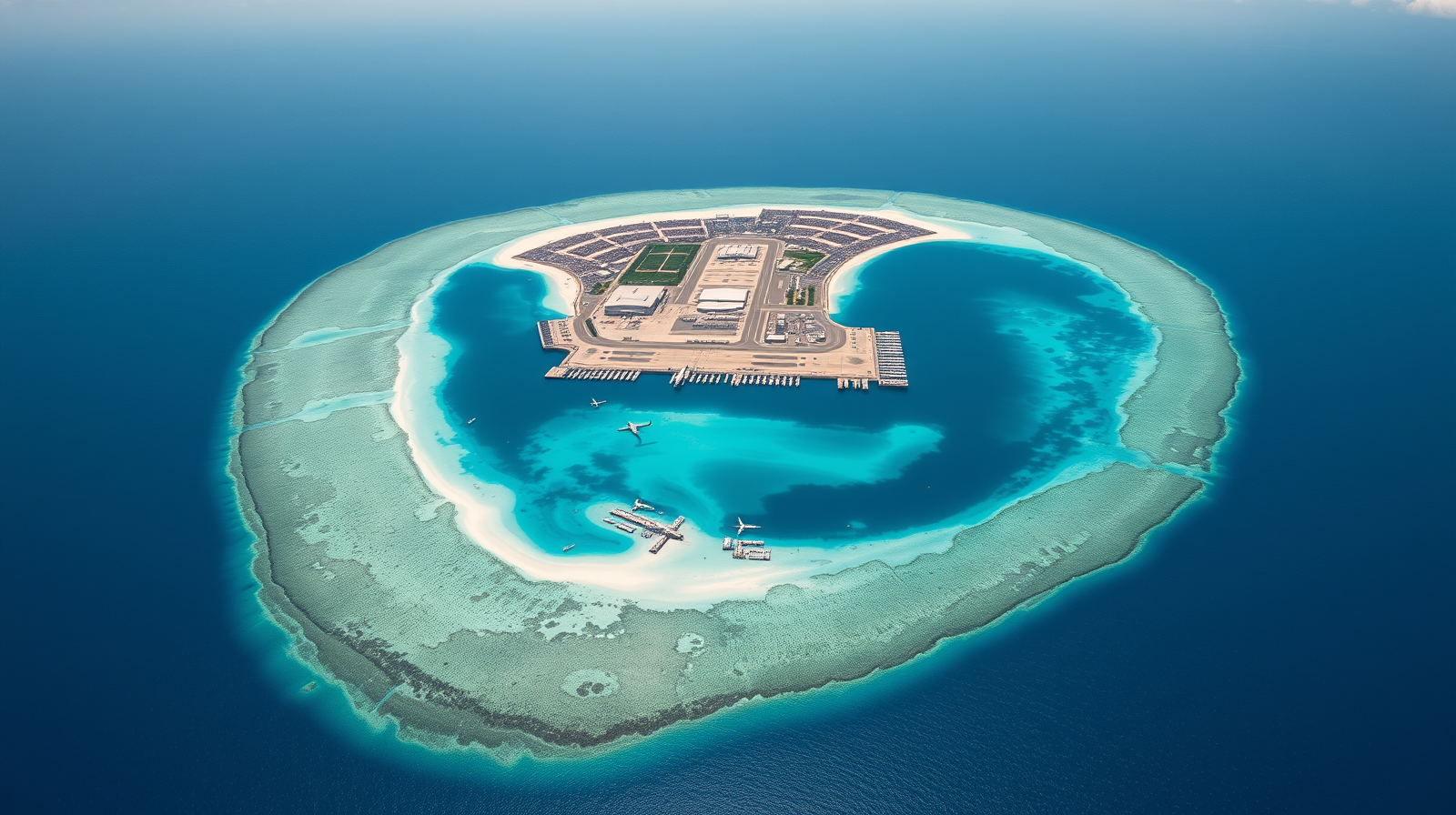
The strategic calculus of Diego Garcia is built on unrefueled and aerial-refueled combat radii from the island's dual 12,000-foot runways.
- Persian Gulf and North Arabian Sea: Approximately 2,000 to 2,500 nautical miles. Strategic bombers (B-52, B-2, B-21) can execute heavy-payload strike missions without depending on regional allies in the Middle East for basing or overflight rights.
- Strait of Malacca: Approximately 1,600 nautical miles. The base provides continuous maritime domain awareness and strike capability over the principal sea line of communication (SLOC) connecting East Asia to Middle Eastern energy supplies.
- East African Littoral: Approximately 2,000 nautical miles. It offers long-range surveillance and rapid deployment capacity across the Western Indian Ocean.
Deep-Water Lagoon Mechanics
Flight infrastructure represents only half of the capability equation. The geography of Diego Garcia features a natural coral atoll enclosing a deep-water lagoon capable of anchoring large naval fleets and pre-positioned supply ships.
The primary asset inside the lagoon is the Military Sealift Command's Prepositioning Ship Squadron. These specialized vessels store heavy equipment, ammunition, fuel, and medical supplies for land-based combat units. Instead of steaming heavy armor from CONUS (Continental United States) ports—a process taking weeks—personnel can be flown directly into Diego Garcia’s airfield, board the pre-positioned vessels, and deploy fully equipped combat elements into theater within days. This reduces the deployment loop for heavy ground or littoral forces by several weeks.
The Cost Function and Structural Vulnerabilities
While Diego Garcia eliminates conventional political constraints, it introduces distinct operational vulnerabilities rooted in its geography and legal status.
Logistical Resupply Bottlenecks
The base produces no native resources. Every barrel of aviation fuel, ton of ordnance, gallon of fresh water (via desalination), and calorie of food must be imported via long sea lines or strategic airlift.
- Fuel Dependency: A high-tempo strategic bombing campaign consumes millions of gallons of JP-8 daily. Disruption to the maritime tanker resupply chain rapidly reduces operational readiness.
- Single-Point Airfield Vulnerability: Dual parallel runways provide redundancy against single-aircraft accidents, but a coordinated missile strike against the runway surfaces or the fuel farm halts flight operations completely.
Missile Salvo Dynamics and Defense Limits
Historically, Diego Garcia's primary defense was its isolation; it lay beyond the operational range of most regional combatants. The proliferation of long-range precision strike assets, anti-ship ballistic missiles (ASBMs), and intermediate-range ballistic missiles (IRBMs) alters this equation.
A adversary employing saturation salvo tactics faces significantly fewer target coordinates on an atoll measuring roughly 12 square miles in land area compared to a continental basing network. Defensive surface-to-air missile systems (such as AEGIS or THAAD platforms) face inventory exhaustion when subjected to high-density, multi-axis cruise and ballistic missile attacks.
Diplomatic and Legal Friction
The legal architecture constructed in the 1960s faces increasing friction from international courts and institutions.
- ICJ Advisory Opinions: International Court of Justice rulings regarding the decolonization of Mauritius have categorized the UK's continued administration of the Chagos Archipelago as unlawful.
- UN General Assembly Resolutions: Broad international diplomatic support for Mauritian sovereignty claims creates persistent diplomatic overhead for both London and Washington.
- Lease Extension Nuances: Subsequent political agreements attempting to transfer sovereignty to Mauritius while securing a long-term, 99-year lease for the military base introduce a host-nation dynamic that the original 1965 structure explicitly sought to avoid.
Operational Realignment Protocols
To maintain the operational utility of Diego Garcia over a 20-year horizon, force planners must execute three specific realignments:
First, harden infrastructure by constructing dispersed, underground fuel distribution networks and reinforced aircraft shelters to raise the missile salvo threshold required to neutralize the facility.
Second, integrate Diego Garcia into a wider, distributed network of secondary and tertiary posture sites throughout the Indian Ocean and Australian littoral (Agalega, Cocos Keeling, Darwin). Using Diego Garcia as a central command and logistics hub while dispersing tactical aircraft to austere fields mitigates single-point failure risks.
Third, codify sovereign operational guarantees in any negotiated territorial transfer agreements. If sovereignty over the Chagos Archipelago transitions to Mauritius, the underlying status-of-forces structure must explicitly retain unreviewable, unilateral operational control of the airfield, lagoon, and surrounding maritime zone to prevent future legal vetoes over military deployments.