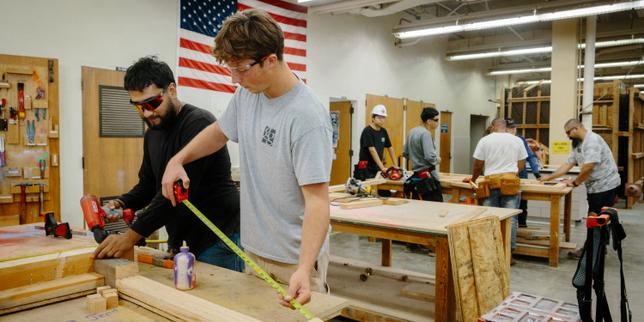
An algorithm cannot crawl under a suburban ranch house to solder a burst copper pipe. That single, stubborn physical reality is driving the most significant shift in American labor demographics since the rise of the personal computer. Across the United States, enrollment in vocational and trade programs is surging while traditional four-year college attendance stagnates, fueled by a generation of young workers calculating that artificial intelligence threatens entry-level desk jobs far more than physical infrastructure.
For decades, the American economic playbook was linear and unquestioned. High school graduates took on tens of thousands of dollars in debt, earned a bachelor's degree, and entered corporate cubicles with the promise of upward mobility. Today, that math no longer works for millions of families. Tuition costs have outpaced wage growth for years, and the rapid deployment of generative AI tools has begun automating the exact entry-level tasks—basic coding, copywriting, financial analysis, and administrative coordination—that once served as the bottom rungs of the white-collar ladder.
The Economics of the Physical World
Follow the money. When a massive server farm goes up in northern Virginia or central Ohio to power the latest cloud computing models, it requires armies of master electricians, HVAC technicians, and pipefitters to keep those processors from melting. The digital economy rests entirely on an analog foundation.
According to data from the National Student Clearinghouse Research Center, enrollment in vocational-focused community colleges has seen sharp, consecutive annual increases, particularly in construction trades, precision production, and vehicle maintenance. While overall undergraduate enrollment has struggled to recover to pre-pandemic levels, trade schools are frequently running waitlists.
The financial calculus is straightforward. A traditional four-year degree routinely leaves graduates with $30,000 to $40,000 in student loan debt before they earn their first paycheck. Conversely, many union apprenticeships and trade programs pay students while they learn. A twenty-two-year-old completing an electrical apprenticeship can enter the workforce debt-free, commanding a starting salary that rivals or exceeds that of a junior marketing associate or paralegal, with substantial overtime potential and strong union benefits.
The Demographic Cliff Nobody Planned For
This sudden enthusiasm for vocational training is colliding with a massive demographic bottleneck. For thirty years, high school guidance counselors pushed students toward universities, treating shop class as a dumping ground for underachievers. As a result, an entire generation skipped the trades.
Now, the Baby Boomers who built and maintained America’s electrical grids, municipal water systems, and commercial buildings are retiring in droves. Industry estimates from organizations like the Associated Builders and Contractors consistently point to a deficit of hundreds of thousands of skilled workers needed just to meet current construction and maintenance demands.
When supply drops and demand stays inelastic, prices rise. Homeowners and commercial property managers feel this every time they call a plumber on a holiday weekend or request a quote for a new heat pump. Labor shortages have pushed hourly billing rates for specialized trades to historic highs, turning skilled technicians into some of the most secure earners in the modern economy.
What Corporate America Gets Wrong About Automation
Silicon Valley executives love to talk about efficiency. Yet boardrooms consistently underestimate the sheer friction of the physical world. Software scales at near-zero marginal cost; plumbing does not. Every residential crawlspace, commercial boiler room, and aging municipal bridge presents unique, chaotic variables that robotics cannot navigate economically.
Consider a hypothetical scenario. Imagine a mid-sized residential plumbing company in Chicago attempting to automate its service calls. Even if robotics engineers built a machine capable of diagnosing a leak, navigating narrow basement stairs, identifying corroded galvanized steel pipes installed in 1924, and cutting them out without damaging surrounding joists, the capital cost of that machine would bankrupt the business. A human journeyman with a van full of tools solves the problem in ninety minutes.
Robotics works brilliantly in controlled environments like automotive assembly plants or Amazon fulfillment centers, where lighting, floor flatness, and object placement are strictly standardized. Outside those walls, human dexterity, spatial reasoning, and on-the-fly improvisation remain completely irreplaceable. Young workers watching tech companies lay off thousands of software engineers and middle managers have drawn an obvious conclusion: physical proximity to the work is the ultimate job security.
The Hidden Toll of the Toolbelt
To paint the skilled trades as a utopian escape from corporate drudgery, however, is dishonest. Anyone who has spent twenty years on concrete floors or in unconditioned attics knows that blue-collar wealth is extracted directly from the human body.
The trade-off is physical depreciation. White-collar workers risk carpal tunnel syndrome and sedentary health issues; ironworkers, roofers, and plumbers risk blown discs, ruined knees, chronic respiratory exposure, and severe acute injuries. Bureau of Labor Statistics data consistently ranks construction, extraction, and installation roles among the most hazardous occupations in the country.
Furthermore, the romanticized vision of the "toolbelt millionaire" ignores the business realities of scaling a trade career. Earning $120,000 a year as a union pipefitter or independent HVAC contractor is entirely achievable, particularly in high-cost-of-living metro areas. Yet hitting that ceiling often requires grueling sixty-hour weeks, emergency on-call shifts in freezing weather, and navigating complex licensing exams, bonding requirements, and liability insurance if one chooses to go independent.
The Fragility of Cyclical Markets
There is also the matter of economic sensitivity. Tech workers learned painfully over the past few years that venture capital dries up when interest rates rise. The trades face their own version of this cycle.
Service and repair work—fixing broken air conditioners, clearing sewer lines, restoring storm-damaged power grids—is largely recession-proof. People cannot ignore a flooded basement regardless of what the Federal Reserve does. New construction, however, is brutally cyclical. When commercial real estate stalls or high mortgage rates freeze residential development, apprentices and junior tradespeople are often the first to see their hours cut or face temporary layoffs.
How Private Equity Is Quietly Buying Up the Trades
A major structural shift is underway behind the scenes that rarely makes it into viral social media posts celebrating trade school enrollment. Wall Street has noticed the recurring revenue and irreplaceable nature of home services.
Over the past decade, private equity firms have aggressively rolled up independent plumbing, electrical, and HVAC companies across North America. They buy out retiring Baby Boomer owners, rebrand local shops under regional umbrellas, and implement aggressive, commission-based sales tactics.
For young workers entering the field, this changes the workplace dynamic. Instead of working for a local master tradesman who prioritizes craftsmanship and mentorship, a new technician might find themselves working for a private-equity-backed franchise that measures performance by average ticket size and upsell conversion rates. Knowing how to fix a furnace is no longer enough; technicians are increasingly pressured to sell lucrative service contracts and full system replacements to homeowners who might only need a $200 capacitor swap.
Rebuilding the Pipeline Without the Stigma
If the United States wants to sustain this momentum and actually close its infrastructure labor gap, enthusiasm alone will not suffice. The training infrastructure itself is badly frayed.
Decades of disinvestment left many public high schools without functional workshops, welding bays, or certified instructors. You cannot teach a teenager how to wire a three-phase commercial panel using a Chromebook. Vocational education requires expensive consumables, heavy machinery, strict safety protocols, and instructors willing to take a massive pay cut from private industry to teach in a classroom.
Community colleges and trade unions are scrambling to expand capacity, yet they face severe bottlenecks in finding qualified faculty. A master electrician earning $140,000 in the field rarely jumps at the chance to make $65,000 teaching first-year apprentices. Until school districts and state legislatures fund technical education on par with college-preparatory tracks, waitlists will persist while critical infrastructure projects stall for lack of manpower.
The New Status Symbol
Culture shifts slowly, then all at once. For forty years, cultural prestige in the West was tethered to proximity to information, abstraction, and capital management. Working with your hands was framed as a fallback option for those who couldn't cut it in academia.
That hierarchy is fracturing. A generation raised entirely on glowing screens is discovering tangible satisfaction in building, repairing, and maintaining physical reality. They see the immediate, undeniable proof of their labor at the end of every shift—a wired house, a running engine, a pressurized water line—without needing a quarterly performance review to validate their existence.
The migration toward the trades is not a temporary fad driven by viral TikTok videos of welders flashing stacks of cash. It is a rational market correction. As software eats routine cognitive labor, the economic value of physical competence rises proportionally. Until someone invents a robot capable of squeezing behind a water heater in a cramped basement, the people holding the wrenches hold the leverage.