The Sound of Velcro in the Void
Fabric has a memory. Every tailor knows this. Wool remembers the slope of a shoulder; cotton records the frantic heat of a sprint; polyester holds the flat, synthetic indifference of a fluorescent warehouse. But what does cloth remember when it is designed for a domain with no up, no down, and no atmosphere?
We have spent decades arguing about the philosophy of space. We debate orbital debris, rocket trajectories, and the geopolitical chess match playing out a few hundred miles above our heads. Yet, when the moment arrived to outfit the newest branch of the United States military, the cultural conversation did not stall on stealth technology, propulsion mechanics, or satellite defense grids.
It stopped dead at the mirror.
Consider what happens next: a multi-billion-dollar military apparatus, tasked with guarding the silent vacuum of the cosmos, steps out in a fresh wardrobe, and the entire internet immediately channels a Saturday morning cartoon villain convention.
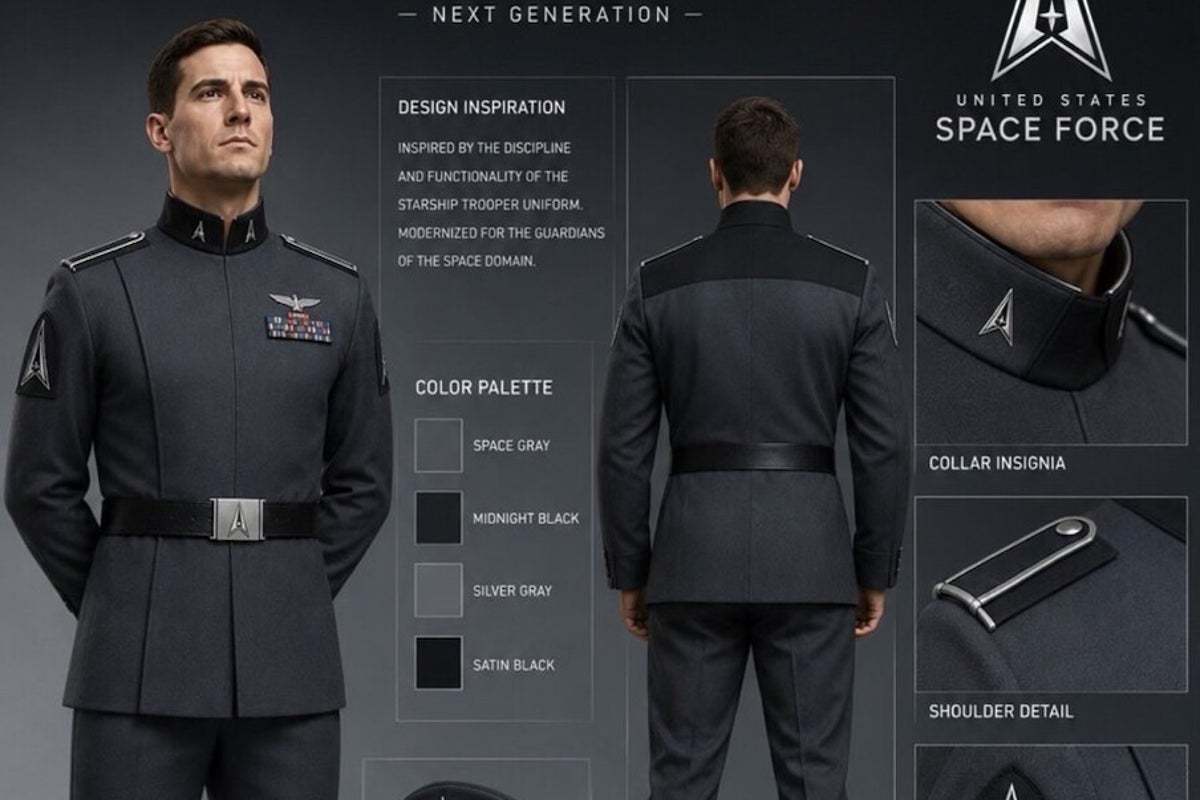
Mockery is a swift and unforgiving weapon. Within hours of the unveiling of the new Space Force uniform prototypes, social media feeds filled with side-by-side comparisons. Galactic Empires. Sci-fi despots. The sort of cinematic antagonists who monologuize while slowly lowering a cage over the hero.
Dark tones. Sharp lines. Collars that stand a little too high, cutting a silhouette that feels less like a modern combat utility and more like an extra waiting for a cue from a director wearing a headset.
Why? Why do we do this?
The Trap of the Cinematic Echo
History is heavy. When you invent something new, you have no template. You are stumbling in the dark, reaching blindly into the cultural ether for something—anything—that signals authority and readiness.
Think about the early days of aviation. The first pilots didn't wear sleek, aerodynamic G-suits; they wore leather caps, goggles, and thick silk scarves. Why scarves? Not for fashion, but to keep the castor oil leaking from early rotary engines from whipping back into their faces. But over time, that functional gear transmuted into a romantic archetype. The daring aviator. The knight of the clouds.
When the Space Force was established, it inherited a vacuum not just of space, but of imagination. We have consumed a century of science fiction. Our collective visual dictionary for people in space is entirely authored by Hollywood, pulp magazines, and franchise merchandise.
So, when designers sit down to sketch a uniform for space operators, their hands are guided ghosts. They cannot escape the gravity of Star Wars, Star Trek, or Battlestar Galactica. The irony is thick enough to cut with a laser cutter. We built a real-world military branch to operate beyond the stratosphere, only to watch its aesthetic get devoured by the very pop culture tropes it is trying to transcend.
It is a trap. If you make the uniforms look too normal—say, standard Army green or Air Force blue with a different patch—people yawn. You lack vision. You aren't dressing for the stars. But if you lean into the futuristic edge, if you dare to design something striking, angular, or dark, the peanut gallery pounces. You become the Empire. You become the punchline.
The Human Weight of Looking Ridiculous
Let us strip away the memes for a moment and look at the person standing inside the cloth.
Imagine a young enlisted specialist, twenty-four years old, sitting in a windowless room at Schriever Space Force Base in Colorado. Outside, the plains stretch flat and brown toward the Rockies. Inside, glowing screens map the silent dance of thousands of satellites—the invisible nervous system of modern navigation, weather forecasting, financial transactions, and missile warning systems.
This specialist did not join the military to become a meme. They joined because the work matters. They monitor anomalies, track orbital conjunctions, and ensure that a stray piece of space junk doesn't take out a constellation of weather sensors vital to farmers in the Midwest.
Then, the new uniform drops.
Suddenly, their daily grind is trending on social media. Strangers on the internet are cracking jokes about the Death Star cafeteria. Late-night television hosts are mocking the collar.
That hurts. Uniforms are supposed to do something specific. They are designed to flatten individuality into collective strength, to wrap a person in a tradition older than the nation itself, to say: I am part of something larger, and you can trust me. When a uniform becomes a pop-culture joke, that psychological armor cracks. It is hard to feel like a serious guardian of the cosmos when your coat makes you look like a misplaced extra from a space opera prequel.
The Functional Paradox
To be fair to the tailors, designing military garb for the twenty-first century is an engineering nightmare.
Traditional military uniforms were built for mud, trenches, and jungle foliage. They needed cargo pockets for compasses, heavy canvas to resist tearing, and camouflage patterns designed to trick the human eye in forests or deserts.
What does a space operator need?
They sit at consoles. They manage data streams. They don't need knee reinforcements for crawling through underbrush; they need breathability for long shifts in climate-controlled operations centers. They don't need woodland camo; they need fabric that doesn't melt instantly in a cockpit or an accidental electrical fire.
When designers attempt to solve these modern, digital-age problems while still satisfying the ancient military craving for ceremonial grandeur, things get weird. You get hybrid garments. You get garments trying to be a combat utility, a business suit, and a movie prop all at once.
And that is where the disconnect happens. The public looks at a uniform through the lens of narrative. We want our heroes to look like heroes, but our cultural definition of a space hero is deeply confused. We oscillate between rugged nostalgia and sleek dystopia.
The Mirror We Did Not Ask For
Perhaps the mockery isn't really about the clothes at all.
Maybe the internet is laughing because the very idea of a Space Force still feels slightly unreal to us. We live in a fractured, chaotic world plagued by terrestrial, messy problems. Poverty, political polarization, crumbling bridges, and ancient hatreds dominate our news feeds. The thought of pouring national resources into guarding the dark void above us can feel jarring, distant, and absurd.
When we see those dark uniforms with their high collars, we aren't just reacting to the tailoring. We are reacting to the audacity of the enterprise. We are laughing to keep from confronting the quiet, terrifying reality that our future is migrating upward, whether we are ready for it or not.
The uniforms will change. Hemlines will drop, collars will lower, colors will shift from prototype dark to whatever practical, durable shade passes muster with procurement boards. The memes will fade into the digital dustbin, replaced by the next viral distraction.
Yet the quiet hum of the terminals in Colorado will continue. The satellites will keep spinning through the dark, tracing silent circles around a world that is still learning how to dress for tomorrow.
The villains of fiction always lose in the end, defeated by farm boys and rebels. But the guardians of the real sky do not get a script. They only get the shift, the screen, and the weight of a uniform that is still trying to figure out what it means to belong to the stars.