Grief is heavy. It has weight, mass, a gravitational pull that bends the days around it. But an empty space has no gravity at all. It is a vacuum. It pulls you upward, leaving you suspended between the world of the living and the phantom realm of the unaccounted for.
Consider what happens when a body vanishes. A mountain swallows a hiker. A swift river pulls a child beneath the foam. A landslide erases a village in the middle of the night, turning homes into silt. The rescue boats go home. The search parties roll up their wet tarps. The official reports are filed away in heavy manila folders, marked with a quiet, bureaucratic finality.
Case closed.
Except the heart does not close cases.
In Nepal, where the vertical majesty of the Himalayas masks a terrifying fragility, families face this suspension constantly. Earthquakes shatter valleys. Treacherous climbing routes claim lives that are never recovered. Rivers swollen by monsoon rains sweep people away into the murky distance. When a loved one does not return, the legal, spiritual, and emotional machinery of life grinds to a halt. You cannot bury a ghost. You cannot inherit property, remarry, or settle an estate without a death certificate. And you cannot issue a death certificate without a body.
So, what do you do when the mountain keeps your dead?
You build a pyre out of straw.
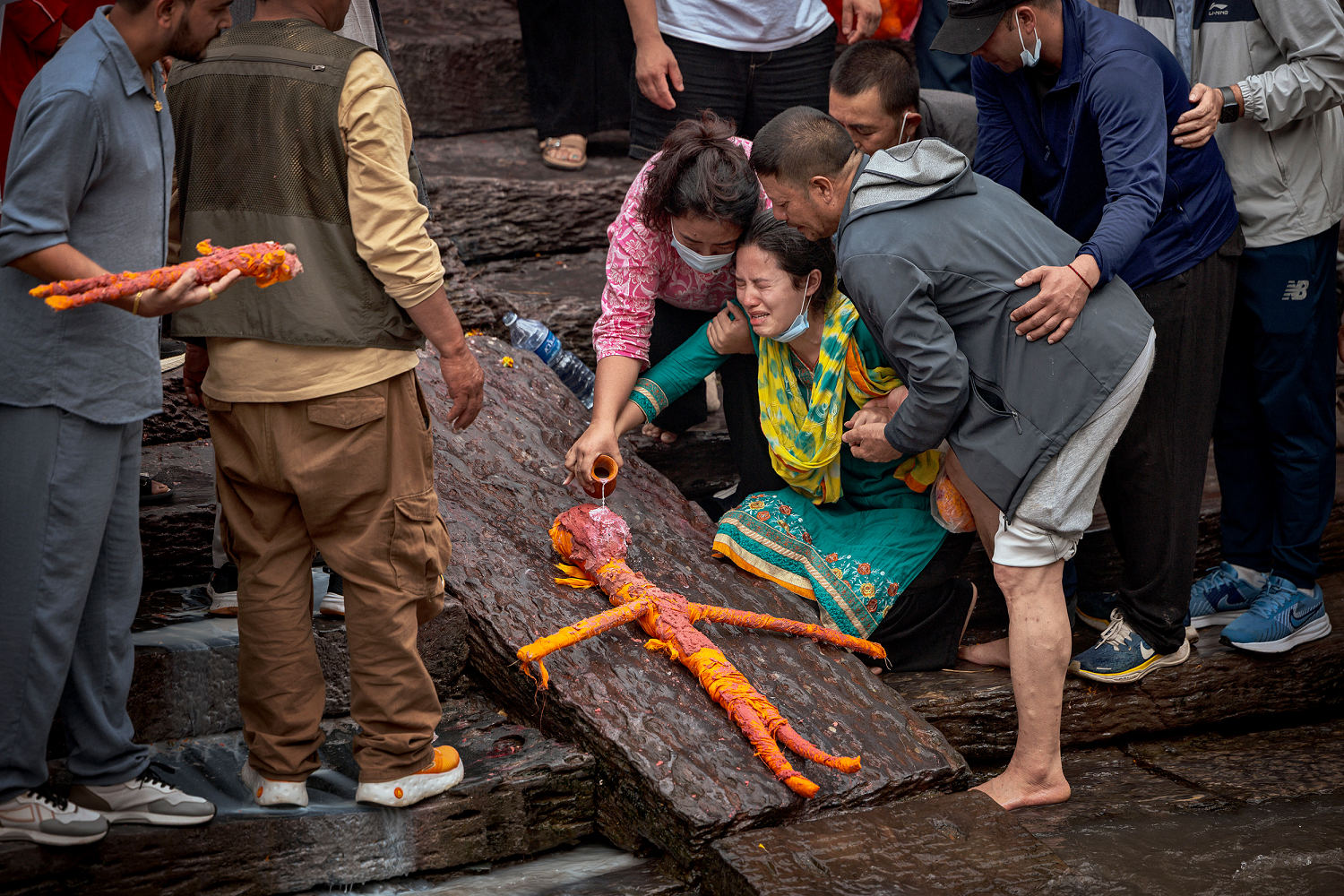
In rituals that pierce the soul with their raw, agonizing necessity, families gather along riverbanks to hold symbolic cremations. Imagine standing by the holy waters of the Bagmati River in Kathmandu, or beside a rushing mountain stream, holding not a beloved brother, mother, or daughter, but a bundle of dry kusha grass. That straw represents the physical form. It is wrapped in white cloth, marked with the personal belongings left behind—a faded shirt, a woolen cap, a silver ring that still holds the shape of a finger.
The match is struck. The flames rise.
Smoke carries prayers upward. In Hindu tradition, fire is the great transformer. It is the psychopomp, the bridge between the physical and the transcendent. Without fire, the soul of the departed is believed to wander, trapped in a purgatorial limbo known as pret state—restless, hungry, unable to cross over.
By burning the straw effigy, the living grant the dead passage. But make no mistake. This is not just a theological exercise. It is a psychological survival mechanism.
Grief requires a container. Without funeral rites, mourning stretches out into an infinite, jagged horizon. Psychologists call this ambiguous loss—a situation of unclear loss that remains unverified and lacks resolution. It is the most toxic form of grief because it paralyzes the coping mechanism. You cannot move through the stages of grief when the first stage—acceptance of the reality of the loss—is denied to you by the sheer absence of proof.
The symbolic cremation provides that proof. It forces the hand of reality. When the straw turns to ash, the family pours water over the embers, shaves their heads in mourning, and sits through the thirteen days of traditional death rituals. They cry real tears onto fake bodies. They mourn a physical absence with a physical act.
It is heartbreakingly clever, this human capacity to invent rituals when reality refuses to cooperate.
We see this pattern across human history whenever catastrophe outstrips our ability to recover our dead. Cenotaphs rise in war memorials for soldiers lost at sea. Empty graves are dug in remote villages after tsunamis. People need a place to put their sorrow. If the earth will not hold the body, the community must hold the space.
When the last ember of the straw pyre dies down in Nepal, the ashes are swept into the river. The water carries them away, past the ancient temples, past the stone steps where monkeys chatter, down toward the plains. The family walks back home under a sky that suddenly feels a little closer to the earth.
The missing person is still missing. The legal battles may still loom. The bed remains unmade in the corner of the room.
But the smoke has cleared. The soul, at least in the hearts of those who loved them, has finally been given permission to rest. And sometimes, in the darkest corners of human endurance, that permission is all we have to keep us from breaking entirely.