The air in Kathmandu does not circulate; it hangs. It is a thick blend of dust from incomplete roadworks, exhaust from thousands of sputtering microbuses, and the faint, sweet scent of incense drifting from temple steps. On a typical afternoon, this mixture simply settles over the valley like a heavy blanket, numbing the senses of the people navigating the crowded alleys of Baneshwor.
But on this afternoon, the air carried something else.
It was the smell of gasoline. Then, a sudden, blinding flash of orange.
When a human being decides to set themselves on fire in public, the reaction of the crowd follows a predictable, tragic sequence. First comes the collective gasp—a sharp intake of breath as the brain struggles to comprehend the sheer impossibility of what it is seeing. Then comes the screaming. Finally, the desperate rush of bystanders throwing jackets, water, and sand onto a body that has already ceased to belong to the living.
For the young people of Nepal, that plume of black smoke was not an isolated tragedy. It was a mirror.
The young man who chose to end his life on the hot asphalt of the capital was not just a statistic in a mental health report. He was a symbol of a generation that feels it has been systematically pushed to the edge of a cliff. Within hours of his death, the shock mutated into something far more volatile. Anger.
The Boiling Point of Kathmandu
To understand why thousands of young people, mostly teenagers and those in their early twenties, filled the streets of Kathmandu the very next morning, you have to look beyond the immediate horror of the self-immolation. You have to look at the quiet, grinding desperation that preceded it.
Imagine a young man. Let us call him Ramesh, a composite of the countless young men and women who crowd the tea shops of the city. Ramesh did everything right. He studied late into the night under the flickering glow of a rechargeable lamp during the years of power cuts. He earned his degree. He wore his best clothes to interviews, carrying a plastic folder filled with certificates that promised him a future.
And then, nothing.
In Nepal, the path to adulthood has become a series of closed doors. The state offers few jobs, and those that exist are often locked behind a wall of nepotism and political patronage. For a young person without connections, the only viable industry seems to be the passport office.
Every single day, thousands of young Nepalese queue up outside the Department of Passports in Kathmandu. They are seeking an exit visa to the Gulf countries, to Malaysia, to anywhere that will take them. They are willing to endure extreme heat, dangerous working conditions, and intense isolation just to send a few thousand rupees back home.
This is the reality. A country exporting its most valuable resource—its youth—to build the skyscrapers of other nations, while its own capital decays under the weight of political apathy.
When the news of the young man’s self-immolation spread across TikTok, Instagram, and Telegram, it acted as a spark dropped into a dry forest. Gen Z did not wait for the political parties to organize rallies. They did not wait for the older generation to tell them how to grieve.
They simply walked out.
The Anatomy of a Protest
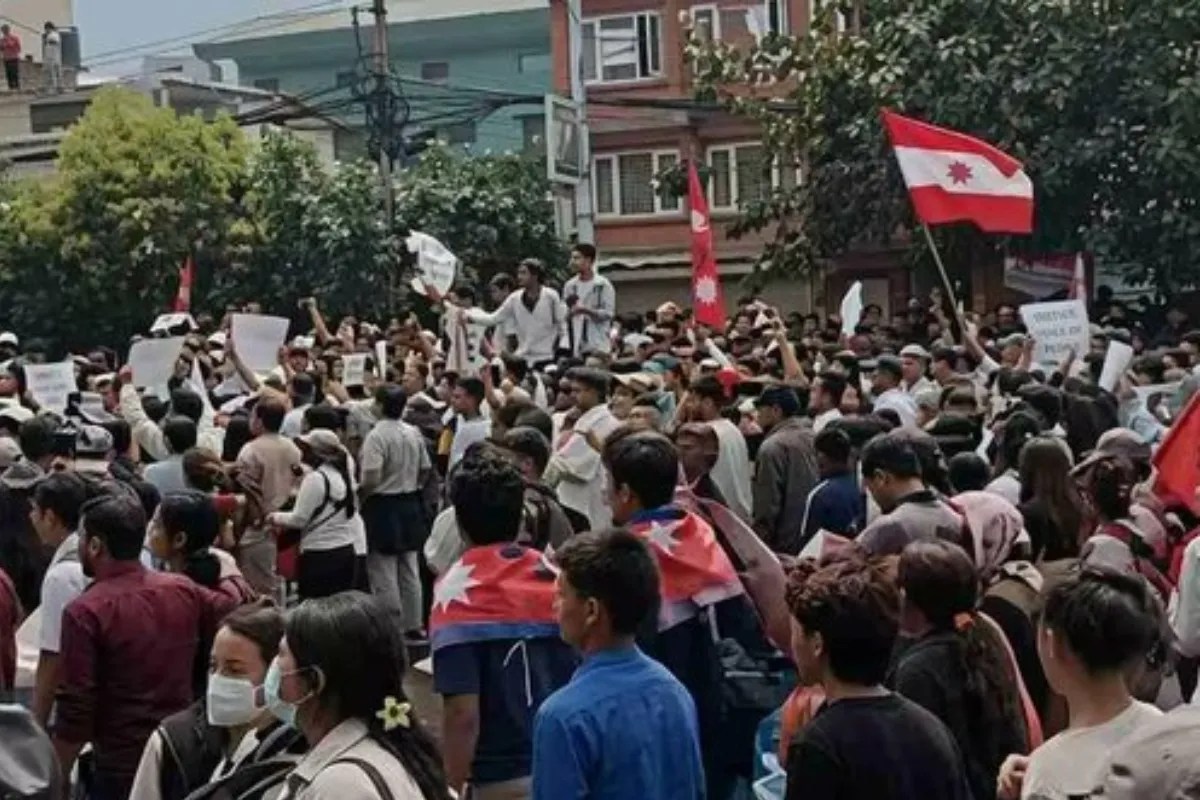
They came with handmade placards. They came with their school bags still slung over their shoulders. Some wore their college uniforms; others wore oversized hoodies and sneakers.
The older generation often dismisses Gen Z as the screen-time generation, distracted by dances on social media and superficial trends. But on the streets of Kathmandu, that digital connectivity became a weapon. Within minutes, coordinates for gatherings were shared. Livestreams broadcasted the police crackdowns in real-time, bypassing the state-controlled narratives and the slow-moving traditional media.
"How many more must burn?" read one sign, held by a young woman whose eyes were red from tear gas.
The police responded with the usual tools of crowd control. Water cannons sprayed chemically treated blue water into the crowd, stinging the eyes and staining the clothes of the protesters so they could be identified and arrested later. Bamboo batons, known as lathis, cracked against pavement and bone.
But the crowd did not disperse. They stood their ground, singing songs of resistance that their parents had sung decades ago during the democratic movements, but with a new, bitter edge.
Consider the irony of the situation. The politicians currently sitting in the parliament building—the very building near where the self-immolation took place—were once young rebels themselves. They had fought against the monarchy, promising a republic where every citizen would have a voice and a future.
Now, decades later, those same leaders remain in power, shuffling positions in endless coalition governments like a deck of cards that never changes. They have become the very establishment they once fought. And to the youth on the street, they look less like leaders and more like ghosts occupying the halls of power.
The Hidden Cost of the Dream
There is a specific kind of grief that comes with knowing your own country does not want you. It is a slow, corrosive feeling. It starts in the stomach and climbs to the throat, leaving a bitter taste that no amount of sweet milk tea can wash away.
This is the invisible stake of the Kathmandu protests. It is not just about a demand for jobs or cheaper education. It is a fight for dignity.
When we look at the numbers, the picture becomes clear. The remittance sent home by migrant workers makes up nearly a quarter of Nepal's gross domestic product. The economy is literally kept alive by the sweat of young people working abroad. Yet, when those same young people ask for basic opportunities at home, they are met with silence.
The self-immolation was a tragic, extreme manifestation of this pain. It was a cry to be seen. In a society where the young are expected to suffer in silence, to defer to their elders, and to quietly board planes to Doha or Dubai, the act of burning oneself in the middle of the street is a horrific refusal to go quietly.
It says: If you will not hear my voice, you will see my fire.
The protest organizers, speaking through megaphones over the roar of police sirens, made it clear that they are tired of promises. They are tired of the five-year plans that lead nowhere. They are tired of watching their friends pack their lives into cardboard suitcases at the Tribhuvan International Airport.
A Crack in the Silence
As the sun began to dip behind the hills surrounding the Kathmandu valley, casting long, dark shadows across the protest sites, the energy did not dissipate. Instead, it deepened. Candlelight vigils began to appear on the spots where the water cannons had recently sprayed.
Small circles of light flickered against the dark asphalt.
The government will likely announce a committee. They always do. There will be an investigation, a report compiled on expensive paper that will eventually find its way into a dusty filing cabinet in some forgotten government ministry. They will promise reforms. They will appeal for calm.
But something has shifted in the air of Kathmandu.
The fear is gone. In its place is a cold, calculated realization among the youth that they are entirely on their own. The older generation’s promises are bankrupt. The political slogans have lost their magic.
This is not a temporary riot that will end when the tear gas clears. It is the beginning of a long reckoning. The fire that consumed a young man in the streets of Kathmandu has illuminated a truth that the leaders of Nepal have spent years trying to ignore.
You cannot build a nation by exporting its soul.
The candles on the pavement continue to burn, small and fragile against the mountain wind, but stubborn. They are a reminder of a life lost, and of a generation that has finally decided it has nothing left to lose.