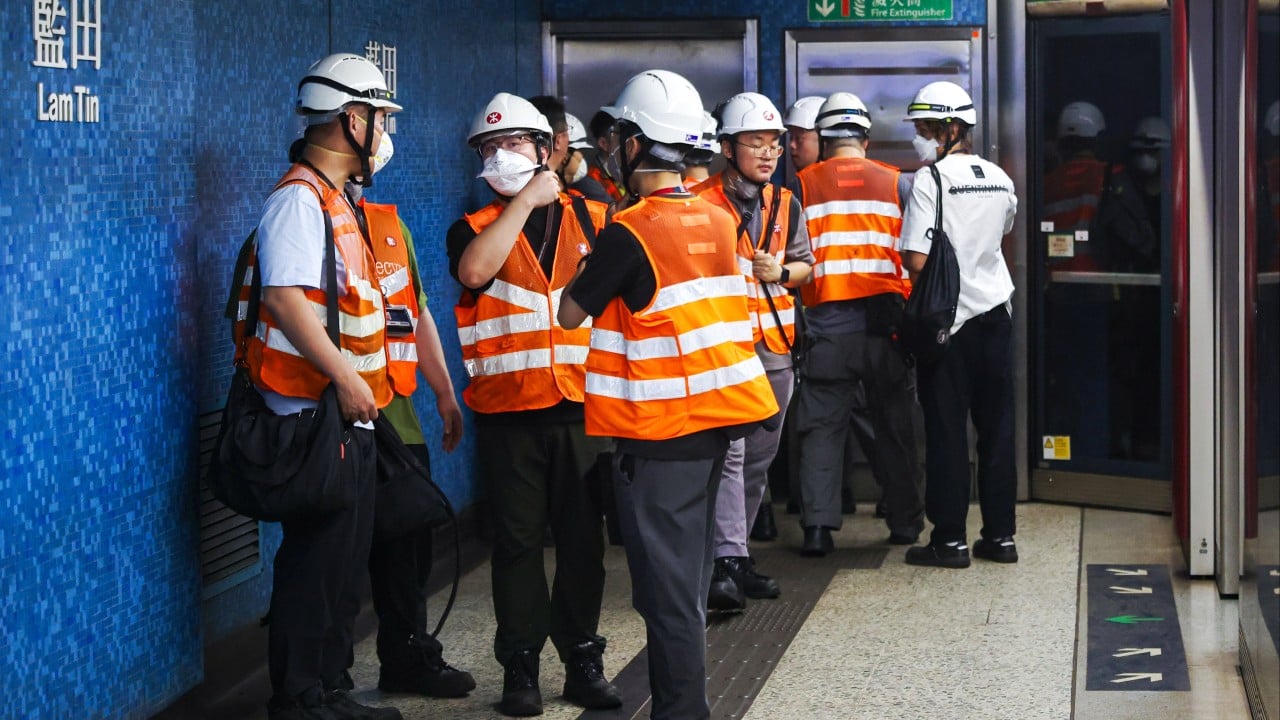
At 6:45 on a Tuesday morning in Kowloon East, the air inside Lam Tin station smells faintly of damp concrete, ozone, and the sharp, sweet tang of warm soy milk cooling in paper cups.
If you have ever ridden the Kwun Tong Line during the morning rush, you know the choreography by heart. You do not walk so much as surrender to a current. Thousands of shoulders angle inward. Octopus cards tap against plastic readers in a rapid, percussive rhythm—beep, beep, beep—like a giant mechanical heart beating at two hundred pulses a minute. People stare at the glowing strip maps above the sliding doors, calculating transfer times at Yau Tong or Prince Edward down to the second. They are nurses heading to United Christian Hospital, teachers clutching graded essays, line cooks, bankers, and grandparents taking toddlers to kindergarten.
They do not think about signal relays. They do not think about track circuits or high-voltage switchgears buried beneath the granite hills of East Kowloon. Why would they? For decades, Hong Kong’s Mass Transit Railway has operated with a clockwork arrogance that trained an entire city to treat miracle-level engineering like tap water. You turn the handle. The train arrives.
Until it doesn't.
Twice in the span of fifteen hours, the invisible machinery beneath Lam Tin station stuttered, coughed, and forced tens of thousands of lives out of the tunnels and onto the gridlocked streets above. When the dust settled and the shuttle buses finally cleared the curbs, MTR Corporation issued its technical post-mortem. To the casual reader skimming a morning headline, the explanation sounded dry, bureaucratic, almost clinical: the two service disruptions were not random coincidences, nor were they entirely separate accidents. They were linked faults. A chain reaction hiding inside the steel nerves of the railway.
Silence.
That is the most terrifying sound on a subway platform. Not the screech of brakes, not the roar of tunnel wind pushing ahead of an approaching eight-car train, but the sudden, heavy stillness when the overhead displays go blank and the ventilation fans seem to grow louder in the absence of movement.
The Anatomy of a Domino Effect
To understand what actually happened inside the rock cavern of Lam Tin station, picture a fictional commuter—let’s call him Marcus—standing near the third car door on the platform bound for Tiu Keng Leng.
Marcus is twenty-nine, a logistics coordinator whose boss tracks arrival times to the minute. During the first disruption, Marcus watches the yellow safety line fill up three rows deep while the station broadcast repeats its polite, bilingual apology. Overhead, deep inside the cable ducts and equipment rooms that passengers never see, a specific component has failed. In rail engineering, modern signaling and power distribution networks are built on redundancy—backup systems watching over primary systems, like a tightrope walker working above three layers of safety nets.
When a primary fault occurs—say, an anomaly in a trackside signaling module or a power supply circuit feeding a specific section of rail—the system is designed to fail safely. That is a critical distinction most commuters miss when they are sweating on a crowded platform. A train stopping dead in a tunnel is not a sign that the railway is reckless; it is proof that the safety architecture is working. The computers refuse to let a train move forward into a zone whose status cannot be verified with one hundred percent certainty.
During the first incident at Lam Tin, technicians scrambled into the restricted corridors behind those unmarked gray doors you walk past every day. Under the pressure of a ticking clock and an angry rush-hour crowd, engineers isolated the initial fault, bypassed or replaced the compromised hardware, and restored service. The trains rolled again. Marcus made it to his desk, breathless and forty minutes late. The city exhaled.
But complex infrastructure has a long memory.
Think of an aging apartment building where a pipe bursts behind the kitchen wall. You shut off the main valve, patch the copper joint, and turn the water back on. Everything looks dry. Yet three rooms away, the sudden spike in water pressure from restarting the line finds a weakened gasket that has been quietly degrading for six years. Fifteen hours later, your living room ceiling collapses.
That is the essence of a linked fault. When MTR engineers resolved the first failure at Lam Tin, the electrical and diagnostic stress of resetting, re-energizing, and bringing the system back under full passenger load exposed a secondary vulnerability down the line. What looked on a control room monitor like a clean recovery had actually left a latent strain on a connected circuit. Less than a day later, while the evening or early-morning traffic pressed against the system, that secondary component gave way.
Why "Linked" Is the Word That Matters
When a transit operator admits that two disruptions within fifteen hours are connected, it triggers a very specific kind of public anxiety. A single mechanical failure is bad luck—a stray bolt, a fried capacitor, an act of industrial entropy. Two linked failures in under a day suggest something harder to swallow: that the diagnostic net missed the full blast radius of the first event.
I have stood on those platforms during signal failures. I remember the particular helplessness of watching the minutes tick past on a phone screen while the crowd around you shifts from mild irritation to claustrophobic dread. You check the MTR Mobile app, watching the red alert banner pulse at the top of the screen. You weigh your options. Do you climb the four long escalators out of Lam Tin’s deep cavern—one of the deepest stations on the network—only to discover a three-hundred-person queue snaking around the bus terminus on Lei Yue Mun Road? Or do you stay underground, gambling that the engineers in the control room at Tsing Yi are sixty seconds away from flipping the switch that brings the tunnels back to life?
Every commuter in Hong Kong has played that psychological poker game. And every time, your bet rests on an unspoken contract with the people maintaining the tracks while the city sleeps.
Between 1:30 a.m. and 4:30 a.m., when the shutters drop over the station entrances, the MTR transforms into a nocturnal construction site. Hundreds of workers in yellow reflective vests descend onto the tracks with ultrasonic flaw detectors, thermal cameras, and insulated wrenches. They have roughly three hours—sometimes less—to inspect miles of rail, test thousands of relay switches, and tighten joints shaken loose by nineteen hours of non-stop train traffic.
Now consider the geometry of Lam Tin itself.
Opened in 1989 as part of the Eastern Harbour Crossing project, Lam Tin is not a simple, flat-bottomed trench dug beneath a wide boulevard. It is carved directly into a hillside. The tracks dive steeply toward the harbour tunnel on one side and climb toward Kwun Tong on the other. Steep gradients mean higher mechanical stress on braking systems, heavier electrical draws when eight-car trains accelerate uphill out of the station, and tighter quarters for maintenance crews working inside curved, subterranean chambers. Heat builds up differently here. Moisture seeps through the surrounding rock differently here.
When a fault strikes a node like Lam Tin, it does not stay neatly contained inside one box. The Kwun Tong Line acts as a spinal cord connecting the dense residential towers of Tseung Kwan O and East Kowloon to the commercial arteries of Mong Kok and Central. Choke off Lam Tin, and the backup ripples backward within minutes. Trains stack up at Yau Tong. Platforms at Kwun Tong overflow. Passengers spill onto surface roads where double-decker buses sit bumper-to-bumper in lanes never designed to absorb fifty thousand displaced rail riders at once.
The Trap of World-Class Reliability
There is an irony buried in Hong Kong’s frustration with the MTR, and it is worth confronting honestly.
For years, the MTR has boasted an on-time performance rate hovering above 99.9 percent. In almost any other major metropolis on earth—New York, London, Paris—a transit agency with that record would have statues built in its honor. Yet in Hong Kong, that very perfection created a dangerous cultural blind spot. Because the trains almost always ran, the city built its entire rhythm of life around the assumption that they could not fail.
Employers rarely build a thirty-minute transit buffer into shift schedules. Schools penalize tardiness to the minute. Real estate prices are calculated by walking distance to the nearest station exit. When you build an entire urban ecosystem without slack, even a brief mechanical hiccup feels like a civic betrayal.
At the same time, high reliability can breed institutional tunnel vision inside a maintenance organization. When a fault occurs during peak operating hours, the overwhelming operational mandate is speed: clear the line, restore service, stop the bleeding on the evening news. Technicians are trained to isolate the immediate culprit and get trains moving safely as fast as humanly possible.
But speed is the enemy of forensic depth.
If you replace a blown fuse without spending four hours tracing why the upstream voltage spiked in the first place, you have solved the symptom while leaving the disease alive in the conduit. In the case of the twin Lam Tin disruptions, the fifteen-hour window between the two breakdowns tells a classic engineering story. The first repair was fast enough to get the city moving again, yet the underlying chain of cause and effect remained unbroken until the second failure forced engineers to tear deeper into the system architecture.
To be fair to the crews working those tunnels, modern railway electronics do not always advertise their wounds. A hairline fracture inside an insulated cable or an intermittent fault in a signal processor can pass every standard diagnostic check when a line is restarted, only to fail again once ambient temperatures rise or consecutive trains draw peak current through the exact same section of track. Anyone who has ever taken a car to a mechanic because of a strange grinding noise—only for the car to purr silently the moment the mechanic turns the key—understands how maddening intermittent faults can be. Multiply that frustration by ten thousand interconnected sensors, high-voltage feeders, and legacy components working alongside upgraded digital signaling, and you begin to see the scale of what sits behind the platform screen doors.
What Happens When the Ground Shifts
Walk through Lam Tin station today, and you will see no scar tissue.
The platform screen doors slide open with their familiar pneumatic hiss. The floor tiles shine under fluorescent tubes. Commuters step across the yellow gap without glancing down, eyes locked onto messages, podcasts, and stock tickers. The escalators carry their silent human cargo up out of the rock and back into the humid daylight of Kowloon.
Yet something subtle changes in the collective memory of a city after back-to-back breakdowns like those fifteen hours at Lam Tin. People start leaving ten minutes earlier. They glance more nervously at the station departure boards. They keep an eye on the exit signs, quietly mapping an escape route to the nearest bus stop just in case the tunnel goes quiet again.
That vigilance is not cynicism. It is a reminder of a truth that sleek modern cities love to forget: civilization is not an automatic machine. Every smooth commute, every effortless connection beneath the harbour, is a temporary victory won overnight by human hands against rust, heat, gravity, and time.
Deep beneath the granite of East Kowloon, inside narrow concrete rooms lit by bare bulbs, thousands of copper wires still hum in the dark, carrying the weight of a city that never stops moving—and waiting for the next moment someone has to figure out why one quiet spark turned into two.