Electronic warfare is facing a silent crisis. For years, the military playbook for stopping a hostile drone was simple: jam the radio frequency, break the GPS link, and watch the quadcopter drift aimlessly to the ground. That playbook is officially obsolete.
On the front lines in southern Lebanon and Ukraine, a lethal mechanical evolution has taken hold. Militaries are getting hit by first-person-view (FPV) drones that don't transmit radio signals at all. Instead, they unspool a microscopic, ultra-thin thread of fiber-optic cable behind them as they fly. Read more on a connected subject: this related article.
Because there is no wireless signal, traditional electronic jamming systems are useless. They are blasting radio energy at a weapon that communicates through physical glass wire. The drone flies straight through the invisible electronic wall, carrying an explosive payload directly into troops or light armor.
Israel's defense establishment was caught flat-footed by this shift. Now, defense tech firms are rolling out an entirely new blueprint to solve the fiber-optic problem. The fix isn't about building bigger signal jammers; it’s about deploying decentralized artificial intelligence, tactical radar clouds, and automated computer vision at the absolute edge of the battlefield. More analysis by Gizmodo delves into related views on the subject.
The Fatal Flaw of the Umbilical Cord
To understand why wire-guided drones are terrifying, you have to look at how they operate. A standard drone uses radio frequencies to talk to the pilot. An electronic warfare vehicle can broadcast high-power noise on those same frequencies to drown out the pilot's commands.
Fiber-optic drones eliminate the wireless link entirely. The physical cable acts as a secure, un-jammable umbilical cord that sends high-definition video back to the operator and carries commands to the drone.
It turns out this design provides immense tactical advantages:
- Zero RF Footprint: The drone doesn't give away its position by broadcasting radio waves, rendering electronic warfare tracking sensors blind.
- Immunity to Electronic Warfare: High-power microwave or radio frequency jammers can pump gigawatts of energy into the air, but the signal inside the glass fiber remains entirely unaffected.
- Deep Structural Penetration: A radio-controlled drone loses its signal the moment it dives into a concrete bunker or a subterranean tunnel network. A wire-guided drone can wind its way through tight door frames and deep into underground fortifications because the physical line stays intact.
The weapon isn't a theoretical concept anymore. Hezbollah has successfully deployed these systems in southern Lebanon, causing real casualties and forcing front-line units to rely on primitive stopgaps like metal netting and shotguns just to survive.
Building a Cloud of Early Warning Radar
If you can't jam the signal, you have to hit the physical drone. But before you can shoot it down, you have to see it. That's exceptionally difficult when a micro-drone is tracking low to the ground at 60 miles per hour.
To fix the detection blind spot, Israel's Ministry of Defense recently signed a 21 million shekel ($5.7 million) contract with Magos Systems. The strategy focuses on deploying hundreds of short-range, AI-powered mobile radar units directly to front-line tactical teams.
Instead of relying on one massive, centralized radar station that can miss low-flying threats, this approach deploys a swarm of smaller sensors that stitch together a continuous "coverage cloud" over a moving force.
The radar hardware itself is only half the battle. The real work happens in the software layer developed by firms like Kela. When a tiny drone enters the airspace, it produces a minute radar cross-section that can easily be confused with a bird, a falling branch, or blowing debris. The AI system instantly sifts through this chaotic background data, identifies the specific kinematic signature of an FPV drone, and transmits precise targeting data to nearby defensive systems in real-time.
Moving the Brain to the Edge of the Rifle
Once the radar cloud flags an incoming wire-guided threat, the counter-measure must act within seconds. When a drone is already inside its final attack run, a soldier aiming a standard assault rifle is highly unlikely to hit it under pressure.
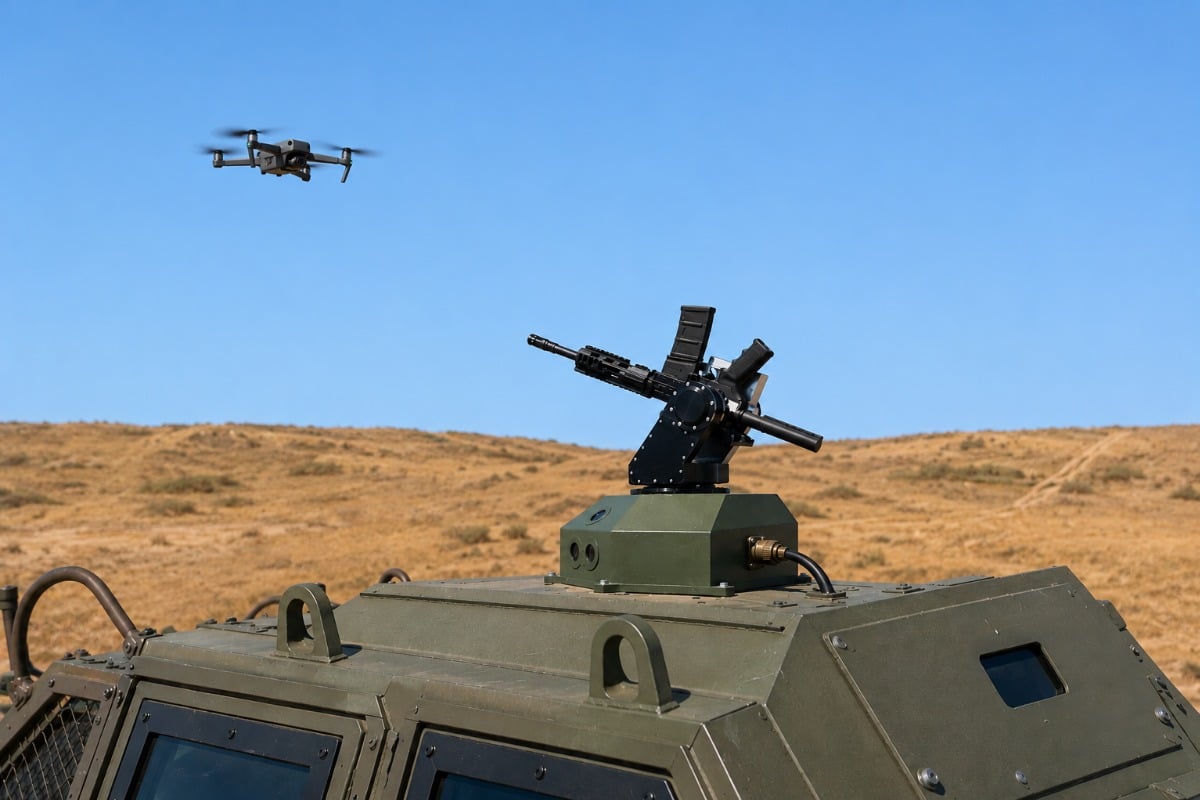
This is where algorithmic target acquisition comes in. Tech companies are shifting the heavy computing power directly onto the weapon platforms themselves. Axon Vision has been demonstrating its EDGE ClearSky system, an AI computer vision module designed for armored vehicles that uses thermal sensors to track and intercept aerial threats instantly.
For the individual infantryman, the solution has shifted to automated fire control optics. The U.S. Army and the Israel Defense Forces have heavily leaned into the SMASH family of smart optics designed by Smart Shooter.
[Target Detection via Radar Cloud]
               │
               ▼
[Real-Time AI Data Fusion & Classification]
               │
               ▼
[Weapon Lock: Smart Optics / Autonomous Interceptor]
               │
               ▼
[Kinetic Defeat / Net Capture]
The SMASH system mounts directly to a standard 5.56 mm or 7.62 mm rifle. It uses computer vision algorithms to instantly lock onto the flying profile of a drone. The soldier pulls and holds the trigger, but the gun won't actually fire until the internal processor calculates the exact trajectory, velocity, and lead angle required for a guaranteed hit. It turns a chaotic situation into a precise, automated calculation, ensuring the very first bullet neutralizes the threat.
Fighting Drones with Autonomous Nets
Bullets work, but they require a clear line of sight and an operator ready to pull the trigger. When the terrain gets complicated, the best way to stop an autonomous flying threat is with another autonomous flying platform.
Drone-makers like Xtend are pivoting toward interceptor systems like the Scorpio 1000. These are high-speed, highly maneuverable counter-drones that don't rely on human piloting skills to chase down an enemy weapon.
When the local radar network flags a wire-guided threat, the interceptor launches autonomously. Using onboard edge computing and vision algorithms, it tracks down the incoming FPV drone in mid-air. Instead of trying to detonate a costly missile or crash into the target, it deploys a specialized net-launching system developed by ParaZero.
The net entangles the rotors of the hostile drone, dropping it instantly without detonating its explosive payload prematurely. This approach provides a massive economic advantage: a couple-hundred-dollar interceptor deployment completely neutralizes an attack that could have crippled a multi-million-dollar armored vehicle.
What Military Planners Must Do Next
The battlefield deployment of wire-guided drones has proven that you cannot build a defense strategy around electronic jamming alone. To secure positions against this new reality, defense planners need to change their procurement priorities immediately:
- Stop buying standalone jammers. Shift capital allocation toward active, multi-sensor detection platforms that combine acoustic tracking, thermal cameras, and micro-radar.
- Equip front-line squads with smart fire control. Standard optics are insufficient against fast-moving micro-threats. Computer-vision-assisted optics must become standard issue for point-defense teams.
- Deploy kinetic interceptor swarms. Establish automated launch systems on armored vehicles that can release net-deploying counter-drones the moment a threat enters a 500-meter perimeter.
The era of clean, silent electronic warfare is drawing to a close. The defense networks that survive the next decade will be the ones that rely on fast algorithms and hard kinetic solutions to cut the digital cord.