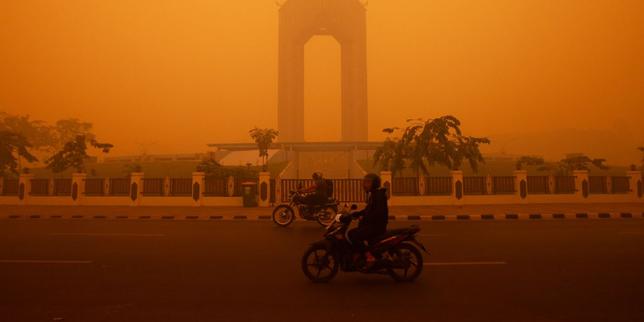
Every dry season, the same headline rolls off the assembly line. Giant fires in Indonesia. Toxic haze choking Southeast Asia. Villains in boardrooms. Victims in masks.
It is comforting. It is tidy. It is also lazy.
When coverage frames Indonesian fires as a straightforward story of rogue arsonists setting a rainforest alight for quick cash while neighboring capitals gasp for air, it misses the machinery driving the crisis. Treating smoke as a standalone villain blinds us to land tenure, drainage engineering, commodity incentives, and seasonal meteorology. A regional haze event is not a single match struck in isolation. It is the predictable outcome of a system built to reward short-term extraction and push long-term costs onto everyone downwind.
The standard narrative treats fire as the root cause. Fire is the symptom.
The Lazy Consensus Around Smoke and Arson
Walk through the usual reporting on transboundary haze and you will see a predictable cast of characters: reckless clearers, helpless regulators, coughing commuters, and outraged neighbors. That framing has a real cost. When the public believes the crisis comes down to a few bad actors lighting brush fires, policy defaults to crackdowns, emergency air-quality alerts, and diplomatic scolding.
Crackdowns make great press conferences. They rarely stop the next dry spell from turning into an ecological and public health emergency.
To understand why these fires keep roaring back, we have to separate peatland from mineral soil and transboundary haze from ordinary smoke. Most casual readers lump all forest or land fires into one bucket. On dry mineral soil, a surface fire burns fuel and moves on. On tropical peatland—layers of partially decayed plant matter accumulated over millennia in waterlogged conditions—fire behaves differently. Once drained and dried out, peat does not merely flame on top. It smolders underground for weeks or months, releasing dense, fine particulate matter ($\text{PM}_{2.5}$) that travels across borders when winds align with the dry monsoon.
Blaming "slash-and-burn" in the abstract obscures how fire actually gets a foothold. Fire in intact, water-saturated peat swamp forest is remarkably hard to sustain. You usually have to engineer the vulnerability first by digging canals that draw down the water table.
I have watched policy initiatives and corporate sustainability pledges burn through millions of dollars chasing the wrong lever—funding satellite watchtowers or short-term firefighting teams while leaving drained canal networks intact. Without rewetting the peat, extinguishing surface flames is like mopping the floor while the pipe behind the drywall keeps leaking.
Why We Are Asking the Wrong Questions
When haze blankets cities in Indonesia, Malaysia, or Singapore, search queries spike with urgent, understandable questions: Who is setting the fires? Why can't the government just put them out? How do we stop the haze before next year?
Each of those questions rests on a flawed premise.
"Why can't authorities just put the fires out?"
Because fighting deep peat fires with water drops from aircraft is often like trying to drown a stubborn coal bed from a helicopter. Surface water evaporates or runs off; smoldering organic matter beneath the crust keeps cooking. Real containment requires raising the water table through canal blocking and ground-level suppression, often in remote terrain with weak road access and shrinking water sources during El Niño years.
"Aren't palm oil giants the sole reason this happens?"
Large plantation companies have played a major historical role in land conversion and drainage, and accountability matters. Yet treating big corporate plantations as the only driver misses how fragmented land use actually works on the ground. Smallholders, local speculators, disputed land claims, and competing agricultural commodities—including pulpwood, rubber, and smallholder oil palm—all operate inside the same economic incentives. When a small farmer has insecure land title or faces a steep financial squeeze, cheap land clearing looks rational even when the regional consequences are catastrophic.
"Why don't strict bans on burning solve it?"
Paper bans fail when enforcement capacity is thin and economic alternatives are missing. If clearing by fire costs a fraction of mechanical clearing and labor is scarce or expensive, prohibition without economic alternatives and clear land governance simply drives the activity out of sight.
Thought Experiment: Imagine a scenario where a regional government bans every match and lighter across a peat province for twelve months, deploys drones everywhere, and levies heavy fines—yet leaves miles of drainage canals open during a strong El Niño drought. What happens to the water table? It still drops. What happens to dead roots and dry peat? They still become tinder. Lightning, a discarded cigarette, or a tiny spark from a small clearing can still trigger a stubborn smolder. Enforcement without hydrology treats the spark and ignores the powder keg.
The Mechanics Behind the Haze
Transboundary haze is a collision between land engineering, economic incentives, and climate variability. Change one piece and the risk shifts; leave all three aligned and a regional crisis becomes almost inevitable.
1. Drainage Turns Swamps into Tinderboxes
Peat swamps store massive amounts of carbon precisely because standing water deprives microbes of oxygen, slowing decay. When canals are dug to drain land for agriculture or forestry, the peat dries out and oxidizes. It subsides, loses its sponge-like capacity, and turns into a carbon-rich fuel bank. Even modest ignition sources can turn drained peat into a persistent smoke factory.
2. Climate Cycles Load the Dice
Southeast Asia experiences recurring climate oscillations, most notably El Niño, which brings drier-than-average conditions to much of maritime Southeast Asia. During dry years, moisture deficits climb, rivers drop, and fires spread faster and burn deeper. Framing every major haze episode solely as a sudden freak accident ignores how predictable seasonal and El Niño dry spells are.
3. Economics Rewards Short-Term Land Value Over Regional Health
The costs of haze are widely distributed across millions of people, healthcare systems, schools, and businesses across multiple countries. The short-term upside of cheap land preparation is concentrated locally. Whenever the private cost of clearing land is lower than the cost of alternatives—and the public cost of smoke is externalized—the math tilts toward fire.
| Common Framing | What It Misses | Practical Consequence |
|---|---|---|
| Fires are just arson by bad actors | Drained peat, land tenure disputes, and economic incentives set the stage | Punitive crackdowns miss structural root causes |
| Putting out flames solves the crisis | Deep peat smolders underground and reignites when dry | Recurring multi-week smoke episodes return |
| Haze is purely a local law-and-order issue | Wind patterns, El Niño, and cross-border supply chains link the region | National-only fixes stall on regional spillover |
| Sustainability pledges equal ground truth | Supply-chain traceability often stops short of complex land ownership | Smoke still emerges from non-traceable or disputed plots |
What Serious Experts Actually Point To
Serious researchers and policy analysts studying peatlands and fire—including institutions such as the Center for International Forestry Research (CIFOR), the World Resources Institute (WRI), and fire ecology researchers across Southeast Asia—have spent years documenting the same core lesson: peat restoration and hydrological management are non-negotiable.
Satellite hotspot counts tell us where heat signatures appear, not how much carbon is burning or how deep the peat is. Air-quality indexes tell us how bad the air is today, not whether canals were blocked last winter.
Even our own contrarian emphasis on hydrology and incentives carries real trade-offs. Rewetting drained peatlands is expensive, technically demanding, and socially sensitive. Blocking canals can disrupt local transport routes used by villagers who rely on waterways to move goods. Restoring degraded land can trigger pushback from communities worried about livelihoods if alternative income or fair compensation is not built in from day one. Anyone pretending peat restoration is frictionless has never walked a canal dike during a land dispute.
Unconventional Moves That Actually Work
If you care about fewer toxic haze seasons rather than louder outrage, stop looking for silver bullets and start pulling levers that change physical conditions and economic math.
- Measure canal water levels and rewetting progress, not just hotspot counts. Hotspots are a lagging indicator. Track how many kilometers of canals have actually been blocked or backfilled and whether peat moisture holds during dry months.
- Pair fire prevention with legal land clarity and practical livelihoods. You cannot ask cash-strapped rural producers to abandon cheap land-clearing methods without offering viable alternatives, fair dispute resolution, and clear tenure rules that reward stewardship.
- Treat smoke mitigation as cross-border public health and supply-chain infrastructure. Clean indoor air standards for schools and clinics, transparent procurement rules that trace commodities down to the plot level, and joint regional preparedness before dry seasons peak do far more good than reactive blame games once the sky turns orange.
Stop reacting to the smoke as if it fell out of nowhere. Fix the water, fix the incentives, and you starve the fire before it starts.