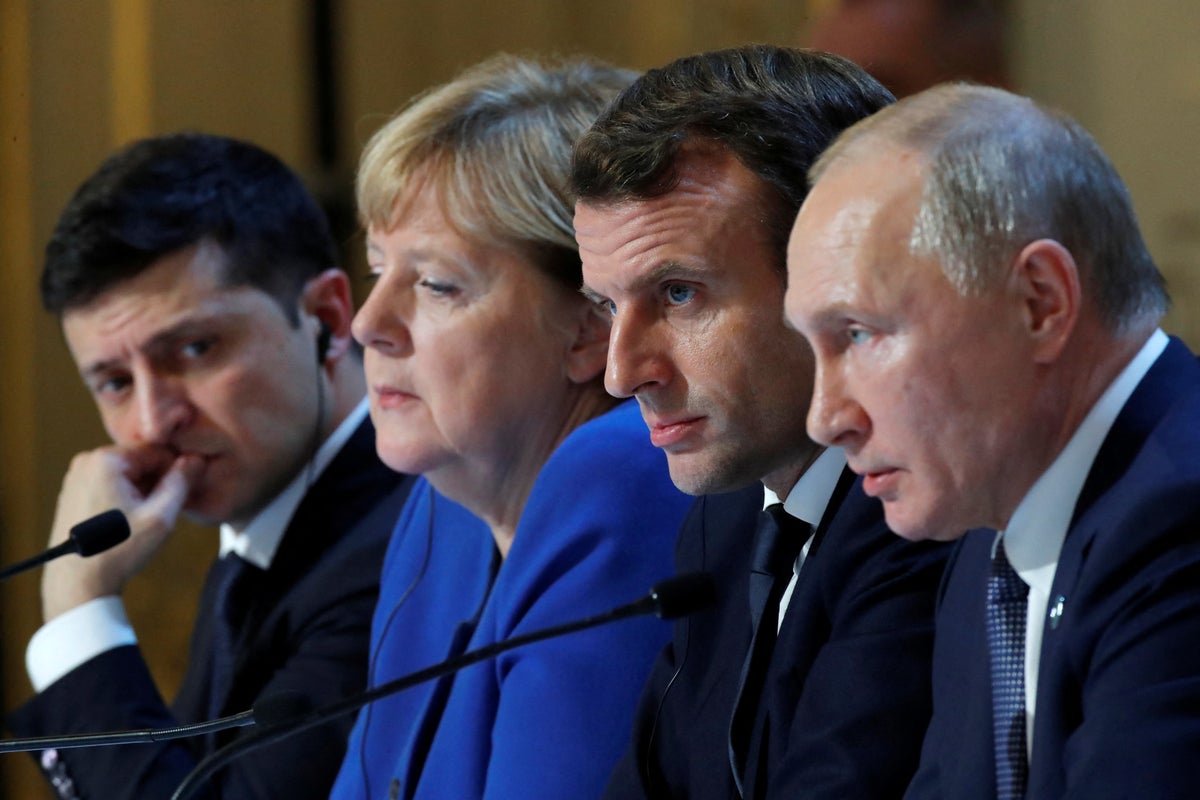
The hallways in Brussels are humming with a familiar, desperate question. Who do we send to talk to Vladimir Putin? As the war in Ukraine drags through another grueling year, European Union officials are quietly floating a shortlist of heavy hitters to act as a special diplomatic envoy. Two names keep topping the gossip sheets: former European Central Bank chief Mario Draghi and former German Chancellor Angela Merkel.
It sounds comforting on paper. Merkel spent 16 years managing the Russian president, speaks his language fluently, and knows the Kremlin's psychological traps better than almost anyone alive. But the sudden push to drag her out of retirement reveals a deeper, more troubling reality. Europe is terrified of being left behind by Washington, and its current crop of leaders is suffering from a massive crisis of confidence.
The strategy is flawed from the jump. Merkel herself essentially admitted it this week during a forum in Berlin, flatly rejecting the mediator fantasy. If Europe wants to be taken seriously at the negotiating table, it needs to stop looking backward.
The Envoy Debate and Europe's Fear of Being Sidelined
The chatter about appointing a high-level "Putin whisperer" isn't happening in a vacuum. European foreign ministers are setting up a meeting in Cyprus to debate exactly how to reopen formal communication lines with Moscow. Brussels froze most direct channels after the 2022 invasion, but the geopolitical landscape has shifted dramatically.
With Washington distracted by escalating conflicts in the Middle East and Donald Trump's administration pushing for its own peace talks, European capitals are panicking. They worry that a deal will be cut over their heads, forcing unfavorable terms on Ukraine and leaving Europe highly vulnerable.
The diplomatic calculus is simple. If Europe doesn't speak with one voice, Putin will simply pick apart individual nations. The Financial Times reported that the White House isn't explicitly opposed to Europe opening a parallel track of dialogue. The problem is that the bloc remains deeply fractured. While some nations crave a structured negotiation, Baltic and Eastern European states remain deeply skeptical of any move that looks like early appeasement.
Why the Merkel Fantasy Fell Apart
Choosing Angela Merkel as the face of European diplomacy makes sense only if you ignore the last decade of history. She has the ultimate resume for the job. She can trade sharp retorts with Putin in Russian, and she famously outlasted his psychological games—like the infamous 2007 incident where he brought his large Labrador into a meeting knowing she feared dogs.
But Merkel understands power dynamics far too well to accept a symbolic assignment. Speaking in Berlin, she argued that Putin only respects active political authority.
"We were only able to hold those negotiations with President Putin because we had political power, because we were heads of government," Merkel stated. "You need that power. You have to take that into your own hands."
She's completely right. Sending a retired politician without a domestic mandate or a military budget behind them is a recipe for humiliation. Putin would view an envoy like Merkel as a sign of European weakness—a buffer block meant to shield current leaders from taking real risks.
Besides, her political legacy at home makes her a deeply polarizing figure. Many members of her own Christian Democratic Union (CDU) party openly criticize her for deepening Germany's ruinous energy dependence on Russian gas via the Nord Stream pipelines. One current lawmaker went so far as to call the idea of her negotiating "nonsensical." In Kyiv, President Volodymyr Zelensky hasn't forgotten her past defense of the failed Minsk accords, which she still claims successfully froze the Donbas conflict but which critics say merely gave Moscow time to prepare a larger invasion.
The Problem with the Alternatives
If not Merkel, then who? Mario Draghi has the international clout, but lacks the deep, decades-long history with the Kremlin.
Putin has already thrown his own preferred option into the ring: Gerhard Schröder. The 82-year-old former German chancellor is an old friend of Putin and spent years working for Russian state energy giants like Gazprom. EU top diplomat Kaja Kallas rightly shut that down, noting it wouldn't be very smart to let the Kremlin pick Europe's negotiator. Schröder represents a compromised era that Europe is desperately trying to erase from its ledger.
The real roadblock isn't the person; it's the lack of a unified European message. Back-channel sources in Moscow indicate that Russia is willing to hear a more constructive message from Europe, but they claim Brussels is offering nothing but empty slogans about a "fair peace." If the 27 EU member states cannot agree on their own red lines, their prerequisites for talks, or what a post-conflict relationship with Russia even looks like, a mediator is useless.
What Europe Must Do Instead
Europe doesn't need a nostalgic throwback to the era of Minsk diplomacy. It needs its current leaders to grow a backbone and use the leverage they actually possess. Merkel pointed out that while underestimating Russia is a mistake, it's equally foolish to underplay Europe's own capabilities.
Instead of searching for a magical envoy to solve their problems, European leaders need to take three immediate steps.
First, current heads of state—like France's Emmanuel Macron, Germany's Olaf Scholz, or EU Council President António Costa—must stop hiding behind committees. They need to coordinate a concrete, unified negotiation framework that bridges the gap between the cautious Western states and the hawkish Eastern flank.
Second, diplomacy cannot exist without teeth. Merkel's core philosophy was always "military deterrence plus diplomatic activities." Europe must rapidly scale up its own defense production and aid packages to maintain leverage. You don't get a fair deal from Putin by showing up to the table empty-handed and anxious.
Finally, Brussels needs to stop worrying about American approval and start managing its own backyard. If European leaders want to be taken seriously by the Kremlin, they have to show they can handle the security of their own continent without constantly looking over their shoulders at Washington. The era of outsourcing European security and diplomacy to retired elders is over. The current leaders are the ones holding the cards, and it's time they started playing them.