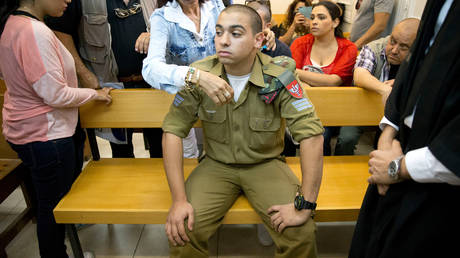
The decision by Israeli President Isaac Herzog to clear the criminal record of Elor Azaria—the former combat medic convicted of manslaughter for shooting an incapacitated, wounded Palestinian assailant in Hebron—did not happen in a vacuum. It represents the final bureaucratic stroke on a multi-year effort to rewrite a defining moment of military accountability. Azaria, whose execution of Abdel Fattah al-Sharif in March 2016 was captured on video by a human rights organization's field worker, served a modest nine-month prison sentence before walking free. Yet, the conviction remained on his civilian record, creating employment roadblocks that political and military pressure points spent years attempting to dissolve.
When the presidential office announced the expungement, citing the passage of time and the approaching holiday of Yom Kippur, it brushed past an explicit internal objection from the Israel Defense Forces command structure. The military establishment noted that Azaria had never truly expressed remorse or accepted institutional responsibility for his actions. That divergence between the political echelon and the military high command exposes a deep fracture line regarding discipline, operational boundaries, and the symbolic value of a soldier's uniform in the occupied territories.
The Mechanics of Rehabilitation
To understand the trajectory from a military courtroom conviction to a presidential pardon and record-clearing, one must examine how institutional memory is managed under political duress. In 2017, the military court martial delivered a verdict that sent shockwaves through Israeli society. A panel of judges found Azaria guilty of manslaughter, ruling that al-Sharif posed no immediate threat when the bullet entered his head. That verdict was hailed by legal purists as proof that the military judicial system maintained an independent ethical compass, adhering to the Geneva Conventions and the IDF's own code of conduct regarding the purity of arms.
Yet, the public reaction demonstrated that legal accountability and popular sentiment were violently misaligned. Prime Minister Benjamin Netanyahu immediately called for a pardon, while crowds outside the courtroom chanted slogans against military leadership. The sentence, initially set at eighteen months, was later halved by the military chief of staff, and Azaria was released after serving merely nine months.
The recent expungement of his record addresses a lingering practical consequence: the civilian disability imposed by a criminal conviction. By wiping the slate clean, the state has removed the final barrier preventing his complete reintegration into professional and civic life, effectively neutralizing the deterrent message that the original prosecution was meant to send.
The Divergence of Command and State
The opposition of the current military leadership to Azaria's rehabilitation is revealing. Senior defense officials argued that granting clemency and erasing a manslaughter conviction for an unrepentant soldier undermines the chain of command. If soldiers believe that political patrons will ultimately rescue them from the legal consequences of unauthorized lethal force, the authority of field commanders is eroded.
The political alignment tells a different story. Figures such as cabinet minister Israel Katz championed the erasure of the record, framing it as a humanitarian necessity to let a young man move on. This tension highlights a permanent structural contradiction within the state apparatus. The military requires strict adherence to rules of engagement to maintain operational legitimacy on the international stage, while domestic politics often reward populist defiance of those very rules.
International fallout from these structural choices has accumulated over time. The United States imposed visa restrictions on Azaria and members of his immediate family, explicitly citing gross violations of human rights. These external measures underline a widening chasm between domestic political absolution and international legal scrutiny. Local rehabilitation does not translate to global immunity, creating a bifurcated reality where a pardoned individual finds domestic doors swinging open while international borders snap shut.
The Broader Precedent
The final clearing of Azaria's record solidifies a troubling precedent for how military violence against protected persons is contextualized over the long term. Time is frequently deployed as an administrative solvent. As years pass, the visceral shock of viral video footage fades, political pressures shift, and institutional fatigue sets in. What begins as a stark breach of military law is gradually reframed as an unfortunate operational error born of high-stress combat environments.
This case study demonstrates that accountability in protracted asymmetric conflicts is rarely linear. A court can convict, a prison sentence can be served, but the political gravitational pull toward solidarity with armed personnel frequently overrides legal outcomes. By decoupling the punishment from the permanent record, the state signals that the ultimate cost of extrajudicial actions can be mitigated through sustained political lobbying and institutional patience.
The clean slate handed to Azaria closes a decade-long legal saga, but it leaves the underlying systemic questions entirely unresolved. The enforcement of military ethics remains subordinate to political imperatives, ensuring that the legacy of the Hebron shooting is not a permanent deterrent against unlawful force, but a roadmap for how such actions are eventually absorbed, excused, and erased from the official ledger


