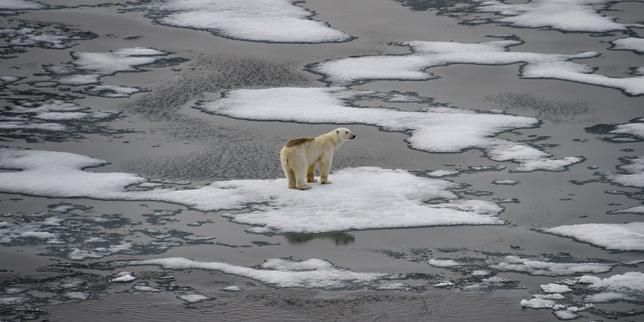
The air at seventy degrees north does not just bite. It remembers.
If you have ever stood on the edge of the frozen world during a polar winter, you know the silence. It is not the absence of sound; it is an active presence, heavy and ancient, pressing down against your coat. For generations, the people who watch the ice—the indigenous hunters whose families have tracked the shifting leads of the Beaufort Sea for centuries, and the quiet scientists who huddle in insulated trailers counting permafrost decay—have relied on a single, invisible anchor.
Data.
Not just numbers on a spreadsheet, but a collective memory. A baseline. A way to measure how fast the floor is dropping out from under the northern hemisphere.
Then, a keystroke in Washington.
Imagine, for a moment, the quiet hum of a bureaucratic office thousands of miles south of the snow line. No frost clings to the windowpanes here. No wind howls across the tundra to remind the occupants of what is at stake. Someone sits at a desk, clicks a mouse, and a benchmark assessment compiled by some of the sharpest minds on the planet simply ceases to be official. The Arctic Report Card, a comprehensive, peer-reviewed health check of the northernmost tier of the Earth, is pulled from public view. Relabeled. Demoted. Erased.
Silence.
Why does a government administration bury a report about melting ice?
The official justifications are administrative, dry, wrapped in the neutral gray language of policy shifts and priority realignments. But the reality is far more visceral. To acknowledge the changing Arctic is to acknowledge a ticking clock. And when the clock is ticking too loudly, sometimes the easiest political maneuver is to smash the dial.
To understand why this matters, you have to leave the abstract world of politics and walk out onto the ice with someone who has seen it vanish.
(Hypothetical Scenario: Meet Sarah, a climatologist who spent twenty consecutive summers on the shores of Utqiagvik, Alaska. In her first year, back in the late nineteen-nineties, the sea ice stayed packed tight well into July, a solid white fortress stretching to the horizon. By her twentieth year, she watched open water lap against shores that used to be unyielding barriers of multi-year ice. When she talks about her work, she does not speak in equations. She speaks in the language of loss—of shorelines swallowed by storm surges, of ancient ice cellars thawing because the permafrost beneath the village has turned to slush.)
Sarah’s data did not live in a vacuum. It was funneled directly into the foundational federal assessments that the administration just swept aside. These reports are the connective tissue between scientific discovery and policy execution. They dictate how infrastructure is built, how shipping lanes are managed, how national security assets are deployed in the rapidly opening polar theater, and how coastal communities prepare for the rising tide.
When you delete the baseline, you do not stop the warming. You simply blindfold yourself while walking toward the cliff.
History is littered with the wrecks of leaders who thought that ignoring a crisis would cause it to grow bored and go away. In the mid-twentieth century, the Soviet Union infamously suppressed genetic science that conflicted with ideological dogmas, setting back its agricultural productivity for decades. Reality does not negotiate with political timelines. The permafrost does not care about election cycles. The sea ice does not read executive orders.
There is a profound psychological comfort in denial. It is easier to pretend that an inconvenient truth is merely a matter of political opinion. If the report says the Arctic is warming at twice the global average, and you don't like the economic implications of that fact, you can declare the report flawed. You can replace the scientists with loyalists. You can stamp withdrawn across the cover page and pretend the thermometer is lying.
But the thermometer is indifferent to your administration.
Consider what happens next in a world where climate data is treated as partisan property.
When the next catastrophic storm slams into the Alaskan coast, washing entire ancestral villages into the Bering Sea, the emergency managers will look for historical hazard models. When commercial shipping companies try to navigate the newly opened Northwest Passage, they will look for reliable ice thickness projections. When insurance syndicates try to price the risk of global coastal flooding, they will search for verified trends.
If the foundational science has been scrubbed, watered down, or cast into doubt, everyone operates in the dark.
This is not just an American story. The Arctic is the air conditioner of the planet. What happens in the high latitudes dictates weather patterns in the grain belts of the Midwest, monsoon schedules in South Asia, and the stability of the jet stream overhead. When the ice goes, the entire atmospheric engine stutters.
By tossing out the premier federal reference report on the Arctic, the administration is doing something far more dangerous than just hiding bad news. They are signaling to the global scientific community that facts are negotiable. They are teaching a generation of researchers that their life's work can be vaporized overnight because it clashes with a narrative of perpetual economic expansion at all costs.
I remember talking to an old Inupiat hunter years ago who looked out over a thinning ice pack and said something that has stayed with me ever since. He didn't sound angry. He sounded profoundly tired.
"The white man," he told me, gesturing toward the horizon, "thinks he can write new rules for the weather. But the ice only knows what it knows. When it melts, it doesn't matter what your papers say."
The administrative erasure of a climate report feels small in the grand scheme of daily headlines. Wars rage, economies fluctuate, elections loom. A bureaucratic document disappearing from a government server does not trigger an immediate siren. There are no flashing lights. No explosions.
Just a quiet, creeping blankness where the truth used to be.
We are standing at a historic crossroads. We can choose to face the physical reality of our changing planet, with all its terrifying complexity and hard economic truths, or we can retreat into a comforting fantasy where inconvenient data is simply wished away.
The ice continues to melt. The dark water drinks the sun. The report is gone, but the wind keeps blowing off the polar cap, sharp, cold, and entirely unconcerned with what we have chosen to write down on paper.