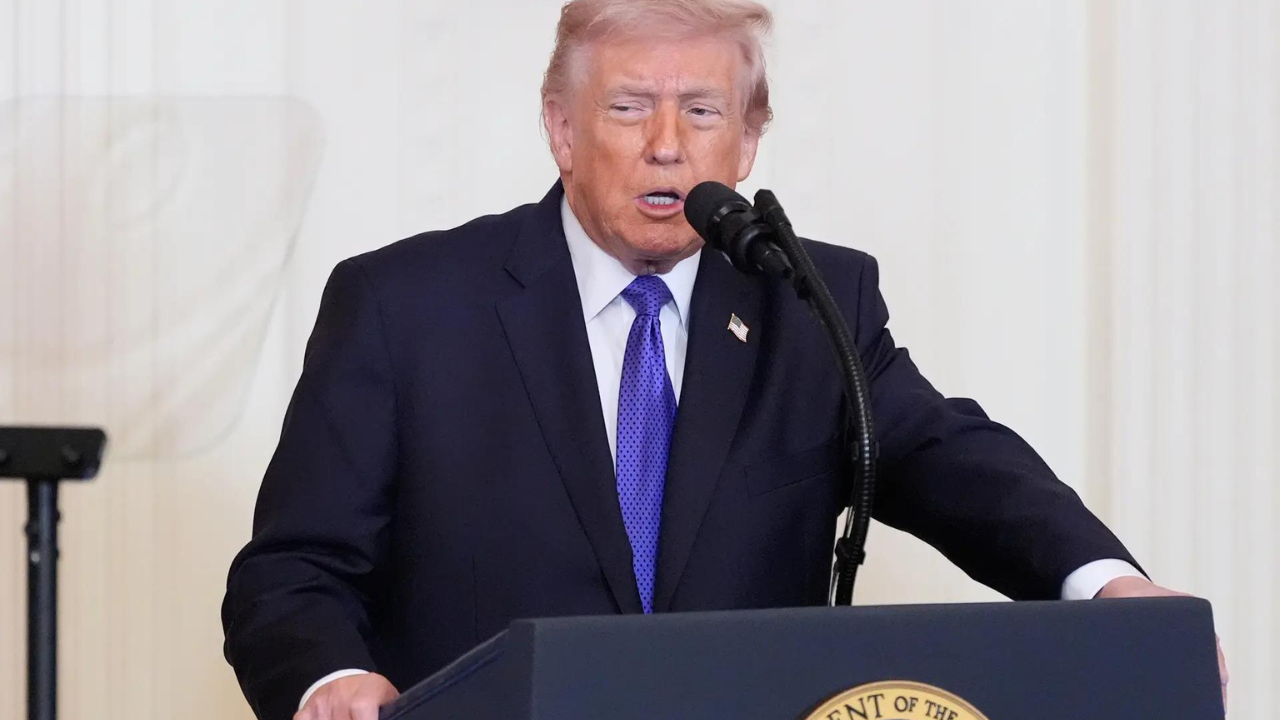
The morning air is crisp, but inside the kitchen, the atmosphere is heavy. A radio hums in the background, reciting the latest tally. Eight. Eight wars supposedly closed, settled, filed away in the archives of history by the stroke of a pen and a flurry of executive orders. And yet, before the coffee has cooled, a new frequency cuts through the static. There is a ninth.
We are told this is a strategic necessity. We are told the logic is impeccable. But there is something older, something far more primal, operating beneath the surface of these policy statements.
Consider the rhythm of the last few weeks. Ten interviews. Ten distinct opportunities to explain why a ninth conflict is not only inevitable but, in some bizarre framing, essential. Most people speak to justify a mistake. Here, the sheer volume of conversation feels like an attempt to rewrite the physics of the situation. It is as if by describing the necessity of the fight enough times, the speaker can force the world to agree that the fire was already burning before the match was even struck.
The rhetoric is simple, stripped of the usual geopolitical jargon: "I got him before he got me."
That sentence sits in the air, vibrating with a desperate, frantic energy. It is not the language of a head of state considering the sovereignty of nations or the balance of power. It is the language of a schoolyard standoff. It is the logic of a man cornered by his own narrative.
To understand why we find ourselves here, we have to move away from the map and look at the mirror.
We are taught that history is a series of movements by great men, decisions etched in marble. We rarely see the messy, agonizing reality of how those decisions are made. Imagine the quiet of the Oval Office at 3:00 AM. The wood paneling absorbs the sound of a ticking clock. There is no one there to challenge the internal monologue. In that silence, the world shrinks. Geography becomes personal. A foreign adversary, thousands of miles away, ceases to be a head of state and becomes a ghost, a shadow in the doorway that needs to be chased off.
When we speak of "solving" a war, we use the language of mathematics. We assume that if you apply enough pressure, or cut the right supply lines, or sign the right treaty, the equation will balance to zero. But war is not a math problem. It is a biological one. It is a chain reaction of grief, debt, and trauma that doesn't stop just because a microphone is turned off.
Those eight "solved" conflicts? Walk through the streets of the places where those wars were meant to have ended. You will not find a ledger balanced to zero. You will find broken windows, unrepaired bridges, and families holding onto the memory of people who never came home. They are not "solved." They are merely suppressed, waiting for the pressure to drop enough for the next explosion to occur.
And now, we are told that a ninth war is the logical conclusion of the previous eight.
The rationale hinges on a personal vendetta against Ali Khamenei. The narrative being built is one of preemption—the idea that the only way to ensure safety is to strike first. "He got me" is the accusation; "I got him" is the defense. It is a psychological loop. It assumes that there is a finite amount of power in the world, and if one man possesses it, the other must lose it.
Think about the human toll of this mentality. It is not just the soldiers on the front lines, the ones who wake up with the sun to prepare for a day that might be their last. It is the fear that trickles down to every household. When leadership acts out of a sense of personal survival, the rest of the world becomes collateral damage.
There is a specific kind of vertigo that comes from watching this play out. It is the realization that the machinery of our national security, the vast, intricate network of intelligence, military, and diplomatic assets, is being directed by a impulse that feels uncomfortably familiar to anyone who has ever watched a bruised ego turn into a crisis.
We look for reasons. We search for grand strategies, for secret cables, for complex motivations. But sometimes, the reason is the most terrifying one: it is simply because it can be done.
If we look closely at the interviews—those ten performances of justification—what stands out is not the substance of the argument, but the texture of the speaker’s voice. It is a voice that is constantly checking to see if it is being heard. It is a voice that needs to win the argument not because the argument is right, but because losing would mean admitting that the previous eight wars were not the tidy victories they were promised to be.
This is the hidden cost of the "solved" claim. Once you commit to the idea that you have mastered the art of war, you cannot stop. You are trapped. To acknowledge that a conflict still burns, or that a new one has ignited, is to shatter the illusion of your own competence. And so, the only option left is to keep moving, to keep escalating, to keep finding new "others" to define yourself against.
Imagine a young lieutenant sitting in a Humvee in the desert, staring at the horizon. He does not know about the ten interviews. He does not know about the desire to "get him before he gets me." He only knows the heat, the sound of the engine, and the fear that hums in his marrow. For him, the geopolitics are stripped away, leaving only the reality of the present moment. He is the one who bears the weight of the ninth war. He is the one who pays the interest on the debt that the politicians have accrued through their vanity.
We often talk about the strength of a nation as if it were a solid block of granite. But it is not. It is a collection of people, a fabric of relationships, a shared understanding of what it means to be safe and free. That fabric is fragile. When we use it to cover the jagged edges of a personal dispute, it starts to tear.
We are currently witnessing a dangerous erosion of the distance between the personal and the political. When statecraft is treated as a contest of wills between individuals, the entire architecture of global stability is compromised. We become prisoners to the emotional states of those in power.
There is a lingering question that the interviews fail to address. When the ninth war is "solved," what happens when the tenth appears? Or the eleventh? Is there a point where the scoreboard is full? Or is this just the nature of this particular way of governing—a relentless pursuit of the next victory to distract from the reality that the previous ones are fraying?
Consider the alternative. What if, instead of framing the world as a place where we must either hunt or be hunted, we admitted that we are all, to some degree, at the mercy of forces we cannot control? What if we acknowledged that security is not a zero-sum game, but a collective effort?
That would require something that the current discourse lacks: humility. It would require the ability to sit with the discomfort of an unsolved problem without needing to rush into a new one to prove one's worth.
But humility does not make for a compelling interview. It does not play well on the news. It does not fit the narrative of the strongman, the winner, the one who settles scores.
And so, the loop continues.
We are left watching the cycle repeat, waiting for the moment when the weight of these contradictions finally becomes too heavy to carry. It is a slow, agonizing process, the turning of a great, rusted gear.
The ninth war will be fought with the same weapons as the eight before it. It will be justified with the same rhetoric. It will be reported on with the same mixture of alarm and numbness. But the result will be different, because the world is changing. The tolerance for these theatrics is thinning.
The people who are tasked with living through these decisions—the families of the enlisted, the citizens of the target nations, the taxpayers footing the bill—they are beginning to see the pattern. They are beginning to understand that the "me or him" dynamic is a trap. It is a way to keep the focus on the ego of the leader, rather than the well-being of the led.
There is a point in every long, exhausting march where the participants stop looking at the map and start looking at their own boots. They realize the distance they have covered, and they realize how much further they have to go. They realize the journey has been circular.
We are reaching that point now.
The sun will set on this latest interview, and the cameras will turn off, but the reality will remain. The ninth war will continue to demand its price. And somewhere, in the quiet of a home that feels a little less secure than it did yesterday, someone will look at the news, then look at their own life, and wonder if there is ever going to be a way out of this room.
The silence that follows is the loudest part of the whole story. It is the sound of a question that has no easy answer, a question that lingers long after the politicians have moved on to the next set of talking points.
It is the question of what happens when the one who claimed to be the savior becomes the architect of the very fire he promised to put out.
The horizon is dark, but the lights in the kitchen are still on. We are still here. We are still listening. And we are still waiting for a truth that doesn't require a justification.