The needle on the dashboard didn't just point to "E." It felt like a verdict.
For Elena, a nurse in a suburb where the nearest grocery store is a four-mile trek through sun-scorched asphalt, that little red line was a thief. It was stealing her ability to provide. Every time the price at the pump ticked upward, her world physically shrank. She began calculating her life in liters. A trip to her mother’s house? That’s two gallons. A drive to the park for the kids? Another one. Eventually, the math stopped adding up.
This isn't just Elena’s story. It is the quiet, grinding reality for millions as the global fuel crisis shifts from a headline into a household intruder. We are witnessing a fundamental rewriting of how humans move, work, and exist within their own geography. The era of cheap, thoughtless motion has hit a wall.
The Geography of Necessity
In Greece, the response wasn't just a personal choice; it was a systemic pivot. Public sectors began eyeing the four-day work week not as a progressive perk, but as a survival tactic. By keeping the lights off and the commuters home for just one extra day, the collective carbon and financial footprint of a nation begins to shift.
Think about the sheer energy required to move a two-ton metal box just to transport a 160-pound human to a desk. It is an absurdity we’ve accepted as "business as usual" for seventy years. Now, that absurdity has a price tag that many can no longer afford to ignore.
In some regions, the school bell is ringing earlier or staying silent on Fridays. Imagine a child in a rural district where the bus route spans fifty miles of winding backroads. When the cost of diesel outpaces the local education budget, the classroom has to move. We call it "remote learning," a phrase polished during the pandemic, but today it’s being repurposed as "fuel shedding." It is a forced evolution.
The Two-Wheeled Revolution
While some retreat into their homes, others are taking to the pavement. In cities like Paris and Bogota, the bicycle has transformed from a weekend hobby into a tool of defiance.
Consider the "cycling to work" phenomenon. It sounds idyllic until you’re the one pedaling through a cold drizzle at 7:00 AM. Yet, there is a profound psychological shift that happens when you stop being a passive passenger in a gridlocked sea of brake lights. You become the engine.
The data backs this up. Cities that invested in "pop-up" bike lanes during the height of the supply chain crunches saw a permanent uptick in ridership. It turns out that when gas hits a certain threshold, the fear of a sweaty shirt at the office is eclipsed by the fear of an empty bank account.
But this transition isn't equal. For a tech worker in London, a high-end e-bike is a lifestyle statement. For a laborer in a developing economy, a bicycle is the difference between keeping a job and falling into poverty. The stakes are invisible until they are absolute.
The Great Contraction
We are living through what sociologists might call "The Great Contraction." For decades, the goal of modern civilization was expansion. Build further out. Fly further away. Ship strawberries from one hemisphere to the other in the dead of winter.
Fuel was the invisible blood of that expansion. Now, the body is pulling that blood back to its core.
In Germany, the "9-Euro Ticket" experiment offered a glimpse into a different future. For a single summer, public transport was nearly free. The result? Trains were packed. People who hadn't left their neighborhoods in years visited distant relatives. It proved that the desire for mobility is innate, but our current method of delivering it—the private internal combustion engine—is a bottleneck.
The Hidden Cost of Staying Home
There is a darker side to this narrative. When we talk about "staying home" to save on fuel, we aren't just talking about Zoom calls. We are talking about isolation.
For the elderly in rural areas, the fuel crisis is a wall. If the local volunteer driver can't afford the gas to take them to a doctor's appointment, or if the family can only afford to visit once a month instead of once a week, the cost isn't measured in dollars. It's measured in loneliness.
We are seeing a rise in "energy poverty," a term that feels clinical until you see a family huddling in a single room because heating the whole house—and fueling the car—is an "either-or" proposition. The narrative of the fuel crisis is often framed as an environmental win in disguise, a "nudge" toward green energy. But a nudge feels like a shove when you're standing on the edge.
The Machinery of Change
How did we get here? It's a tangle of geopolitical posturing, aging infrastructure, and a stubborn refusal to see the horizon.
The physics of it are simple: $Work = Force \times Distance$. For a century, we’ve used fossil fuels to apply massive force over massive distances. As the price of that force rises, the only variable we can truly control is the distance.
This is why we see the resurgence of the "15-minute city" concept. The idea is that everything you need—work, food, health, joy—should be within a fifteen-minute walk or bike ride. It’s an old-world idea being forced back into the new world by the sheer pressure of economics.
The Silent Streets
Walking through a city that has begun to price out the car is a surreal experience. The hum of the world changes. You hear footsteps. You hear snippets of conversation from people on bikes. You see the "invisible stakes" manifest in the way people interact with their environment.
In some South American cities, Ciclovía—the practice of closing main arteries to cars on Sundays—has become a secular religion. It’s a weekly rehearsal for a post-fuel world. It’s vibrant, loud, and human.
But then you look at the freight trucks idling at the borders, the ships waiting in the harbors, and the farmers looking at their tractors with a sense of dread. The fuel crisis isn't just about your commute. It’s about the bread on your table. Every calorie we eat is, in a sense, a disguised drop of oil. The fertilizer, the harvest, the transport—it’s all part of the same fossil-fuel chain.
The New Rhythm
Humans are remarkably adaptable creatures. We complain, we resist, and then we recalibrate.
Elena, the nurse, eventually bought a used electric moped. It wasn't her first choice. She missed the air conditioning of her sedan and the ability to sing along to the radio without the wind whipping past her ears. But she found something else. She found that her commute, once a period of road-rage-induced stress, became a moment of connection with the air and the morning light.
She saved $200 a month. That $200 became music lessons for her daughter. The "crisis" forced a trade-off that she never would have made voluntarily, yet the result was a life that felt, in some strange way, more intentional.
This is the bittersweet core of the global shift. We are losing the ease of the old way, a luxury we perhaps didn't deserve and certainly couldn't sustain. In its place, we are finding a more rugged, localized existence.
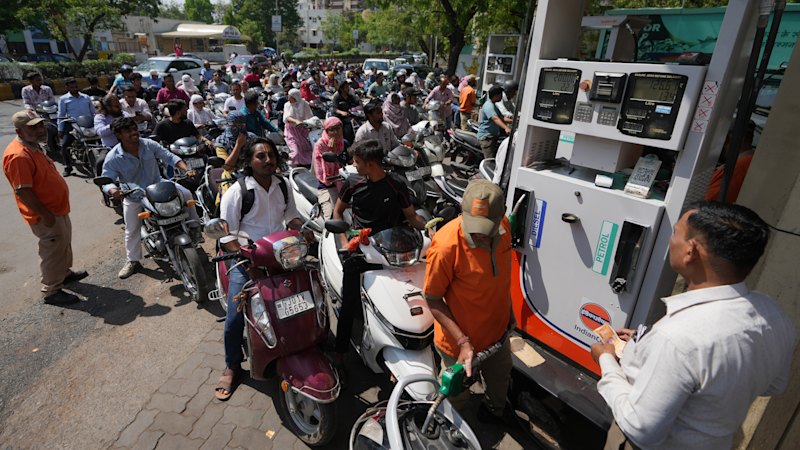
The gas stations are still there, their glowing signs acting as a pulse check for the global economy. But more and more, people are driving past them. They are staying home. They are carpooling with neighbors they haven't spoken to in years. They are rediscovering the strength of their own legs.
The tank might be empty, but the road is still there. It just looks different when you're moving at a human pace.