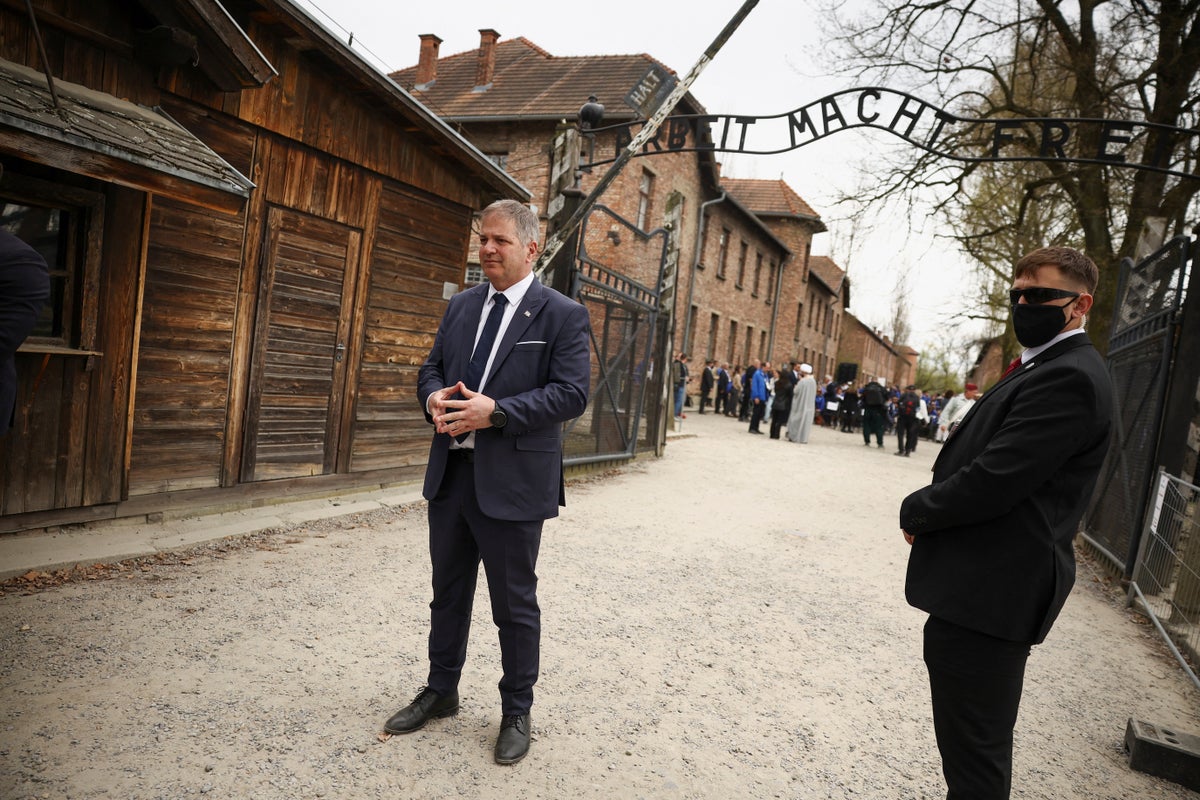
The collapse of historical memory regarding the Holocaust among Americans under 40 is not a random lapse in trivia but a systemic failure of institutional knowledge transfer. Data from the Claims Conference survey reveals a breakdown in fundamental historical baseline awareness: 48% of Gen Z and Millennial respondents could not name a single concentration camp or ghetto, while 63% were unaware that six million Jews were murdered. This phenomenon represents a regression in "social fact" retention, where the primary mechanisms of history—geographic specificity, statistical magnitude, and causal chains—are being replaced by vague moral abstractions.
The Three Pillars of Historical Dissipation
The erosion of Holocaust knowledge follows a predictable decay function. To understand why half the population fails to identify Auschwitz-Birkenau, we must analyze the structural shifts in how information is prioritized, curated, and consumed.
1. The De-contextualization of Curricula
Educational mandates across the United States lack a unified standard for Holocaust education. While many states require the subject to be taught, the implementation often focuses on "universal lessons" of tolerance rather than the specific political and logistical mechanics of the Third Reich. When students are taught that the Holocaust was a generic byproduct of "hate" rather than a state-sponsored industrial process requiring bureaucratic cooperation, the specific details—the names of camps, the geography of the Pale of Settlement, the Wannsee Conference—become secondary to the emotional narrative. This creates a high-level awareness that something "bad" happened without the structural scaffolding necessary to anchor that knowledge in long-term memory.
2. Digital Information Fragmentation
The transition from linear historical narratives (textbooks and documentaries) to fragmented digital consumption (social media snippets) has optimized for engagement over depth. Algorithms prioritize current events and emotive content, creating a temporal bias that pushes historical literacy to the periphery. In this environment, the Holocaust is often reduced to a digital symbol or a rhetorical weapon used in contemporary political discourse. When a historical event is primarily encountered as a meme or a comparative slur, its factual integrity—the names, dates, and figures—is the first element to be discarded.
3. The Sunset of Primary Witnesses
We are currently traversing the "critical transition" phase where the last generation of survivors is passing away. This removes the "experiential anchor" from the historical record. Living history functions as a powerful reinforcement mechanism; personal testimony creates a psychological weight that data points cannot replicate. Without the presence of survivors to provide a human face to the logistics of the camps, the Holocaust shifts from "memory" to "history," and finally to "mythos," where facts become malleable and details feel optional.
Quantifying the Knowledge Gap
The survey data suggests a correlation between the lack of specific knowledge and the rise of revisionist narratives. If a respondent cannot name a camp, they are statistically more likely to underestimate the death toll or believe the event has been "exaggerated."
- The Identification Deficit: 56% of respondents were unable to identify Auschwitz, the most notorious site of the genocide.
- The Geographic Blind Spot: In several states, over 60% of young adults did not know the Holocaust took place in Europe, or they conflated it with other 20th-century conflicts.
- The Proportional Error: 11% of respondents believe Jews caused the Holocaust, a statistic that points toward the infiltration of online misinformation and the failure of critical thinking frameworks in schools.
This isn't merely a failure of rote memorization. It is a failure to understand the Cost Function of Extremism. When the specific steps that led to the "Final Solution"—the Nuremberg Laws, the expropriation of property, the ghettoization—are forgotten, the public loses its ability to recognize the early-stage indicators of institutionalized persecution.
The Mechanics of Misinformation and Distortion
The vacuum left by formal education is being filled by active distortion. This is distinct from simple ignorance. Distorted history is a deliberate reconstruction of the past to serve a specific ideological end.
The Algorithmic Feedback Loop
Platforms like TikTok and X (formerly Twitter) operate on engagement metrics that often favor controversial or contrarian content. Holocaust denial has evolved into "Holocaust Distortion," which acknowledges the event occurred but minimizes its scale or shifts blame. For a young person without a factual baseline (the 48% who cannot name a camp), a well-produced but factually incorrect video can become their primary source of truth. The lack of a "ground truth" makes the individual susceptible to the "Illusory Truth Effect," where repeated exposure to a lie makes it seem more plausible.
The Problem of Historical Equivalence
A secondary mechanism of decay is the tendency to equate the Holocaust with every contemporary social grievance. While comparisons are a natural tool for understanding, the over-application of the term "Holocaust" or "Nazi" to modern political disagreements dilutes the specific gravity of the 1941-1945 period. This semantic saturation leads to "concept creep," where the specific historical parameters of the Holocaust are stretched so thin they no longer carry distinct meaning.
Structural Interventions and the Logic of Recovery
Addressing this literacy crisis requires moving beyond the "awareness campaign" model, which has proven insufficient. The goal must be the re-institutionalization of rigorous, fact-based historical analysis.
Standardizing the Minimum Knowledge Base
Curricula must be anchored in the "Seven Points of Facticity":
- Chronology: From the 1933 rise of the Nazi Party to the 1945 liberation.
- Geography: The pan-European nature of the genocide and the specific locations of the six death camps (Auschwitz-Birkenau, Belzec, Chelmno, Majdanek, Sobibor, and Treblinka).
- Statistics: The verified death tolls across different victim groups, with the six million Jewish victims as the central figure.
- Logistics: How a modern state used rail networks, census data, and industrial technology to commit mass murder.
- Ideology: The specific racial and pseudoscientific theories that underpinned the regime.
- Agency: The role of collaborators and bystanders across occupied Europe.
- Resistance: The various forms of Jewish and non-Jewish opposition.
Digital Literacy as a Defensive Layer
Schools must teach students how to navigate historical disinformation. This involves "lateral reading"—checking the source of a claim against established archival records like Yad Vashem or the USHMM. If a student can be trained to spot the rhetorical patterns of denial—such as the "Just Asking Questions" (JAQing off) technique or the misuse of cherry-picked technical data—they become more resilient to the erosion of truth.
The Integration of New Media Archives
As survivors pass, the use of interactive holograms and high-fidelity video testimony becomes the necessary surrogate for living memory. However, these tools must be used as supplements to, not replacements for, rigorous reading. The goal is to create a "multi-modal" learning environment where the emotional weight of testimony is supported by the hard data of historical documentation.
The Geopolitical Risk of Historical Illiteracy
The stakes of this knowledge gap extend beyond academic performance. A society that cannot remember its darkest chapters is inherently more volatile. Historical literacy acts as a "buffer" against the resurgence of authoritarianism and the scapegoating of minorities. When half of a generation is unable to identify the physical locations where state-sanctioned genocide occurred, the "Never Again" mantra becomes an empty slogan.
The decline in Holocaust knowledge is a leading indicator of a broader trend: the de-prioritization of the humanities in favor of vocational training and the surrender of the "public square" to unmoderated algorithmic influence. Restoring this knowledge is not an act of nostalgia; it is a critical investment in the cognitive security of the next generation.
The immediate strategic priority for educational boards and policymakers is the mandatory implementation of a facts-first Holocaust curriculum that emphasizes the industrial and bureaucratic nature of the genocide. This must be coupled with a robust digital literacy program that trains students to identify the markers of historical distortion before they become ingrained as fact.