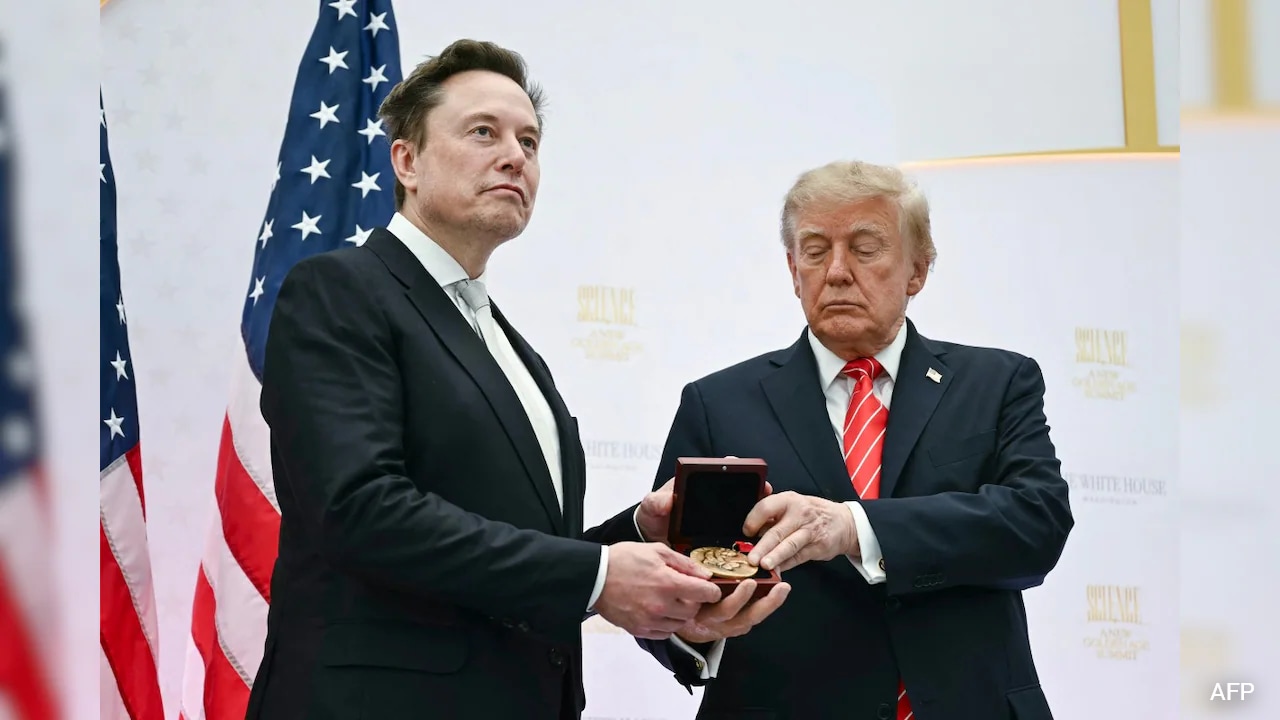
President Donald Trump recently presented Elon Musk with the National Medal of Science at a ceremony in Washington, labeling the billionaire entrepreneur a "modern-day Thomas Edison". This comparison relies on a lazy historical shorthand. It frames Musk merely as an eccentric inventor tinkering in a garage, a narrative that fundamentally misunderstands how modern industrial empires are built and sustained.
Thomas Edison operated during the late nineteenth century, a period defined by individual patent accumulation, mechanical tinkering, and brute-force trial and error. Menlo Park was an artisanal workshop compared to the sprawling, vertically integrated manufacturing and software ecosystems Musk oversees today. When we evaluate the actual mechanics of Tesla, SpaceX, and Starlink, the Edison analogy breaks down. Edison was fundamentally an inventor who commercialized discrete electrical devices. Musk is an orchestrator of massive industrial output, capital allocation, and systemic logistical overhaul.
To understand why the Edison comparison falls short, one must examine the divergent paths of historical invention versus contemporary systems engineering. Edison famously tested thousands of filaments before finding a practical incandescent bulb. That trial-and-error method was well-suited for an era when materials science was in its infancy and individual genius could outpace institutional labs.
Musk does not operate via individual trial and error. Instead, he constructs massive feedback loops that combine software iteration, heavy manufacturing, and state-subsidized infrastructure. SpaceX did not succeed because Musk figured out a clever chemical compound for rocket propellant in his spare time. It succeeded because he instituted a philosophy of rapid internal manufacturing, stripping away traditional aerospace contractors who bloated budgets and stretched timelines across decades.
Consider the production line of the Falcon rocket or the Starship prototype yard in Boca Chica. These facilities do not resemble Edison's tidy New Jersey laboratory. They look more like automotive plants crossed with high-yield software development houses. Design changes happen weekly, not yearly. Hardware is blown up on the landing pad intentionally to gather telemetry data, a method of aggressive stress-testing that would have bankrupted Edison's backers within a single quarter.
Furthermore, the scale of state and private capital intertwining in Musk's enterprises has no parallel in Edison's career. Edison relied on private financiers like J.P. Morgan to fund his electrical lighting grid. Musk’s companies exist in a symbiotic, yet often tense, relationship with federal agencies like NASA and the Department of Defense. SpaceX became viable precisely because NASA pivoted from building its own heavy launch vehicles to purchasing commercial cargo and crew services. Without government payload contracts during its near-bankruptcy phase in 2008, SpaceX would have folded long before reaching orbit. Edison never had to manage the geopolitical sensitivities of controlling a global low-Earth orbit satellite constellation like Starlink, which now underpins military communications and civilian internet access across entire continents.
Another critical divergence lies in the realm of labor and institutional structure. Edison is often remembered as a lone genius, though historical records show he managed large teams of brilliant engineers like Nikola Tesla and Lewis Latimer, frequently absorbing their contributions into his own corporate brand. Musk operates in an era of hyper-public scrutiny and intense social media visibility, projecting an image of hands-on technical management. Yet, beneath the public persona lies a sprawling corporate apparatus employing tens of thousands of software architects, metallurgists, propulsion specialists, and supply chain managers.
Attributing the achievements of Tesla or SpaceX solely to Musk's individual brilliance ignores the thousands of institutional cogs required to keep those machines running. It diminishes the structural engineering, the regulatory navigation, and the raw capital markets engineering that made mass-market electric vehicles and reusable orbital-class boosters possible in the first place.
The political framing of the National Medal of Science adds another layer of complexity. Traditionally reserved for academic researchers, biologists, mathematicians, and foundational physicists who spend decades in obscurity publishing peer-reviewed papers, the award's pivot toward high-profile commercial technologists signals a shift in how the American state values scientific contribution. When the highest scientific honor is bestowed upon industrial magnates, it blurs the line between scientific discovery and commercial enterprise. Edison himself was inducted into various halls of fame and showered with accolades, but his inventions were products of an industrial revolution that valued immediate utility over abstract theoretical physics. Musk operates at the intersection of applied physics and software supremacy, yet his primary output is commercial disruption rather than foundational scientific theory. He did not discover the principles of quantum mechanics or relativity; he optimized the supply chain for lithium-ion battery cells and figured out how to land an orbital booster upright on a drone ship.
The danger of the Edison label is that it sanitizes the friction of modern technological dominance. Edison is remembered as a benevolent benefactor of the modern lightbulb. Musk, by contrast, is a polarizing figure whose corporate decisions directly influence global supply chains, freedom of speech via digital platforms, and the militarization of near-Earth space. Reducing him to a twentieth-century inventor misses the systemic reality of twenty-first-century techno-capitalism.
We are not watching a solitary inventor in a workshop. We are watching the consolidation of heavy industry, aerospace, and digital communications under the banner of a single private philosophy. Whether that concentration of capability serves the broader public interest remains the defining question of our current industrial era.
The medal has been handed out, the political speeches have faded from the news cycle, and the comparison to a nineteenth-century lightbulb pioneer will likely linger in press archives. But the reality on the ground in South Texas, at orbital launch sites, and inside automated gigafactories bears little resemblance to Menlo Park. The ambitions are interplanetary, the capital stakes are planetary, and the institutional machinery is entirely unprecedented.
This video provides a direct visual record of the official ceremony where the highest state technological honors were presented alongside the presidential remarks comparing modern tech leaders to historical inventors.


