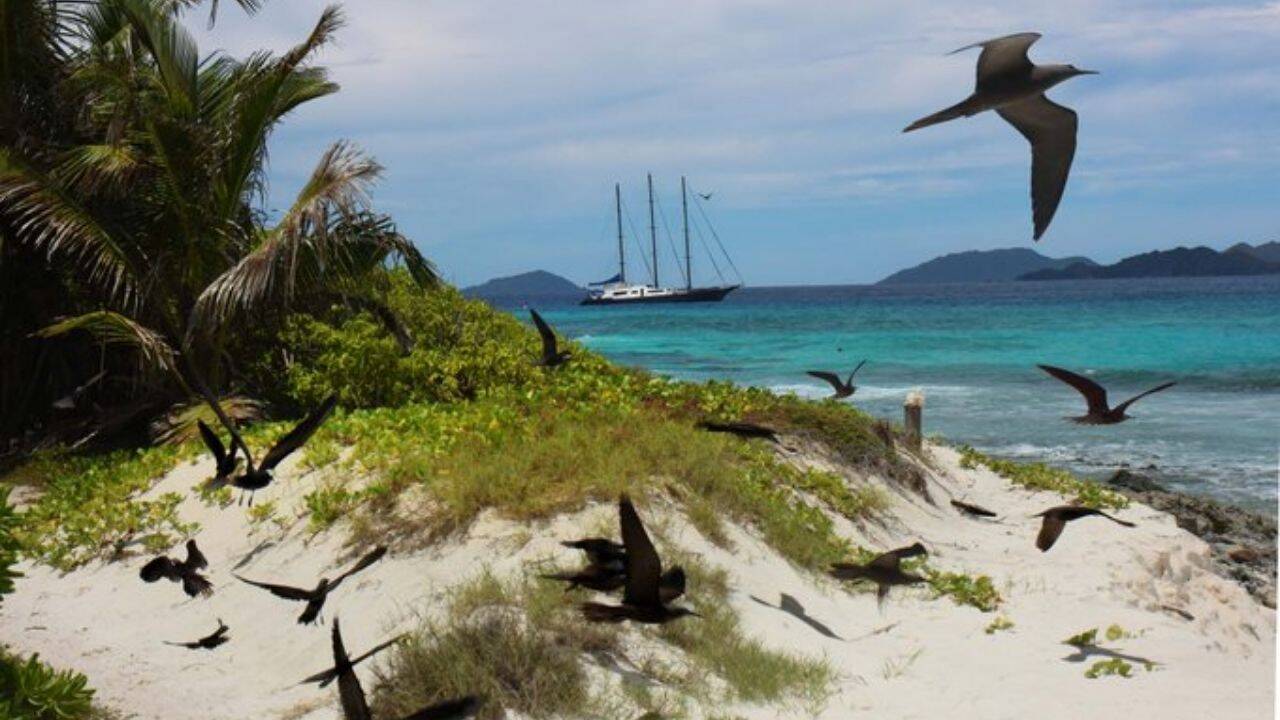
Capital allocation in conservation historically treats nature as an amenity rather than an asset with measurable biological yield. When Christopher Cadbury financed the acquisition of Aride Island in 1973 for forty thousand pounds, the transaction was not an act of traditional philanthropy. It was a high-leverage ecological intervention that exploited the mechanics of habitat degradation and island biogeography. By converting a stripped commercial coconut plantation into a legally protected sanctuary, the intervention triggered a compounding recovery loop. Today, the site supports over one million breeding seabirds annually, proving that targeted capital deployment can reverse catastrophic anthropogenic collapse when structural ecosystem drivers are corrected.
The Pathology of Extraction
Prior to 1973, Aride Island operated as an extractive economic unit. The operational model relied on monoculture plantation forestry, specifically coconut cultivation, which demanded the systematic elimination of native flora. This industrial conversion created a systemic failure across three vectors.
- Canopy Destruction: Native broadleaf forests were cleared to maximize nut yield, stripping away the multi-tiered vertical habitat required by endemic landbirds and arboreal nesting species.
- Soil Degradation: Intensive agriculture depleted organic soil composition, halting the nutrient cycling driven by seabird guano deposits.
- Predator Introduction: Human settlement introduced non-native predators, fundamentally altering the trophic pyramid and driving ground-nesting species toward local extinction.
The extraction model generated short-term capital for private owners while externalizing the ecological costs onto the regional biosphere. The biological carrying capacity of the island plummeted, leaving behind a sterile landscape incapable of sustaining native fauna.
The Mechanics of the 1973 Intervention
The acquisition executed by the Society for the Promotion of Nature Reserves, funded by Cadbury, altered the property rights framework. Shifting ownership from an extractive private entity to a preservation-oriented trust created an absolute boundary against commercial exploitation.
The intervention succeeded because it addressed root causes rather than symptoms. Financial capital did not fund short-term feeding programs or superficial cleanup efforts. Instead, it purchased legal sovereignty over the land, enabling an operational reset. In 1975, the government of the Seychelles reinforced this private capital deployment by granting the island Special Reserve status, establishing criminal penalties for habitat disturbance.
The Three Pillars of Ecological Recovery
Reversing a century of degradation required a structured operational sequence. The recovery of Aride Island operates on three distinct biological pillars that interact to compound population growth.
- Trophic Restoration: The cessation of coconut harvesting allowed native vegetation, particularly Pisonia grandis and scrub forests, to regenerate. This structural complexity returned, providing nesting sites for avian species.
- Biosecurity Enforcement: Maintaining strict isolation from invasive species protected eggs and chicks from predation, lowering mortality rates to baseline natural levels.
- Nutrient Cycling Reinforcement: As seabird populations returned, marine-derived nutrients deposited via guano re-enriched the terrestrial soil, accelerating botanical growth and completing a closed-loop ecosystem.
Quantifying the Yield
The return on the initial capital investment manifests in exponential biological growth rather than linear metrics. An island once stripped of its biological output now functions as a primary regional breeding node for tropical seabirds. Species such as the lesser noddy, tropical shearwater, and fairy tern utilize the restored microhabitats with high site fidelity.
The carrying capacity expanded because the limiting factors—predation, habitat loss, and human disturbance—were systematically removed. When a degraded island is stripped of anthropogenic pressures, its inherent resilience parameters allow native species to reoccupy ecological niches rapidly. The transformation demonstrates that conservation finance yields the highest returns when directed toward absolute habitat protection rather than perpetual mitigation.
Deploy capital directly into land acquisition and legal encumbrance to eliminate extractive pressures before initiating active biological restoration.


