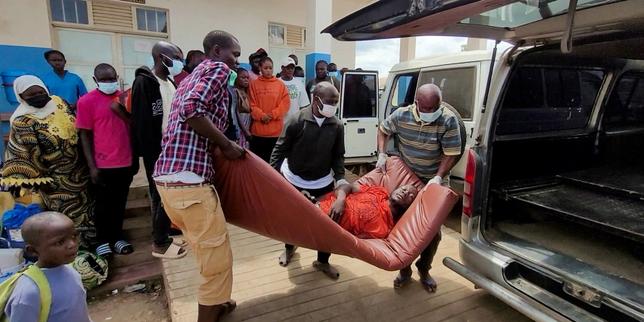
The mainstream media feeds on a predictable script every time an Ebola outbreak flares up in the Democratic Republic of Congo. A Western clinician goes over to save lives, contracts the virus, and suddenly the global news cycle pivots from a regional public health crisis to a single, high-stakes medical drama. The coverage of an American doctor infected at a Congo hospital follows this exact blueprint. It treats the infected Westerner as the central tragedy, framing the crisis through the lens of individual heroism rather than systemic institutional failure.
This framing is fundamentally broken. For another perspective, read: this related article.
Focusing on the peril of foreign medical volunteers obscures the uncomfortable reality of international aid. Parachuting Western doctors into acute outbreak zones is a band-aid on a bullet wound. It creates a fragile, temporary healthcare illusion that collapses the moment the non-governmental organizations pack up and fly home. The savior narrative satisfies a Western desire for moral validation, but it actively undermines the development of resilient, localized medical infrastructure in sub-Saharan Africa.
The Fatal Flaw of Parachute Medicine
International medical interventions during hemorrhagic fever outbreaks rely heavily on "parachute medicine." Well-meaning clinicians from elite Western institutions fly into a crisis zone with minimal understanding of the local linguistic, cultural, or historical context. They set up specialized Ebola Treatment Units that operate entirely parallel to, rather than integrated with, the existing public health system. Further reporting on this matter has been published by Medical News Today.
This dual-system approach creates immediate friction. When a foreign NGO builds a state-of-the-art isolation unit next to a local clinic that lacks basic running water or latex gloves, it sends a clear signal. The message is that resources are available for high-profile, terrifying diseases that might threaten the West, but not for the routine pathogens—like malaria, cholera, or tuberculosis—that kill thousands of Congolese every single day.
I have watched international agencies dump millions of dollars into short-term isolation tents while the local hospital down the road cannot even secure a consistent supply of clean needles. This misallocation of capital is not just inefficient; it is dangerous. It breeds deep resentment and conspiracy theories among the local population. When a community sees foreign doctors arriving in biohazard suits while their children die of preventable dehydration, public trust vanishes. Without trust, contact tracing and epidemiological surveillance become impossible.
Why Outbreak Triage Is Fundamentally Misunderstood
The general public assumes that managing an Ebola outbreak is purely a clinical challenge solved by superior Western medicine. It isn't. It is an operational, logistical, and social challenge.
- Clinical care is secondary to containment: In a highly contagious filovirus outbreak, the primary goal of public health is to break the chains of transmission.
- Isolation requires community consent: If the population fears the treatment center, they will hide their sick relatives, accelerating the spread of the virus within households.
- Resource hoarding kills more than the virus: Diverting all local nursing staff to a single Ebola center leaves the rest of the regional healthcare system completely hollowed out.
Dismantling the Myth of Superior Western Bio-Containment
When an American doctor gets infected abroad, the immediate media response is to question the safety protocols of the local facility. The underlying assumption is that Western clinical protocols are infallible, and the infection must be the result of the chaotic, under-resourced Congolese environment.
This assumption is rooted in a profound ignorance of how viral transmission works in high-pressure environments. The reality is that the personal protective equipment used by Western organizations is notoriously difficult to safely doff. Stripping off a contaminated biohazard suit after a grueling twelve-hour shift in 90-degree heat is one of the most high-risk maneuvers in medicine. A single micro-droplet of sweat flicked onto an exposed eyelid during doffing is all it takes.
[High-Risk Doffing Sequence]
Contaminated Suit -> Manual Zipping/Peeling -> Risk of Aerosol Generation -> Exposure
Data from the World Health Organization regarding past outbreaks shows that local healthcare workers consistently bear the highest burden of infection, not because they are reckless, but because they are forced to work in these environments permanently, long after the international media loses interest. Blaming the infrastructure of a Congolese hospital for a Western doctor’s infection ignores the fact that these outbreaks are intrinsically volatile. No amount of Tyvek suits can compensate for a lack of structural, systemic safety built into the physical architecture of the local healthcare facilities themselves.
The Economic Perversion of Emergency Aid
The international community loves to fund emergencies. A headline about Ebola triggers immediate, massive financial commitments from Western governments and philanthropic organizations.
| Funding Type | Visibility | Long-Term Impact | Sustainability |
|---|---|---|---|
| Emergency Outbreak Response | Extremely High | Low (Temporary) | Negligible |
| Basic Health Infrastructure | Low | High (Permanent) | High |
Emergency funding is highly volatile. It floods a country with cash for six months, driving up local inflation, distorting salaries for medical professionals, and creating an artificial economy centered around the outbreak. Local doctors leave their positions at public clinics to work as translators or logistical assistants for foreign NGOs because the pay is five times higher.
When the outbreak is declared over, the funding vanishes. The foreign experts leave. The local doctors are left without their old jobs, and the local clinics are in worse shape than before the outbreak started. This economic whiplash prevents the establishment of a stable, self-sustaining medical middle class in the host country.
Shifting the Burden: The Case for Absolute Local Autonomy
The alternative to the current model is uncomfortable for Western institutions because it requires giving up control and funding. Instead of financing Western teams to fly into the Congo, international resources must be directly funneled into building permanent, locally-run biomedical infrastructure.
This means funding African universities, training Congolese epidemiologists, and upgrading standard regional hospitals so they can handle infectious diseases as a matter of routine care, not as a catastrophic anomaly. The National Institute of Biomedical Research in Kinshasa, led by veteran researchers who have fought dozens of Ebola outbreaks, understands the terrain infinitely better than any temporary expert from Atlanta or Geneva.
The downside to this approach is that it requires patience, and it lacks the cinematic drama of an evacuation flight landing in the United States with an infected doctor. It means accepting that Western institutions should play a quiet, supportive, financial role rather than taking center stage.
Stop celebrating the sacrifice of foreign clinicians who risk their lives in broken systems. Start asking why the systems are still broken after decades of international aid. The obsession with the Western savior narrative is an ideological security blanket that protects us from confronting our own failure to build a world where a regional hospital in the Congo doesn't need saving in the first place.