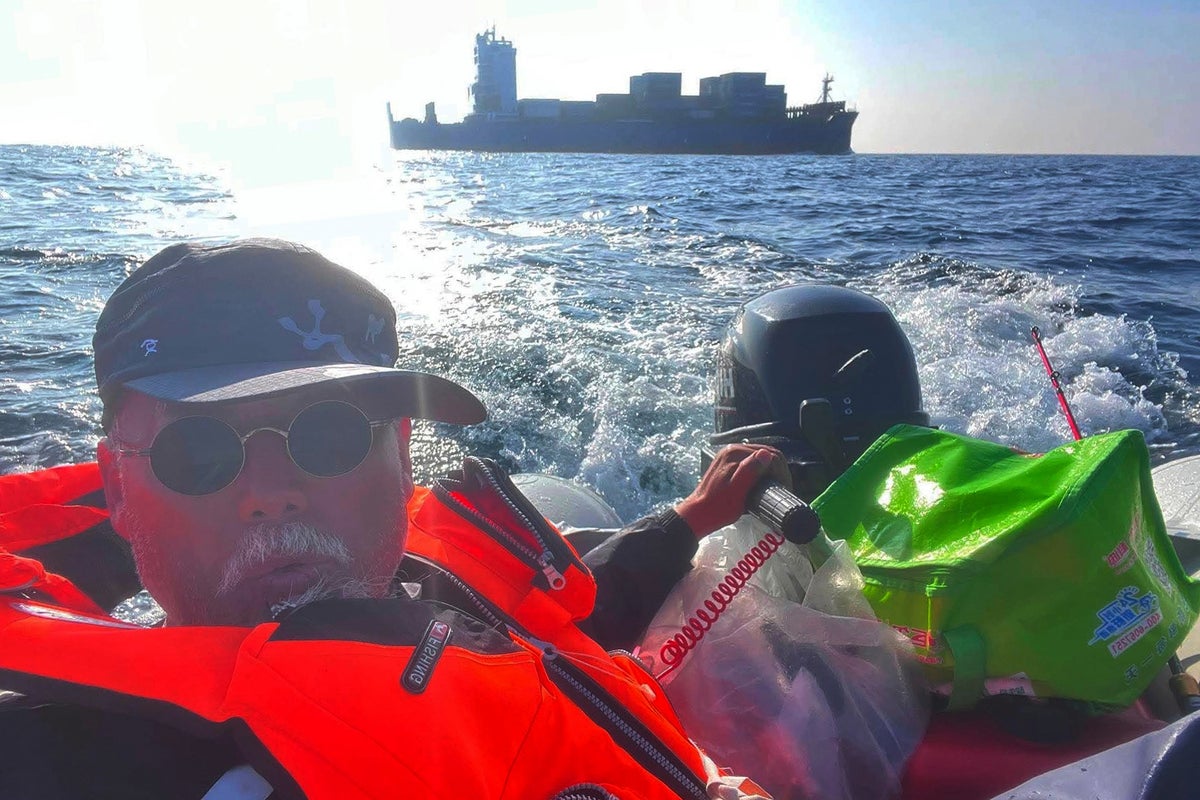
Imagine sitting in a 10-foot inflatable rubber dinghy in the middle of the open sea. The sky and water blend into a blinding expanse of white fog. Your engine is sputtering. Your power bank is dead, and the cell phone you rely on for GPS navigation is sitting on its very last bar of battery.
For most people, that's a nightmare. For 68-year-old Chinese dissident Dong Guangping, it was the price of a chance at a normal life.
Late last week, Dong landed at Toronto Pearson International Airport, ending a decade-long saga of prison terms, cross-border manhunts, and broken promises. His arrival in Canada closes the book on one of the most desperate escapes from China's security apparatus in recent memory. It also exposes a harsh reality about how Southeast Asian nations handle political refugees under pressure from Beijing.
A Decadelong Trap inside the Cage
Dong wasn't always a fugitive. He used to be a police officer in China. That changed in 1999 when he co-signed a petition commemorating the 10th anniversary of the 1989 Tiananmen Square crackdown. He lost his job immediately.
In 2001, the state sentenced him to three years in prison for "inciting subversion of state power." In 2014, authorities locked him up again for eight months after he attended another private memorial for the victims of Tiananmen. When he wasn't behind bars, he lived under constant surveillance, stripped of his passport, and denied his retirement benefits.
"It's like living in a cage," Dong said in an interview after landing in Canada. "Very suffocating."
When the state cuts off your livelihood and tracks your every move, staying put feels worse than running. Dong decided to flee.
The Failed Attempts that Led to the Sea
What makes Dong's final escape so remarkable isn't just the boat ride. It's the fact that he kept trying after failing three times.
- 2015 (Thailand): Dong managed to slip into Thailand with his family. The United Nations refugee agency (UNHCR) officially recognized them as refugees. Canada agreed to resettle them. But before Dong could board a plane, Thai authorities arrested him and handed him straight back to Chinese police. His wife and daughter made it to Canada; Dong went back to a Chinese prison.
- 2019 (Taiwan): Desperate to reunite with his family, Dong tried to swim across the narrow stretch of water separating mainland China from the Taiwanese-controlled Kinmen islands. He couldn't make it.
- 2020 (Vietnam): He crossed into Vietnam, hoping for a safer route. Instead, Vietnamese police caught him and held him until 2022, when they deported him back to China for another prison stint.
Every single time a neighboring country sent him back, the punishment grew worse. By 2026, he knew that land borders were a trap. Southeast Asian governments were too vulnerable to Beijing's economic and political leverage to protect a high-profile dissident.
The only option left was the water.
Forty Hours in a Gray Rubber Dinghy
In the early morning hours of May 24, 2026, Dong pushed a small gray rubber dinghy into the surf at Weihai, a coastal city in China's eastern Shandong province. The boat measured just 3.3 meters—barely 11 feet long. It was powered by a modest 9.9-horsepower outboard motor.
He didn't aim for South Korea initially. He headed for Japan, betting that Tokyo would defy Beijing and grant him asylum.
The weather started fine, but the sea is unpredictable. By the second day, a dense, heavy fog rolled in. Dong lost his bearings completely. Without a horizon line, he couldn't tell north from south. Then his tech failed. His portable power bank died, and his phone screen showed a critically low battery. If the phone died, his GPS died with it.
Faced with the very real prospect of capsizing and drowning in the open ocean, Dong made a calculated pivot. He abandoned the journey to Japan and steered toward the west coast of South Korea.
"Living conditions back in the country are so terrible that being alive is little different than being dead," Dong later recalled. "So there is no point fearing death. If you move forward, there’s a chance at life."
As darkness fell, he spotted distant lights. He ran his boat toward them, screaming for help as a large vessel passed by without seeing him. Finally, a South Korean fishing boat pulled him out of the water. The fishers called the local authorities, and the South Korean Coast Guard detained Dong for violating immigration laws.
The Behind the Scenes Diplomacy
Usually, an undocumented arrival in South Korea leads to prolonged detention or deportation. South Korean prosecutors immediately sought a formal arrest warrant for Dong.
This time, the system blinked. A South Korean court refused to issue the warrant, stating there weren't sufficient grounds or necessity to lock him up. Authorities moved Dong to a refugee center in Incheon instead.
While Dong waited in the center, a quiet diplomatic machine went to work. The UNHCR contacted him via video call. Shortly after, a center manager came to his room to ask for his physical details: height, weight, and eye color. Dong was terrified it was a prelude to another deportation. It wasn't. His lawyer confirmed the Canadian diplomatic mission had requested the information to process emergency travel documents.
Because Canada had already accepted Dong’s family as refugees back in 2015, his legal paperwork for resettlement was technically still valid. The Canadian government, working alongside South Korean officials and the UN, fast-tracked his departure before Beijing could mount a formal extradition request.
Freedom and a Bowl of Noodles
On Friday night, an Air Canada flight touched down in Toronto. Dong walked out of the airport a free man for the first time in nearly thirty years.
His long-time friend and fellow activist, Sheng Xue, met him at the airport. She had spent more than ten years lobbying western governments to secure his release. Her first update on social media didn't feature a political manifesto. It featured a photo of Dong eating a large bowl of noodles with eggs, tomatoes, and shrimp.
At 68, Dong is starting over from scratch. He told reporters he doesn't feel a hint of fear anymore and hopes to find steady work soon, perhaps driving for Uber or operating a delivery truck. He also plans to talk to human rights lawyers about suing the governments of Thailand and Vietnam for breaking international law when they deported him years ago.
If you want to support human rights activists or learn more about the legal frameworks protecting political refugees, you can check out the work done by Amnesty International and the UN Refugee Agency. Both organizations track cross-border repatriations and provide legal aid to dissidents facing deportation back to authoritarian states.